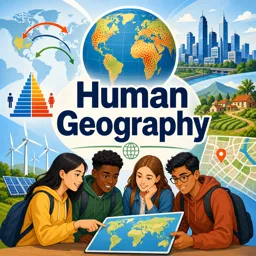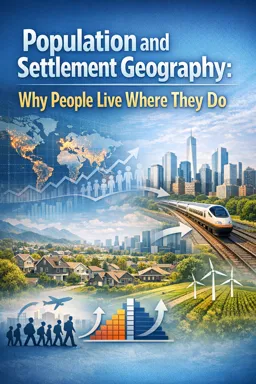

Free ebook on population and settlement geography, explaining migration, urbanization, demographic change, and why people live where they do.
Free ebook content
-

Population and Settlement Geography: Core Questions and Key Measures
+ Exercise: Which statement correctly matches a map type to the question it is best suited to answer?
-
Physical Geography Controls on Where People Live
+ Exercise: Why can river valleys attract dense settlement while also concentrating risk?
-
Economic Drivers of Population Distribution and Settlement Growth
+ Exercise: How does cheaper or faster routine travel typically affect the spacing of towns and service centers?
-
Population Change: Fertility, Mortality, Growth Rates, and Age Structure
+ Exercise: A town’s population pyramid has a very wide base (ages 0–9 are the largest bars) and a small 65+ share. If fertility suddenly fell to replacement level, what outcome is most likely over the next 20 years?


-
Migration Basics: Why People Move and How Flows Reshape Places
+ Exercise: Which scenario best illustrates chain migration and one likely visible effect in the destination?
-
Rural Settlement Patterns and Land Use Organization
+ Exercise: In a rural landscape where houses line up along a main road and fields are divided into long, narrow plots extending back toward a canal with repeated turnouts/bridges, what settlement form and organizing factor are most consistent with these clues?
-
Urbanization Processes: How and Why Cities Grow
+ Exercise: A city’s population increases, but the rural population grows even faster, so the share of people living in urban areas stays the same. Which statement best describes what is happening?
-
Urban Hierarchy and City Systems: Size, Functions, and Influence
+ Exercise: A planner wants to predict which settlement is most likely to host a new hospital in a region. Which approach best applies the ideas of threshold and range?
-
Settlement Morphology Within Cities: Neighborhoods, CBDs, and Suburbs
+ Exercise: A city adds a ring road with several major interchanges and allows large commercial parcels with abundant parking near those interchanges. Which outcome is most likely for the city’s internal structure?
-
Connecting the Factors: Integrated Place Analysis and Real-World Indicators
+ Exercise: Which statement best demonstrates an integrated place analysis supported by both measures and spatial evidence?
About the free ebook
Population and Settlement Geography: Why People Live Where They Do
This free ebook explores the geographic forces that shape population distribution, settlement location, and the growth of towns and cities. It explains why some places attract dense populations while others remain sparsely inhabited.
Understand population patterns
Learn how climate, relief, water supply, soils, resources, employment, transport, and public services influence where people live. The ebook introduces essential population measures, including density, fertility, mortality, natural increase, and age structure, helping readers interpret demographic change with confidence.
Examine movement and settlement change
Migration is presented as a major force in reshaping places. Explore push and pull factors, changing rural populations, and the ways migration affects labor, housing, services, and local identities. Population patterns are never static: they respond to environmental conditions, economic opportunity, policy, and social networks.
Explore rural and urban landscapes
Discover how land use and accessibility influence rural settlement patterns, and how urbanization produces expanding cities, suburbs, central business districts, and distinctive neighborhoods. The ebook also considers urban hierarchy, city functions, and the relationships between settlements of different sizes.
Apply geographic thinking to real places
By connecting demographic data with physical and economic evidence, readers can analyze why a place has developed in a particular way. This ebook supports school geography study and provides a clear foundation for interpreting real-world issues such as urban growth, regional inequality, housing pressure, and population aging.
What factors determine population distribution?
Climate, water, land quality, resources, jobs, transport, services, and political conditions all influence where populations concentrate.
How does migration change settlements?
Migration can increase population, labor supply, cultural diversity, housing demand, and pressure on infrastructure in destination areas.
What is urban hierarchy in geography?
Urban hierarchy ranks settlements by size, services, functions, and the area of influence they serve.
This ebook includes:

10 content chapters

Digital certificate of course completion (Free)

Exercises to train your knowledge

100% free, from content to certificate
Ready to get started?

 recommended
In the app you will also find...

Over 5,000 free courses
Programming, English, Digital Marketing and much more! Learn whatever you want, for free.

Study plan with AI
Our app's Artificial Intelligence can create a study schedule for the course you choose.

From zero to professional success
Improve your resume with our free Certificate and then use our Artificial Intelligence to find your dream job.
You can also use the QR Code or the links below.