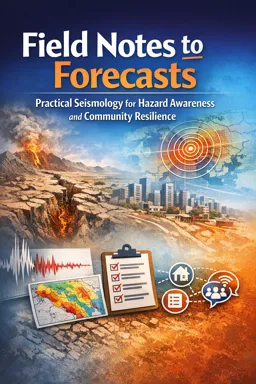

Free ebook on practical seismology, earthquake hazards, site effects, preparedness, and community resilience.
Free ebook content
-

Earthquake Processes and Fault Behavior from Field Clues
+ Exercise: Which field observation most strongly implies that surface rupture hazard may extend across a wide zone rather than along a single sharp fault trace?
-
Tectonic Settings, Local Geology, and What They Imply for Risk
+ Exercise: Two neighborhoods are the same distance from a transform fault, but one sits on soft, young sediments and the other on nearby bedrock. What is the most likely risk implication for planning?
-
Seismic Waves and How They Appear on Seismograms
+ Exercise: When comparing two seismograms of the same earthquake from different stations, what is a primary reason the waveforms can look different even if the event is identical?
-
Magnitude, Intensity, and Damage Expectations in Real Places
+ Exercise: After an earthquake, which approach best translates a reported magnitude into realistic damage expectations for a specific neighborhood?
-
Using Seismic Maps and Catalogs to Track Nearby Earthquake Activity
+ Exercise: Why is it recommended to use both an earthquake catalog and a seismic map when tracking nearby earthquake activity?
-
Aftershock Patterns, Short-Term Forecast Thinking, and Common Misconceptions
+ Exercise: Which statement best reflects how short-term aftershock forecasting should be used for community safety decisions?


-
Site Effects: Soil Amplification, Basin Response, and Liquefaction Susceptibility
+ Exercise: When using the quarter-wavelength approximation to screen for resonance risk at a site, which action best helps identify buildings that may experience stronger motion?
-
Building Vulnerability Concepts for Homes, Schools, and Small Businesses
+ Exercise: Which action best reduces functional vulnerability for a small business that depends on refrigeration after an earthquake?
-
Preparedness Planning: Checklists, Risk Audits, and Scenario-Based Drills
+ Exercise: Which approach best reduces the risk of thinking you are prepared for an earthquake when key weaknesses still exist?
-
Risk Communication: Translating Technical Terms into Responsible Community Actions
+ Exercise: Which message best reflects responsible earthquake risk communication by linking uncertainty to specific, feasible actions?
-
Applied Case Exercises: Interpreting Events and Making Practical Decisions
+ Exercise: When conflicting earthquake reports and rumors are circulating, what is the best approach before taking a high-impact action like mass dismissal?
About the free ebook
Field Notes to Forecasts: Practical Seismology for Hazard Awareness and Community Resilience
This free ebook introduces practical seismology through the evidence that geographers, students, and communities can observe, map, and interpret. It connects earthquake processes with real decisions about safer places, buildings, and preparedness.
Read earthquakes through landscapes and records
Explore how faults, tectonic settings, local geology, and field clues reveal why earthquake hazard differs from one location to another. Learn how seismic waves are recorded on seismograms and how maps and earthquake catalogs help identify patterns of nearby activity.
Interpret hazard without false certainty
Understand the important difference between magnitude, intensity, and damage. The ebook explains aftershock behavior and short-term forecasting in responsible terms: earthquakes cannot be predicted with an exact time, place, and size, but observations can support risk-aware planning.
Connect ground conditions to community impacts
Discover why shaking may be stronger on soft soils or in sedimentary basins, and why liquefaction can affect some water-saturated ground. Apply building-vulnerability concepts to homes, schools, and small businesses while considering local conditions.
Turn knowledge into practical action
- Use hazard maps and catalogs with appropriate caution.
- Recognize site effects and likely sources of damage.
- Develop checklists, risk audits, and scenario-based drills.
- Communicate technical information clearly and responsibly.
- Practice decisions through applied earthquake case exercises.
A geography-focused resource for resilient communities
By linking Earth science evidence with preparedness and communication, this ebook helps readers ask better questions about seismic risk and support practical, community-centered resilience.
What is the difference between earthquake magnitude and intensity?
Magnitude measures energy released at the source; intensity describes shaking and effects at a specific location.
Why can the same earthquake cause stronger shaking in some neighborhoods?
Soft soils, sediment-filled basins, slope conditions, and building quality can amplify or worsen local impacts.
Can aftershocks be predicted exactly?
No. Scientists estimate changing probabilities, but cannot specify an exact aftershock time, location, and magnitude.
This ebook includes:

11 content chapters

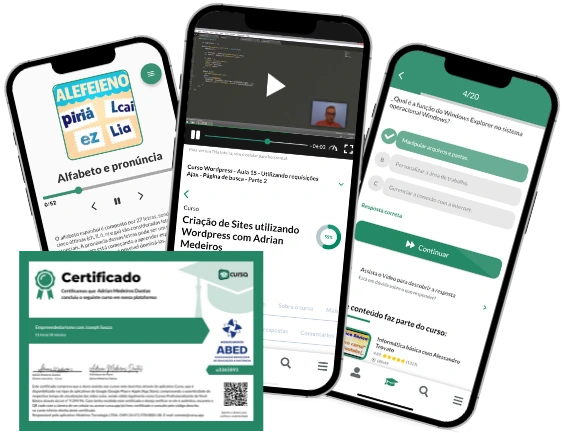
Digital certificate of course completion (Free)

Exercises to train your knowledge

100% free, from content to certificate
Ready to get started?

 recommended
In the app you will also find...

Over 5,000 free courses
Programming, English, Digital Marketing and much more! Learn whatever you want, for free.

Study plan with AI
Our app's Artificial Intelligence can create a study schedule for the course you choose.

From zero to professional success
Improve your resume with our free Certificate and then use our Artificial Intelligence to find your dream job.
You can also use the QR Code or the links below.