For N distinguishable objects with n in one state and N−n in the other, use W = N!/[n!(N−n)!].

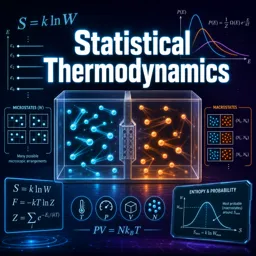
Duration of the online course: 3 hours and 52 minutes
New
Build real intuition for entropy and microstates in this free statistical thermodynamics course, with practice problems and a certificate-ready foundation.
Statistical thermodynamics is where the rules of probability and the behavior of enormous numbers of particles meet to explain the laws you see in everyday thermodynamics. In this free online course, you will learn to translate between microscopic pictures of matter and macroscopic quantities such as multiplicity, probability, and entropy, so the second law stops feeling like a slogan and starts feeling inevitable.
The lessons guide you from the first essential vocabulary and purpose of the field into the core habit of thinking in terms of microstates and macrostates. By working through classic two-state models and coin-toss analogies, you will build a reliable intuition for what it means for a distribution to be likely, why a system naturally drifts toward the most probable macrostate, and how sharply that probability peak grows as the number of particles increases. Along the way, you will use tools like Stirling’s approximation to handle the huge numbers that appear in real systems, and you will see why approximation is not a shortcut but the key that makes large-N physics readable.
As you progress, entropy becomes more than a definition: it becomes a count. You will connect entropy to multiplicity and use that connection to reason about mixing, free expansion, and the difference between something being impossible versus merely astronomically unlikely. Thought experiments with molecules in compartments make the statistical meaning of equilibrium tangible, while guided exercises help you practice turning a physical situation into a counting problem and then into a thermodynamic conclusion.
The course also bridges into quantum ideas that underlie modern statistical physics, including energy levels, degeneracy, and particle distributions across quantized states. By relating confinement, energy spacing, and volume scaling in simple potential well models, you gain a clearer picture of how microscopic constraints shape macroscopic behavior. If you are studying physics as a school subject, preparing for exams, or strengthening fundamentals for chemistry, engineering, or materials science, this course offers a rigorous, practice-driven path to confident reasoning in statistical thermodynamics.

Explore free online Modern Physics courses and master quantum mechanics, relativity, particle physics, atomic theory, and cosmology at your own pace. Learn through flexible lessons from trusted educators, build career-ready scientific skills, and earn a certificate upon completion. Start studying modern physics online for free today.

Explore free online Quantum Physics courses and earn a certificate while mastering wave mechanics, quantum theory, particles, atoms, and real-world applications. Learn at your own pace with accessible lessons from trusted educators, build valuable skills, and start studying quantum physics online for free today from anywhere.

Explore free online Statistical Physics courses and master thermodynamics, kinetic theory, phase transitions, ensembles, and complex systems at your own pace. Learn from expert-led lessons, build practical problem-solving skills, and earn a certificate upon completion. Start studying statistical mechanics online for free today.

Explore free online Thermodynamics courses and build essential skills in heat, energy, entropy, gases, engines, and thermodynamic laws. Learn at your own pace with expert-led lessons for beginners, students, and professionals. Enroll today, complete practical modules, and earn a certificate to showcase your knowledge.

Explore free online Statistical Thermodynamics courses designed to build your understanding of ensembles, entropy, partition functions, molecular energy, and equilibrium. Learn at your own pace with expert-led lessons, strengthen physics and chemistry skills, and earn a certificate to showcase your knowledge and support your academic or career goals.

3 hours and 52 minutes of online video course

Digital certificate of course completion (Free)

Exercises to train your knowledge

100% free, from content to certificate
How do you calculate the number of microstates in a two-state system?
For N distinguishable objects with n in one state and N−n in the other, use W = N!/[n!(N−n)!].
Why does the equal distribution usually have the highest entropy in a two-state system?
It has the greatest multiplicity—the largest number of possible microstates—so S = k ln W is maximized.
Which ensemble describes a system that exchanges both energy and particles with its surroundings?
The grand canonical ensemble, where temperature, volume, and chemical potential are fixed.
Ready to get started?Download the app and get started today.
Install the app now
to access the course
Over 5,000 free courses
Programming, English, Digital Marketing and much more! Learn whatever you want, for free.

Study plan with AI
Our app's Artificial Intelligence can create a study schedule for the course you choose.

From zero to professional success
Improve your resume with our free Certificate and then use our Artificial Intelligence to find your dream job.
You can also use the QR Code or the links below.



Free CourseRelativity Course: Special and General Relativity, Tensors, Black Holes, Gravitational Waves and Cosmology
5

(3)

19h01m

39 exercises
Free CourseIntroduction to Thermodynamics
5
(1)
1h48m
9 exercises
Free CourseNuclear and Radiochemistry
5
(1)
31h56m
31 exercises
Free CoursePhysics for beginners
5
(1)
1h57m
2 exercises
Free CourseThermodynamics and Statistical Physics
5
(1)
14h53m
23 exercises
Free CourseAstrophysics and Cosmology Course
5
(1)
1h24m
5 exercises
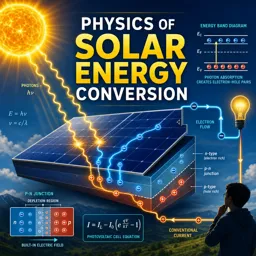
Free CoursePhysics of Solar Energy Conversion
5
(4)
4h59m
16 exercises
Free CourseQuantum Physics
5
(1)
24m
4 exercises
Free CourseFundamentals of Physics
5
(45)
28h44m
23 exercises
Free CoursePhysics 1 course
4.8
(6)
4h10m
19 exercises
Carry knowledge in your pocket.
Download the Cursa app.
There are hundreds of free courses available, with a free certificate of completion that is saved in your mobile image gallery.
Download the app to access the Course Completion Certificate for Free.


+ 10 million
students

Free and Valid
Certificate

60 thousand free
exercises

4.8/5 rating in
app stores

Free courses in
video and ebooks