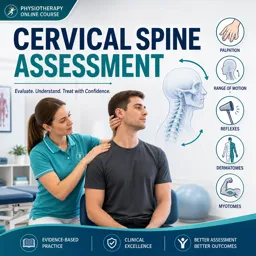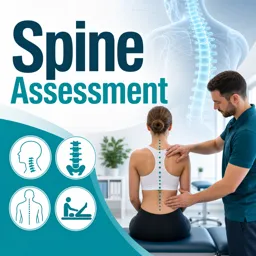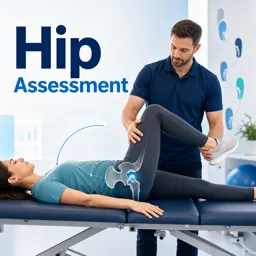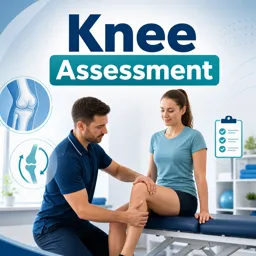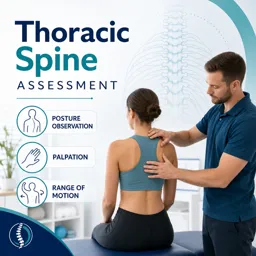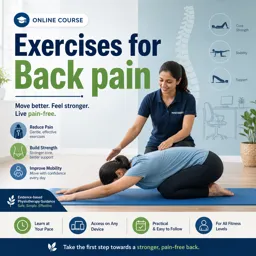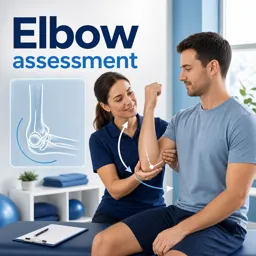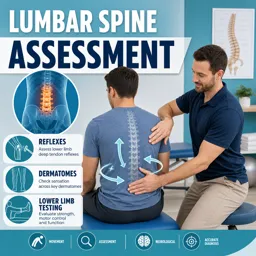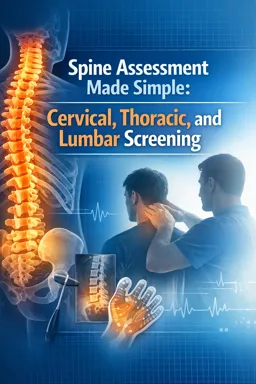

Free ebook on safe cervical, thoracic, and lumbar spine screening for physiotherapy assessment and referral decisions.
Free ebook content
-

Spine Assessment Made Simple: A Safety-First Screening Framework
+ Exercise: During a spine screening exam, which approach best matches a safety-first framework for choosing special tests?
-
Clinical Interview for Cervical, Thoracic, and Lumbar Screening
+ Exercise: During the clinical interview, what information best supports a mechanical pattern of symptoms?
-
Observation and Posture Checks Across the Spine: What to Look For and Why
+ Exercise: During an initial posture observation, which finding most strongly suggests you should slow down and consider deferring end-range or provocative movement testing?


-
Active Movement Screening: Cervical Spine Range, Quality, and Symptom Response
+ Exercise: During cervical active movement screening, which finding most strongly suggests a nerve-related presentation that should prompt a focused neurological screen?
-
Active Movement Screening: Thoracic Spine and Rib-Related Motion Testing
+ Exercise: During an active thoracic screening, which finding most strongly suggests a warning pattern that should prompt stopping the screen and recommending medical review?
-
Active Movement Screening: Lumbar Spine, Hip Contribution, and Functional Tests
+ Exercise: During a lumbar active movement screen, which finding should prompt you to stop or significantly scale back the movements and prioritize neurological testing?
-
Neurological Screening Basics for Spine Assessment: Myotomes, Dermatomes, Reflexes
+ Exercise: Which finding pattern most strongly suggests possible nerve root involvement during a minimal neurological screen?
-
Special Tests Made Simple: Choosing Tests and Understanding What They Mean
+ Exercise: When pre-test probability for a condition is LOW, how should you interpret a positive special test result?
-
Differentiating Mechanical vs Non-Mechanical Features in Spine Presentations
+ Exercise: Which presentation most strongly suggests a non-mechanical/systemic spine pattern that warrants medical review rather than conservative management?
-
Common Presentations and Practical Screening Pathways: Neck Pain, Thoracic Stiffness, Low Back Pain
+ Exercise: During a neck pain screening, when is it most appropriate to perform a quick neuro screen?
-
Referral, Escalation, and Communication: Knowing When to Stop and What to Say
+ Exercise: During a spine screen, which situation most appropriately requires you to stop further provocative testing and arrange urgent same-day escalation?
About the free ebook
Spine Assessment Made Simple: Cervical, Thoracic, and Lumbar Screening
This free ebook provides a practical, safety-first framework for screening the cervical, thoracic, and lumbar spine. It is designed for physiotherapy learners and clinicians who want a clear way to organise assessment findings, identify meaningful symptom responses, and communicate appropriate next steps.
Build a structured screening approach
Learn how to begin with a focused clinical interview, then use observation, posture checks, and active movement testing to explore spinal mobility and movement quality. The ebook emphasises comparing sides, noting symptom behaviour, and considering how adjacent regions such as the hips and ribs may influence presentation.
Connect neurological findings to clinical decisions
Understand the role of basic neurological screening, including myotomes, dermatomes, and reflexes. Special tests are presented as tools that contribute to an overall clinical picture rather than stand-alone diagnostic answers.
Recognise when mechanical explanations may not fit
The guide helps distinguish common mechanical patterns from features that require greater caution. It supports reasoned consideration of persistent, unusual, progressive, or systemic symptoms and reinforces the importance of timely referral or escalation.
Apply findings to common spine presentations
- Screen neck pain with attention to cervical movement and neurological symptoms.
- Explore thoracic stiffness and rib-related movement contributions.
- Assess low back pain through lumbar movement, hip contribution, and functional tasks.
- Document findings clearly and explain recommendations in patient-centred language.
Important note
This educational resource supports screening knowledge and does not replace clinical judgement, local protocols, medical diagnosis, or urgent medical assessment. Stop assessment and seek appropriate support when red flags or serious concerns are present.
What should be included in a basic neurological screen for spinal pain?
A basic screen commonly considers myotomes, dermatomes, reflexes, symptom distribution, and any progressive neurological change.
How can mechanical and non-mechanical spinal pain features differ?
Mechanical symptoms often vary with movement or load, while non-mechanical features may be constant, systemic, unusual, or poorly related to activity.
When should a spine assessment be stopped and escalated?
Stop and escalate when symptoms suggest serious pathology, progressive neurological deficit, severe unexplained pain, or other red-flag concerns.
This ebook includes:

11 content chapters

Digital certificate of course completion (Free)

Exercises to train your knowledge

100% free, from content to certificate
Ready to get started?

 recommended
In the app you will also find...

Over 5,000 free courses
Programming, English, Digital Marketing and much more! Learn whatever you want, for free.

Study plan with AI
Our app's Artificial Intelligence can create a study schedule for the course you choose.

From zero to professional success
Improve your resume with our free Certificate and then use our Artificial Intelligence to find your dream job.
You can also use the QR Code or the links below.