
Free ebook on physiotherapy assessment of the shoulder, hip, knee, ankle, and foot, covering ROM, strength, swelling, and function.
Free ebook content
-

Joint Assessment Essentials Framework for Shoulder, Hip, Knee, and Ankle
+ Exercise: During a joint assessment, which situation best matches the universal “stop test” decision rule and the recommended next step?
-
Safety, Symptom Screening, and Test Setup for Peripheral Joint Assessment
+ Exercise: During peripheral joint testing, which finding should prompt you to stop or modify the assessment immediately?
-
Range of Motion Testing Essentials for Shoulder, Hip, Knee, and Ankle
+ Exercise: During ROM testing, a patient shows decreased AROM while PROM is near full and less limited. What is the most likely driver of this pattern?
-
End-Feel Concepts and Interpretation in Shoulder, Hip, Knee, and Ankle Assessment
+ Exercise: During knee PROM extension, the examiner feels a bouncy rebound (“springy block”) and extension is disproportionately limited compared with flexion. What is the most likely limiter?
-
Basic Strength Testing Foundations Applied to Shoulder, Hip, Knee, and Ankle
+ Exercise: During a resisted isometric strength test, a patient can hold strong resistance but the contraction reproduces pain. Which interpretation best fits this finding?
-
Swelling and Effusion Recognition in Shoulder, Hip, Knee, and Ankle Evaluation
+ Exercise: During a knee evaluation, which finding pattern most strongly supports an intra-articular effusion (true joint swelling) rather than diffuse edema or localized bursitis?


-
Shoulder Joint Assessment Essentials: ROM, End-Feel, Strength, and Functional Testing
+ Exercise: During shoulder AROM flexion, the patient leans back with trunk extension to get the arm higher. What is the most appropriate cue to reduce this substitution and better assess true shoulder motion?
-
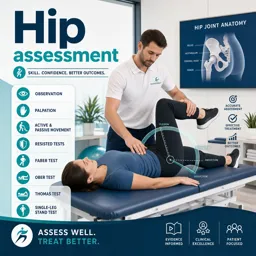
Hip Joint Assessment Essentials: Mobility, Strength, and Functional Performance Screening
+ Exercise: During hip ROM testing, which symptom behavior pattern most strongly suggests a higher irritability presentation that should lead you to reduce test intensity?
-
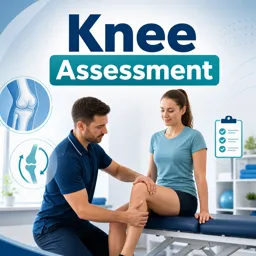
Knee Joint Assessment Essentials: ROM, Effusion Checks, Strength, and Functional Tests
+ Exercise: During a knee screen, which finding and interpretation best supports effusion-related quadriceps inhibition rather than true strength loss?
-
Ankle and Foot Assessment Essentials: ROM, Swelling, Strength, and Functional Stability
+ Exercise: When significant ankle swelling, bruising, or high pain is present, which assessment sequence best reduces symptom flare and improves accuracy?
About the free ebook
Joint Assessment Essentials: Shoulder, Hip, Knee, and Ankle
This free ebook introduces a structured physiotherapy approach to assessing common peripheral joints. It supports learners in gathering clear, clinically relevant information through safe observation, symptom screening, movement testing, strength checks, swelling review, and functional assessment.
Build a consistent assessment process
Learn how to prepare a joint assessment, compare sides, identify movement restrictions, and document findings in a logical way. The material explains how range of motion, end-feel, pain response, muscle performance, and visible swelling can contribute to an overall clinical picture.
Apply principles across key joints
Practical guidance is provided for the shoulder, hip, knee, ankle, and foot. You will explore joint-specific considerations while using a repeatable framework that helps connect impairments with functional limitations.
Key learning outcomes
- Recognize safety considerations and symptom patterns that may require referral.
- Perform and interpret basic active and passive range of motion testing.
- Understand common end-feel descriptions and their clinical relevance.
- Use basic strength, swelling, effusion, and functional screening methods.
- Prioritize findings to guide early physiotherapy reasoning.
Important: This educational resource does not replace an in-person examination, diagnosis, or treatment plan from a qualified health professional. Urgent symptoms, severe trauma, marked swelling, fever, loss of sensation, or inability to bear weight require prompt medical assessment.
What does an abnormal end-feel indicate during joint assessment?
An abnormal end-feel may suggest pain, muscle guarding, swelling, capsular restriction, or a mechanical limitation and should be interpreted with other findings.
How is knee effusion commonly checked in a physiotherapy assessment?
Clinicians may inspect for swelling and use comparison, patellar tap, sweep, or bulge testing, depending on the amount of suspected fluid.
Why compare active and passive range of motion?
Comparing them helps distinguish possible pain, weakness, guarding, joint stiffness, and tissue-related movement restrictions.
This ebook includes:

11 content chapters

Digital certificate of course completion (Free)

Exercises to train your knowledge

100% free, from content to certificate
Ready to get started?

 recommended
In the app you will also find...

Over 5,000 free courses
Programming, English, Digital Marketing and much more! Learn whatever you want, for free.

Study plan with AI
Our app's Artificial Intelligence can create a study schedule for the course you choose.

From zero to professional success
Improve your resume with our free Certificate and then use our Artificial Intelligence to find your dream job.
You can also use the QR Code or the links below.