
It is a clinical rule used after acute knee trauma to identify people at low risk of fracture who may not need radiography.

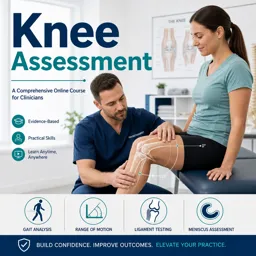
Duration of the online course: 1 hours and 0 minutes
4.7


(55)
Assess knee pain with confidence in this free physiotherapy course—gait analysis, ROM, special tests, and decision rules to support smarter clinical choices.
Knee complaints are among the most common reasons people limit activity, seek rehabilitation, or stop sport altogether. To manage them well, you need more than a handful of special tests you need a clear, repeatable assessment approach that helps you interpret what you see and feel, link it to functional goals, and decide when further investigation is warranted. This free online physiotherapy course builds practical skill in evaluating the knee with a clinician’s mindset, from observation and movement analysis through to targeted testing and clinical decision-making.
You will strengthen your ability to analyze gait and understand how the stance phase and swing phase relate to load, control, and symptoms. From there, the course guides you through assessing active and passive range of motion, resisted isometric testing, and joint play so you can distinguish mobility restrictions, contractile pain, and joint-related limitations with greater confidence. The emphasis is on making your findings meaningful: choosing the right next step, comparing sides, recognizing patterns, and documenting results in a way that supports follow-up and progression.
Screening and safety are also central to a high-quality assessment. You will learn to apply recognized clinical prediction rules for possible fracture and to understand their purpose in reducing unnecessary imaging while still flagging cases that require further evaluation. The course then develops your hands-on examination skills with commonly used tests for muscle length and soft-tissue tightness, swelling and effusion, meniscal involvement, cruciate ligament integrity, collateral ligament stress, patellar instability, and patellofemoral pain presentations.
Throughout, the learning experience is reinforced with short knowledge checks so you can confirm key percentages, indications, positions, and aims behind each assessment step. By the end, you will have a more structured way to assess the knee, communicate findings clearly, and make better-informed clinical decisions in physiotherapy practice, sports settings, or rehabilitation support roles.

1 hours and 0 minutes of online video course

Digital certificate of course completion (Free)

Exercises to train your knowledge

100% free, from content to certificate
What does the Ottawa Knee Rule assess, and when can it help avoid a knee X-ray?
It is a clinical rule used after acute knee trauma to identify people at low risk of fracture who may not need radiography.
Which knee tests are commonly used to assess a suspected ACL tear?
The Lachman test, anterior drawer test, lever sign, and pivot-shift test are commonly used alongside the patient history and examination.
What is the difference between the patellar tap test and the bulge test?
Both check for knee effusion: the patellar tap is more useful for larger effusions, while the bulge test can detect small amounts of fluid.
Ready to get started?Download the app and get started today.
Install the app now
to access the course
Over 5,000 free courses
Programming, English, Digital Marketing and much more! Learn whatever you want, for free.

Study plan with AI
Our app's Artificial Intelligence can create a study schedule for the course you choose.

From zero to professional success
Improve your resume with our free Certificate and then use our Artificial Intelligence to find your dream job.
You can also use the QR Code or the links below.




Free CourseShoulder assessment
5
(5)

2h31m

24 exercises

Free CourseOrthopaedics training
5
(2)
5h41m
13 exercises
Free CourseCervical Spine assessment
5
(2)
2h21m
11 exercises
Free CourseBiomechanics lectures
5
(6)
9h19m
14 exercises
Free CourseAnkle Foot Assessment
4.8
(42)
44m
18 exercises
Free CourseSpine Assessment
4.7
(110)
2h04m
28 exercises

Free CourseShoulder Assessment
4.7
(60)
50m
19 exercises
Free CourseHip Assessment
4.7
(40)
47m
22 exercises
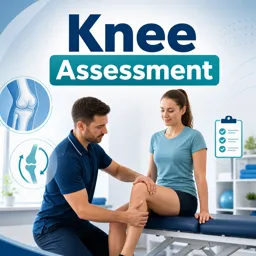
Free CourseKnee assessment
4.7
(3)
2h14m
20 exercises
Free CourseRecovery after exercise
4.7
(3)
1h30m
8 exercises
Carry knowledge in your pocket.
Download the Cursa app.
There are hundreds of free courses available, with a free certificate of completion that is saved in your mobile image gallery.
Download the app to access the Course Completion Certificate for Free.


+ 10 million
students

Free and Valid
Certificate

60 thousand free
exercises

4.8/5 rating in
app stores

Free courses in
video and ebooks
Course comments: Knee Assessment
DIVYANSHU
nice
Mostafa Abdelhamed Awad
Good
Abdelhay morgan
very good