
Internal rotation is commonly assessed by asking the patient to place the back of their hand behind their back and noting the highest spinal level reached, while comparing both sides.

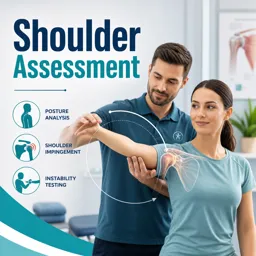
Duration of the online course: 50 minutes
4.7


(59)
Improve shoulder assessment skills with a free physiotherapy course: posture checks, ROM, strength testing, joint play, and key special tests—earn a certificate.
Accurate shoulder assessment is one of the most valuable skills in physiotherapy, because small clinical details can change your hypothesis, your treatment priorities, and the outcomes your patients feel day to day. This free online course helps you build a confident, repeatable approach to evaluating the shoulder complex, from first look to informed clinical decision-making. You will learn to recognize relevant postural and movement clues, identify patterns associated with pain, and connect what you observe to meaningful next steps.
You will strengthen your ability to assess active range of motion with clear reasoning and good test positioning, then progress to resisted isometric testing to interpret pain, weakness, and symptom reproduction. The course also develops your practical understanding of joint play and how to use it to explore capsular behavior and mobility limitations in the glenohumeral joint. These foundations support more precise hypotheses when symptoms are vague, when movement quality is altered, or when functional complaints do not match a simple tissue story.
From there, you will learn how to select and perform common clinical tests used in shoulder girdle assessment, impingement presentations, instability, and scapular dyskinesis. Beyond simply memorizing maneuvers, the course focuses on execution details and interpretation, helping you combine findings instead of relying on a single test result. You will also see how sensitivity and specificity influence confidence in a finding, so you can communicate risk, likely structures involved, and clinical reasoning more clearly.
Designed for physiotherapy students, clinicians, and other health professionals who want a structured refresher, this course supports better exam flow, better documentation, and more consistent decision-making. By the end, you should feel more prepared to screen shoulder complaints, differentiate common patterns such as impingement or instability, and guide patients with clearer, evidence-aware reasoning that fits everyday practice.

50 minutes of online video course

Digital certificate of course completion (Free)

Exercises to train your knowledge

100% free, from content to certificate
How is shoulder internal rotation assessed during an active range-of-motion examination?
Internal rotation is commonly assessed by asking the patient to place the back of their hand behind their back and noting the highest spinal level reached, while comparing both sides.
What does a positive Hawkins-Kennedy test indicate?
A positive test reproduces familiar shoulder pain during forced internal rotation in flexion, suggesting possible subacromial pain or impingement.
What is the difference between the Scapular Assistance Test and Scapular Retraction Test?
The Scapular Assistance Test checks whether assisted upward rotation reduces pain during elevation; the Retraction Test checks whether stabilizing the scapula improves shoulder strength or reduces symptoms.
Ready to get started?Download the app and get started today.
Install the app now
to access the course
Over 5,000 free courses
Programming, English, Digital Marketing and much more! Learn whatever you want, for free.

Study plan with AI
Our app's Artificial Intelligence can create a study schedule for the course you choose.

From zero to professional success
Improve your resume with our free Certificate and then use our Artificial Intelligence to find your dream job.
You can also use the QR Code or the links below.



Free CourseShoulder assessment
5
(5)

2h31m

24 exercises

Free CourseOrthopaedics training
5
(2)
5h41m
13 exercises
Free CourseCervical Spine assessment
5
(2)
2h21m
11 exercises
Free CourseBiomechanics lectures
5
(6)
9h19m
14 exercises
Free CourseAnkle Foot Assessment
4.8
(42)
44m
18 exercises
Free CourseSpine Assessment
4.7
(110)
2h04m
28 exercises
Free CourseKnee Assessment
4.7
(60)
1h00m
28 exercises
Free CourseHip Assessment
4.7
(40)
47m
22 exercises
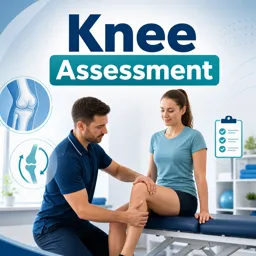
Free CourseKnee assessment
4.7
(3)
2h14m
20 exercises
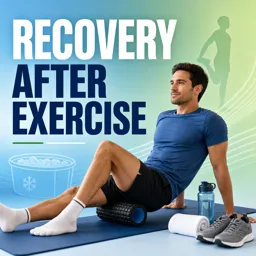
Free CourseRecovery after exercise
4.7
(3)
1h30m
8 exercises
Carry knowledge in your pocket.
Download the Cursa app.
There are hundreds of free courses available, with a free certificate of completion that is saved in your mobile image gallery.
Download the app to access the Course Completion Certificate for Free.


+ 10 million
students

Free and Valid
Certificate

60 thousand free
exercises

4.8/5 rating in
app stores

Free courses in
video and ebooks
Course comments: Shoulder Assessment
Tahmid Apurba
g
Maryam Hassan
so cool
Fatima Hussain
super
Salma Nagy Elmiligy
excellent