
The test measures weight-bearing ankle dorsiflexion by having the knee move toward a wall while the heel stays on the floor; side-to-side differences can indicate restricted mobility.

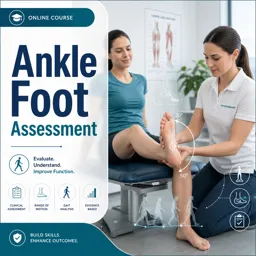
Duration of the online course: 44 minutes
4.8

(41)
Improve ankle and foot assessment skills with a free online physiotherapy course—gait analysis, mobility tests, clinical rules, and key special tests.
Confident ankle and foot assessment can be the difference between guesswork and clear clinical reasoning. This free online physiotherapy course helps you build a practical, structured approach to evaluating common ankle and foot complaints, from acute sprains to overuse conditions. You will strengthen the way you observe movement, interpret signs, and select the right tests to guide decisions in screening, referral, and rehabilitation planning.
You will start by sharpening observational skills through gait cycle understanding and gait analysis, so you can recognize patterns that may reflect mobility restrictions, pain avoidance, or compensations higher up the chain. From there, the course develops your hands-on assessment foundations with active and passive range of motion, resisted isometric testing, and joint play—key steps for differentiating muscle-tendon involvement, joint stiffness, and irritability. Mobility is explored with clinically useful measures such as the weight bearing lunge test, supporting more objective re-testing over time.
As the assessment progresses, you will learn to connect findings to common presentations using well-known clinical prediction and special tests. You will practice decision-making frameworks like the Ottawa ankle rules for fracture screening and apply targeted testing for lateral ankle sprain, syndesmosis injury, peripheral nerve irritation, Achilles tendon rupture, and plantar fascia-related pain. Throughout, integrated exercises reinforce not only how to perform tests correctly, but why they matter, what the findings suggest, and how test accuracy can influence confidence in your conclusions.
By the end, you will be better prepared to assess safely, communicate findings clearly, and choose next steps that are appropriate for the individual in front of you. Whether you are studying, returning to practice, or refining your evaluation skills, this course supports a more consistent and evidence-informed approach to ankle and foot assessment in everyday physiotherapy settings.

44 minutes of online video course

Digital certificate of course completion (Free)

Exercises to train your knowledge

100% free, from content to certificate
How is the Weight-Bearing Lunge Test used to assess ankle dorsiflexion?
The test measures weight-bearing ankle dorsiflexion by having the knee move toward a wall while the heel stays on the floor; side-to-side differences can indicate restricted mobility.
What does an increased navicular drop indicate during foot assessment?
An increased navicular drop is commonly associated with excessive foot pronation and reduced medial arch control during weight bearing.
Which clinical tests help identify an ankle syndesmosis injury?
Common tests include the dorsiflexion-external rotation stress test, syndesmosis squeeze test, fibular translation test, and Cotton test; findings should be interpreted alongside the full clinical assessment.
Ready to get started?Download the app and get started today.
Install the app now
to access the course
Over 5,000 free courses
Programming, English, Digital Marketing and much more! Learn whatever you want, for free.

Study plan with AI
Our app's Artificial Intelligence can create a study schedule for the course you choose.

From zero to professional success
Improve your resume with our free Certificate and then use our Artificial Intelligence to find your dream job.
You can also use the QR Code or the links below.




Free CourseShoulder assessment
5
(5)

2h31m

24 exercises

Free CourseOrthopaedics training
5
(2)
5h41m
13 exercises
Free CourseCervical Spine assessment
5
(2)
2h21m
11 exercises

Free CourseBiomechanics lectures
5
(6)
9h19m
14 exercises
Free CourseSpine Assessment
4.7

(110)
2h04m
28 exercises
Free CourseKnee Assessment
4.7
(60)
1h00m
28 exercises

Free CourseShoulder Assessment
4.7
(60)
50m
19 exercises
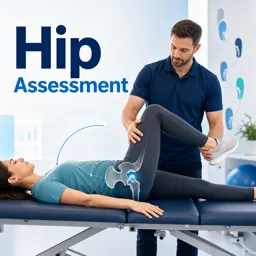
Free CourseHip Assessment
4.7
(40)
47m
22 exercises
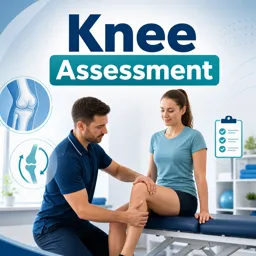
Free CourseKnee assessment
4.7
(3)
2h14m
20 exercises

Free CourseRecovery after exercise
4.7
(3)
1h30m
8 exercises
Carry knowledge in your pocket.
Download the Cursa app.
There are hundreds of free courses available, with a free certificate of completion that is saved in your mobile image gallery.
Download the app to access the Course Completion Certificate for Free.


+ 10 million
students

Free and Valid
Certificate

60 thousand free
exercises

4.8/5 rating in
app stores

Free courses in
video and ebooks
Course comments: Ankle Foot Assessment
nada aljunaibi
good
Rohit Khairnar
very helpful course