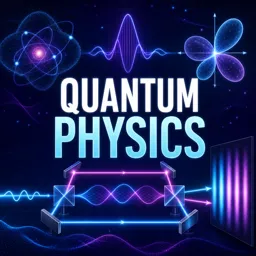

Free ebook on quantum physics foundations: superposition, measurement, uncertainty, tunneling, atoms, semiconductors, and lasers.
Free ebook content
-

Quantum Physics Foundations: Classical Intuition vs Quantum Predictions
+ Exercise: Which statement best matches the role of a physical model in quantum physics as used here?
-
Quantum Physics Foundations: Wave–Particle Duality and Matter Waves
+ Exercise: In a double-slit experiment where particles arrive one at a time, what change should you expect in the accumulated screen pattern when a reliable which-path marker records which slit each particle used?
-
Quantum Physics Foundations: Probability Amplitudes and Interference of Alternatives
+ Exercise: In a two-path setup, you add a device that changes the phase in path 2 but does not reveal which path was taken. What is the expected effect on the screen pattern?
-
Quantum Physics Foundations: Superposition as a Physical State Description
+ Exercise: A photon is prepared in the horizontal polarization state |H⟩. Which statement correctly describes what happens if you measure it using a diagonal/anti-diagonal (D/A) polarizer?


-
Quantum Physics Foundations: Measurement, Outcomes, and State Update
+ Exercise: In an ideal two-outcome measurement, what operational effect does recording an outcome have on predictions for a second, immediately repeated measurement of the same observable?
-
Quantum Physics Foundations: The Uncertainty Principle and Incompatible Properties
+ Exercise: A particle passes through a slit that is made narrower. Which outcome best matches the uncertainty tradeoff described for the state right after the slit and the resulting screen pattern?
-
Quantum Physics Foundations: Simple Quantum States in One Dimension
+ Exercise: A 1D quantum state has a probability density |ψ(x)|² with two equal peaks at x=+a and x=-a, symmetric about x=0. What does this imply about the expectation value ⟨x⟩ and typical single measurement outcomes?
-
Quantum Physics Foundations: Tunneling and Barriers as Probability Flow
+ Exercise: For a particle with energy E lower than a finite barrier height V0, which statement best describes the quantum picture of transmission through the barrier?
-
Quantum Physics Foundations: Quantization in Atoms and Discrete Energy Levels
+ Exercise: An atom is initially in level E4 = −1.0 eV and can drop to lower levels E3 = −3.0 eV, E2 = −7.0 eV, or E1 = −10.0 eV. Which statement best describes the photons it can emit directly from E4?
-
Quantum Physics Foundations: From Energy Bands to Semiconductors
+ Exercise: In an n-type doped semiconductor at ordinary temperatures, which statement best describes the majority carriers and the resulting effect on conductivity?
-
Quantum Physics Foundations: Stimulated Emission, Lasers, and Coherence
+ Exercise: Why is population inversion required for a laser medium to provide net optical amplification?
-
Quantum Physics Foundations: Connecting the Concepts and Testing Understanding
+ Exercise: After a localized wave packet hits a finite barrier, it evolves into reflected and transmitted parts. If you then measure only “left side vs right side,” what does this measurement do to the quantum state?
About the free ebook
Quantum Physics Foundations: The Minimum You Need to Know
This free online ebook introduces the central ideas of quantum physics with clear explanations that connect mathematical language to observable phenomena. It is designed for students who want a reliable foundation for understanding why microscopic systems behave differently from everyday objects.
Build quantum intuition from evidence
Explore how experiments challenge classical expectations through wave–particle duality, matter waves, probability amplitudes, and interference. Learn why a quantum state is not simply an unknown classical condition, but a physical description that can contain multiple possible outcomes.
Understand measurement and uncertainty
The ebook explains how measurements produce outcomes and update state descriptions. It also clarifies the uncertainty principle as a limit related to incompatible properties, rather than a limitation caused only by imperfect instruments.
Connect principles to physical systems
Apply foundational ideas to one-dimensional quantum states, barriers, tunneling, atomic energy levels, energy bands, semiconductors, and lasers. These examples show how quantum theory accounts for technologies and materials encountered in modern science.
What you will gain
- A clearer distinction between classical predictions and quantum probabilities.
- An understanding of superposition, interference, and measurement.
- A conceptual basis for atoms, semiconductors, and laser coherence.
- Practice connecting quantum principles across different physical situations.
Quantum Physics Foundations: The Minimum You Need to Know helps learners develop the essential vocabulary and reasoning needed for further study in physics.
What is wave–particle duality in quantum physics?
It is the observation that light and matter can show wave-like interference and particle-like detection outcomes.
Why does quantum tunneling happen through a barrier?
A quantum state can extend into and beyond a barrier, giving a nonzero probability of finding the particle on the other side.
How do quantum energy bands explain semiconductors?
Allowed energy bands and a band gap determine how electrons respond to energy, doping, and electric fields.
This ebook includes:

12 content chapters

Digital certificate of course completion (Free)

Exercises to train your knowledge

100% free, from content to certificate
Ready to get started?

 recommended
In the app you will also find...

Over 5,000 free courses
Programming, English, Digital Marketing and much more! Learn whatever you want, for free.

Study plan with AI
Our app's Artificial Intelligence can create a study schedule for the course you choose.

From zero to professional success
Improve your resume with our free Certificate and then use our Artificial Intelligence to find your dream job.
You can also use the QR Code or the links below.