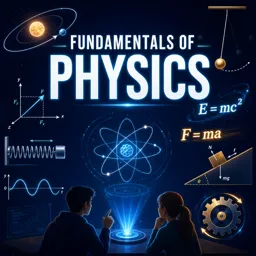
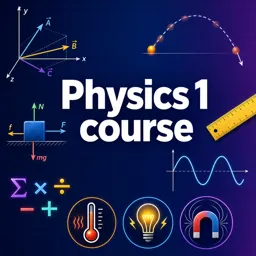
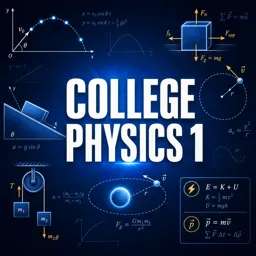
Classical mechanics is the physics of motion you can see and test: rolling balls, swinging pendulums, cars turning corners, and satellites coasting through space. It’s also the best place to build problem-solving habits that transfer to every other branch of physics—because it teaches you how to translate a real situation into a model, choose the right tools, and check whether the result makes physical sense.
This guide focuses on three pillars that make mechanics feel intuitive: (1) drawing correct diagrams, (2) using Newton’s laws when forces matter, and (3) switching to energy and momentum methods when they’re faster. For more foundational learning paths, browse https://cursa.app/free-online-basic-studies-courses and the https://cursa.app/free-courses-basic-studies-online Physics course collection.
1) Start with a model, not a formula
Mechanics problems become hard when the situation is fuzzy. Before calculating anything, decide what counts as the “system” and what you’re willing to ignore. Are you modeling the object as a point mass? Is air resistance negligible? Is the surface rough or smooth? You’re not “cheating” by simplifying—you’re doing physics. A good model keeps only the features that significantly affect the outcome.
2) Free-body diagrams: the most valuable 60 seconds in physics
A free-body diagram (FBD) is a picture of forces acting on your chosen object. It’s the bridge between a messy story and clean equations. The rules are simple but strict: draw only the object of interest; draw every external force on it; label directions and choose axes that reduce components (often along an incline or along the motion).
Common forces to recognize quickly include weight (mg), normal force, tension, friction (static or kinetic), spring force, and drag. When you can “see” these forces, Newton’s second law stops feeling like a formula and starts feeling like a statement of balance.
3) Newton’s laws: equations of motion with a purpose
Once the FBD is correct, Newton’s second law becomes a structured step: write ΣF = ma separately for each axis. The trick is that you’re not hunting for one magic equation—you’re building a small system of equations that matches the physics of constraints (like a rope length, a pulley relation, or circular motion conditions).
Two practical habits help immediately: (1) pick the positive direction first and stick to it, and (2) check limiting cases. If friction goes to zero, does your acceleration approach the frictionless result? If mass doubles, should acceleration halve? These sanity checks catch sign errors early.

4) When energy methods beat force methods
Energy methods are ideal when forces are complicated but energy changes are easy to track. Instead of solving for acceleration at every moment, you compare initial and final states. The core idea is: changes in kinetic energy come from work done by forces, and for conservative forces you can use potential energy.
In practice, energy shines in ramps, springs, pendulums (small or large angles), roller-coaster style motion, and speed-at-a-point questions. You’ll often avoid time entirely and jump straight to speed, height, or compression distance.
5) Momentum: the fastest route through collisions and explosions
Momentum methods are powerful whenever interactions are brief (collisions) or internal (explosions). If external forces are negligible over the short time of impact, total momentum is conserved. This lets you solve for velocities after collisions without tracking the messy contact forces.
To go further, pair momentum with the coefficient of restitution (for bouncy collisions) or with energy conservation (for perfectly elastic collisions). Also remember the “system” choice: the more completely you include interacting objects, the more likely momentum conservation will apply cleanly.
6) Circular motion and constraints: why “centripetal force” isn’t a new force
Circular motion problems often feel mysterious because of the phrase “centripetal force.” The key is: centripetal is not an extra force—it’s the name for the net inward force required for curved motion.
The inward net force can come from tension, gravity, normal force, friction, or some combination. If you learn to write a radial equation (inward/outward) and a tangential equation (speeding up/slowing down), banked turns, vertical loops, and conical pendulums become routine.
7) How to practice mechanics effectively (and enjoyably)
Progress in mechanics comes from deliberate practice, not from memorizing solutions. Use a consistent workflow: (1) sketch the situation, (2) choose a system, (3) draw an FBD, (4) pick a method (Newton/energy/momentum), (5) solve symbolically before plugging numbers, and (6) check units and limiting cases.
Mix problem types: some that emphasize modeling (what can be ignored?), some that emphasize math (solving simultaneous equations), and some that emphasize interpretation (what does a negative sign mean physically?). The goal is to develop flexibility—knowing which tool to reach for and why.

8) Where to go next in physics
Once mechanics feels solid, you’ll find other fields easier because the same habits repeat: careful modeling, clear diagrams, conservation laws, and sanity checks. Explore related physics topics through the curated learning pages:
- https://cursa.app/free-online-courses/thermodynamics
- https://cursa.app/free-online-courses/electromagnetism
- https://cursa.app/free-online-courses/computational-physics
- https://cursa.app/free-online-courses/statistical-physics
For additional open learning materials on introductory mechanics, the https://openstax.org/subjects/science library is a helpful reference for extra practice problems and clear explanations.