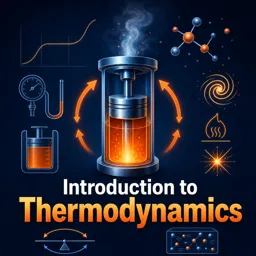
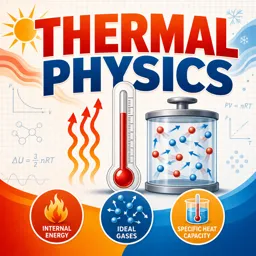
Thermodynamics is the physics of energy—how it moves, changes form, and sets hard limits on what machines, materials, and even living systems can achieve. If you’ve ever wondered why engines waste heat, why ice melts in a warm room, or why “100% efficient” is more marketing than science, thermodynamics is the toolkit that makes those answers precise.
To explore more Physics topics alongside thermodynamics, start with the broader https://cursa.app/free-online-basic-studies-courses collection and the https://cursa.app/free-courses-basic-studies-online Physics subcategory, where you can build a structured path from core concepts to specialized areas.
What thermodynamics actually studies (and what it doesn’t)
Thermodynamics doesn’t track every molecule individually. Instead, it describes systems using macroscopic variables such as temperature, pressure, volume, internal energy, and entropy. This makes it incredibly powerful: you can predict the direction of processes and the maximum possible performance of devices without knowing microscopic details.
It also defines a “system boundary” (what you’re analyzing) and a “surroundings” (everything else). Energy and matter can cross that boundary depending on whether the system is open, closed, or isolated—an idea that shows up constantly in labs, engineering, and everyday problem solving.
The First Law: accounting for energy without guessing
The First Law of Thermodynamics is energy conservation applied to thermal systems: energy can change form, but it cannot be created or destroyed. A common way to express it is that the change in internal energy equals heat added to the system minus work done by the system.
This law is the reason energy bookkeeping works for everything from compressed gases to batteries to metabolic processes. It also clarifies a common misconception: energy conservation alone does not tell you whether a process will happen—it only tells you how to tally energy if it does.

The Second Law: why direction matters
The Second Law introduces entropy, a measure that tracks how energy disperses and how many microscopic configurations correspond to a macroscopic state. In plain terms: some energy becomes less “available” for doing useful work as processes occur, and spontaneous change tends to move toward higher entropy states.
This is why heat naturally flows from hot to cold, why mixing happens without unmixing, and why perpetual motion machines of the second kind are impossible. The Second Law is not about energy vanishing—it’s about energy becoming harder to harness for work.
Heat engines, refrigerators, and the meaning of efficiency
Thermodynamics shines when analyzing devices that convert heat into work (heat engines) or use work to move heat “uphill” (refrigerators and heat pumps). The key takeaway: every real engine must dump some heat to a colder reservoir, and that unavoidable dump is tied to entropy.
Efficiency in this context isn’t a vague “how good it is”—it’s defined. For a heat engine, efficiency is work output divided by heat input.
The theoretical ceiling is the Carnot efficiency, which depends only on the temperatures of the hot and cold reservoirs (in absolute units). Real systems fall below it due to friction, finite-time processes, turbulence, and heat losses.
For refrigerators and heat pumps, the key metric is the coefficient of performance (COP), which can be greater than 1 because it measures heat moved per unit work input—not energy created.
This explains why heat pumps can be remarkably effective for climate control in the right conditions.
Entropy as a practical tool (not just an abstract concept)
Entropy is often introduced as “disorder,” but in problem solving it’s more useful as a quantitative state function. In many courses, you’ll learn to compute entropy changes for idealized processes (like isothermal expansion) and use entropy balances to diagnose irreversibility in real processes.
Irreversibility is the signature of real-world constraints: friction, unrestrained expansion, heat transfer across finite temperature differences, mixing, electrical resistance, and chemical reactions. Thermodynamics gives a way to identify where performance is being lost—even before you build the device.
Connecting thermodynamics to broader Physics topics
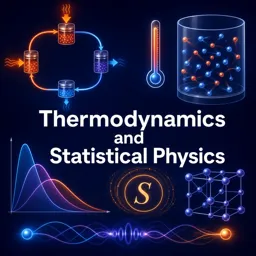
Thermodynamics is deeply connected to microscopic physics through statistical ideas: temperature relates to average energy per degree of freedom, and entropy connects to counting microscopic states. If you enjoy the bridge between “big-picture laws” and particle-level reasoning, exploring https://cursa.app/free-online-courses/statistical-physicsand https://cursa.app/free-online-courses/statistical-thermodynamics is a natural next step.
Thermodynamics also supports modern fields like materials science, atmospheric physics, and information theory. And it complements other Physics routes you might take later—such as https://cursa.app/free-online-courses/electromagnetism, https://cursa.app/free-online-courses/modern-physics, or https://cursa.app/free-online-courses/computational-physics.

How to study thermodynamics effectively (and avoid common traps)
A strong learning strategy is to separate concepts, math, and applications. First, get comfortable defining the system boundary and identifying heat/work interactions. Next, practice using property tables or equations of state (ideal gas law is a start, not the end). Finally, work through cycles (Carnot, Otto, Brayton, refrigeration) to see how the laws constrain performance.
Common pitfalls include mixing up state functions (like internal energy and entropy) with path-dependent quantities (heat and work), using Celsius instead of absolute temperature in efficiency limits, and assuming “energy conserved” implies “process possible.” A well-designed course sequence will reinforce these distinctions through repeated, varied practice problems.
Where to go next
If your goal is practical problem solving, focus on thermodynamic cycles, phase changes, and entropy generation—these unlock real device analysis. If your goal is deeper theory, continue into statistical thermodynamics to see where the laws come from at the microscopic level. Start with https://cursa.app/free-online-courses/thermodynamics and then branch into https://cursa.app/free-online-courses/statistical-physics for the micro-to-macro connection.