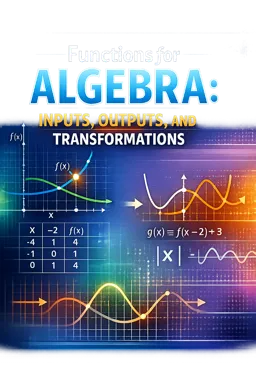

Free ebook on algebra functions: notation, evaluation, domain and range, graphs, tables, parent functions, and transformations.
Free ebook content
-

Functions in Algebra: Inputs, Outputs, and Function Notation
+ Exercise: Which statement correctly explains why the rule x → x² is a function, while the rule x → ±√x is not?
-
Evaluating Functions: Substitution, Simplification, and Interpreting Results
+ Exercise: A student wants to evaluate the rational function g(x) = (x^2 - 9)/(x - 3) at x = 3. Which result and reasoning are correct?
-
Domain and Range Basics: What Inputs and Outputs Are Allowed
+ Exercise: A function is defined by the rule f(x) = 1/(x-4), and you are told the inputs are restricted to 0 ≤ x ≤ 10. What is the actual domain in interval notation?
-
Reading Functions from Tables: Patterns, Inputs, and Output Behavior
+ Exercise: A table lists inputs x = -3, -1, 0, 2 with outputs f(x) = 6, 2, 0, -4. Which statement is true about f(1)?
-
Reading Functions from Graphs: Coordinates, Intercepts, and the Vertical Line Test
+ Exercise: A graph includes two plotted points (2, 1) and (2, -3). What does the vertical line test imply about whether this graph represents a function?
-
Connecting Representations: Formulas, Tables, and Graphs of the Same Function
+ Exercise: A table for h(x)=1/(x+2) is being built to help sketch its graph. Which set of x-values is most appropriate to reveal the function’s behavior?


-
Function Families in Algebra: Linear, Quadratic, Absolute Value, Radical, and Reciprocal
+ Exercise: A function has a domain of all real numbers except x = h and a range of all real numbers except y = k. Which function family best matches these characteristics?
-
Transformations of Functions: Shifts in x and y Using Function Notation
+ Exercise: A point (x, y) lies on y=f(x). After transforming the function to g(x)=f(x-4)-1, what is the correct mapped location of the point on y=g(x)?
-
Stretches and Compressions: Scaling Outputs and Inputs
+ Exercise: A point (4, 2) lies on y = f(x). After the transformation y = -2 f(3x), what is the corresponding point on the new graph?
-
Reflections: Symmetry Through the x-axis, y-axis, and the Origin
+ Exercise: A point (3, -5) lies on the graph y = f(x). Which point lies on the reflected graph y = -f(x)?
-
Combining Transformations: Building Complex Graphs from Parent Functions
+ Exercise: For a transformed function g(x) = a f(b(x - h)) + k, if (x, y) lies on y = f(x), which mapping correctly gives the corresponding point (X, Y) on y = g(x)?
-
Transformation Effects on Domain, Range, and Key Features
+ Exercise: For the reciprocal-type function g(x)=1/(x-2)+3, which statement correctly describes its domain, range, and asymptotes?
-
Algebraic Modeling with Functions: Interpreting Meaning from Function Rules and Graphs
+ Exercise: A graph of a function is increasing on 0 < x < 5 and is steeper near x = 5 than near x = 1. What does this say about how the output changes per 1 unit of input in those regions?
-
Course Review: Mixed Practice on Notation, Evaluation, Representations, and Transformations
+ Exercise: A function is described as linear, crossing the y-axis at (0, -2), and rising 3 units for every 1 unit to the right. Which equation matches this description?
About the free ebook
Functions for Algebra: Inputs, Outputs, and Transformations
This free online ebook develops a practical understanding of algebraic functions as relationships that connect inputs to outputs. Learn to use function notation, evaluate rules accurately, and explain what calculated values mean in mathematical and real-world contexts.
Build confidence with function representations
Functions can be expressed through formulas, tables, and graphs. This ebook shows how to move among these representations while recognizing the same relationship in each form. You will identify ordered pairs, intercepts, patterns, and key graphical features, and use the vertical line test to determine whether a graph represents a function.
Understand allowable values and behavior
Explore domain and range to determine which inputs and outputs are possible. Practice recognizing restrictions caused by operations such as square roots and division, then connect those restrictions to graphs, tables, and function rules.
Transform parent functions precisely
Examine major algebraic function families, including linear, quadratic, absolute value, radical, and reciprocal functions. Learn how changes in notation affect a graph:
- Translations shift graphs horizontally or vertically.
- Stretches and compressions change output or input scale.
- Reflections create symmetry across the x-axis, y-axis, or origin.
- Combined transformations create more complex graphs from familiar parent functions.
Apply functions to algebraic models
The ebook emphasizes interpretation, not just procedures. You will connect a function rule or graph to a situation, describe the meaning of variables and outputs, and analyze how transformations affect domain, range, intercepts, vertices, and other key features. A mixed review reinforces notation, evaluation, representations, and transformations.
| Focus | Skills developed |
| Function rules | Substitution, simplification, and interpretation |
| Graphs and tables | Pattern analysis and feature identification |
| Transformations | Shifts, scaling, reflections, and combinations |
How do you evaluate a function such as f(x) = 3x - 2?
Replace x with the given input, simplify the expression, and report the resulting output.
How can I tell whether a graph represents a function?
Use the vertical line test: no vertical line may intersect the graph more than once.
What does f(x - h) + k do to a graph?
It shifts the graph h units right and k units up when h and k are positive.
This ebook includes:

14 content chapters

Digital certificate of course completion (Free)

Exercises to train your knowledge

100% free, from content to certificate
Ready to get started?

 recommended
In the app you will also find...

Over 5,000 free courses
Programming, English, Digital Marketing and much more! Learn whatever you want, for free.

Study plan with AI
Our app's Artificial Intelligence can create a study schedule for the course you choose.

From zero to professional success
Improve your resume with our free Certificate and then use our Artificial Intelligence to find your dream job.
You can also use the QR Code or the links below.