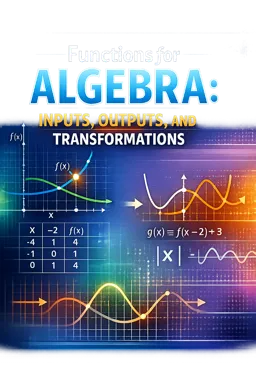
1) Reading Points (x, y) and Connecting Them to f(x)
When a graph represents a function f, every point on the graph has coordinates (x, y) that match the function relationship y = f(x). That means:
- The x-coordinate is the input value.
- The y-coordinate is the output value, so
y = f(x).
How to read a point accurately
To read a point from a grid, move in two steps:
- Start at the origin
(0,0). - Move left/right to the correct
xvalue (input). - Then move up/down to the correct
yvalue (output).
If the graph passes exactly through a grid intersection, you can read the coordinates directly. If it falls between grid lines, estimate using the scale (for example, each small square might represent 0.5 units).
Connecting a point to function language
If you see a point (3, 5) on the graph of f, you can write:
f(3) = 5(input 3 produces output 5)- or
(3, f(3)) = (3, 5)
If you see a point (-2, 1), then f(-2) = 1.
- Listen to the audio with the screen off.
- Earn a certificate upon completion.
- Over 5000 courses for you to explore!

Download the app
Step-by-step: reading outputs from a graph
Suppose you want to find f(4) from a graph.
- Locate
x = 4on the x-axis. - Move vertically until you hit the graph.
- From that intersection point, move horizontally to the y-axis to read the y-value.
- That y-value is
f(4).
Be careful: if the graph is discrete (separate points), you can only read f(4) if there is actually a plotted point with x = 4.
Graph-reading practice (points and f(x))
Answer each as a statement about f.
- A point on the graph is
(-1, 3). Write it using function notation. - The graph shows a point at
(2, -4). What isf(2)? - You read that when
x = 5, the graph’s y-value is about1.5. Writef(5)approximately.
2) Intercepts: x-intercepts and y-intercepts as Inputs and Outputs
Intercepts are special points where the graph crosses an axis. They are useful because they summarize key inputs and outputs quickly.
y-intercept (output when input is 0)
The y-intercept is where the graph crosses the y-axis. On the y-axis, x = 0, so the y-intercept has the form (0, b).
- If the y-intercept is
(0, b), thenf(0) = b. - Meaning: the output when the input is 0.
How to find it on a graph: look for where the graph touches or crosses the y-axis.
x-intercept(s) (inputs that produce output 0)
The x-intercepts are where the graph crosses the x-axis. On the x-axis, y = 0, so an x-intercept has the form (a, 0).
- If an x-intercept is
(a, 0), thenf(a) = 0. - Meaning: the input(s) that make the output 0.
How to find them on a graph: look for where the graph touches or crosses the x-axis. A graph can have:
- no x-intercepts,
- one x-intercept,
- multiple x-intercepts.
Step-by-step: interpreting intercepts
- If you see an x-intercept at
(-3, 0), writef(-3) = 0. - If you see a y-intercept at
(0, 2), writef(0) = 2.
Intercept questions (graph-based reasoning)
- A graph crosses the x-axis at
x = -2andx = 4. What two equations involvingfcan you write? - A graph crosses the y-axis at
y = -5. What isf(0)? - A graph never touches the x-axis. What does that tell you about solutions to
f(x) = 0?
3) The Vertical Line Test: Is the Graph a Function?
A graph represents a function if each input x is paired with exactly one output y. The vertical line test checks this directly on the graph.
How the vertical line test works
Imagine drawing vertical lines x = c for many different values of c.
- If any vertical line intersects the graph in more than one point, then the graph is not a function (one input gives multiple outputs).
- If every vertical line intersects the graph in at most one point, then the graph is a function.
Step-by-step: applying the test
- Pick an x-value where the graph looks “stacked” vertically (common trouble spots: loops, sideways curves, circles).
- Visualize a vertical line through that x-value.
- Count intersection points with the graph.
- If you ever count 2 or more intersections for the same x, it fails.
Examples to visualize (without needing equations)
- A U-shaped curve opening up or down typically passes the test (one y for each x).
- A circle fails the test (many x-values have two y-values).
- A sideways-opening curve often fails (some x-values hit the curve twice).
- A set of discrete points can still be a function if no two points share the same x-value with different y-values.
Function-or-not questions (use the vertical line test)
- A graph shows two points
(2, 1)and(2, -3). Is it a function? Explain using the vertical line idea. - A graph is a closed loop (oval shape). Would it pass the vertical line test? Why?
- A graph consists of points
(-1, 4),(0, 4),(1, 4). Is it a function? What does the vertical line test say? - A graph consists of points
(-1, 2),(0, 2),(0, 5),(1, 2). Is it a function? Identify the x-value that causes failure.
4) Domain and Range from a Graph Using Interval Notation
From a graph, the domain is the set of x-values that appear on the graph, and the range is the set of y-values that appear on the graph. The main skill is describing these sets precisely, often with interval notation.
Reading domain from a graph (x-values covered)
To find the domain visually:
- Scan the graph from left to right.
- Identify the smallest x-value reached and the largest x-value reached.
- Check whether endpoints are included (solid point) or excluded (open circle).
Endpoint symbols:
- Solid (filled) point: the endpoint is included, use
[or]. - Open circle: the endpoint is not included, use
(or).
Reading range from a graph (y-values covered)
To find the range visually:
- Scan the graph from bottom to top.
- Identify the smallest y-value reached and the largest y-value reached.
- Again, decide whether endpoints are included or excluded.
Interval notation reminders (as used on graphs)
| Meaning | Notation | Graph clue |
|---|---|---|
| All x between 1 and 5, including both | [1, 5] | Solid endpoints at x=1 and x=5 |
| All x between 1 and 5, excluding both | (1, 5) | Open circles at x=1 and x=5 |
| All x greater than or equal to 2 | [2, ∞) | Solid point at x=2 and arrow to the right |
| All x less than 3 | (-∞, 3) | Open circle at x=3 and arrow to the left |
Discrete Graphs vs Continuous Curves (and How Domain/Range Descriptions Change)
Discrete graphs (separate points)
A discrete graph is made of individual plotted points (not connected). In this case:
- The domain is a list of specific x-values.
- The range is a list of specific y-values.
- Interval notation is usually not appropriate unless the graph truly includes every value in an interval (discrete graphs usually do not).
Example: Points at (-2, 1), (0, 3), (4, 3).
- Domain:
{-2, 0, 4} - Range:
{1, 3}
Notice the range can repeat outputs (two different x-values can share the same y-value) and still be a function, as long as x-values do not repeat with different y-values.
Continuous curves (connected graph)
A continuous curve includes all points along the drawn path. In this case:
- The domain is often an interval (or a union of intervals).
- The range is often an interval (or a union of intervals).
- Interval notation is the standard way to describe domain and range.
Example: A curve starts at an open circle at x = -1, continues without breaks, and ends at a solid point at x = 5. Then the domain is (-1, 5].
Graphs with gaps or multiple pieces
Some graphs have breaks (holes, jumps, or separate pieces). Then domain and range may require multiple intervals.
Example description: One piece exists for x from -4 to -1 (including both), and another piece exists for x greater than 2 (but not including 2). Domain:
[-4, -1] ∪ (2, ∞)
Domain and range questions (interval notation and discrete vs continuous)
- A continuous graph runs from a solid point at
x = -3to an open circle atx = 2. Write the domain in interval notation. - A continuous graph has lowest y-value at a solid point
y = -1and increases upward forever. Write the range. - A discrete graph has points at
x = -2, -1, 0, 3. How should you write the domain: as an interval or as a set? Write it correctly. - A graph has a hole (open circle) at
(1, 2)but otherwise continues through that x-region. How does that affect the domain? How does it affect the range?
Mixed Practice: Read Values, Intercepts, Function Test, Domain/Range
Set A: Discrete relation
A relation is shown by points: (-3, 2), (-1, 0), (0, 4), (2, 0), (2, 5).
- List the domain and range using set notation.
- Identify all x-intercepts and the y-intercept (if any).
- Does it represent a function? Use the vertical line test idea (focus on repeated x-values).
Set B: Continuous curve description
A curve starts at a solid point at (-2, 1), rises to a highest point at (1, 5), then decreases and ends at an open circle at (4, 2). The curve is drawn continuously between these endpoints.
- Estimate the domain in interval notation.
- Estimate the range in interval notation (pay attention to included/excluded endpoints).
- What is the y-intercept likely to represent on the graph? (State it as
f(0)equals some value you would read from the graph.) - Would the vertical line test pass for a single-peaked curve like this? Explain briefly.
Set C: Function or not (reasoning from shape)
- A graph looks like a circle centered at the origin. Decide if it is a function and justify using the vertical line test.
- A graph looks like two separate line segments: one from
x=-5tox=-2, and another fromx=1tox=3. Can it still be a function? What would you check? - A graph includes a vertical segment at
x=2fromy=-1toy=4. Is it a function? What does the vertical line test say?