It links polynomial ideals over an algebraically closed field with the sets of common zeros they define, relating algebra to geometry.

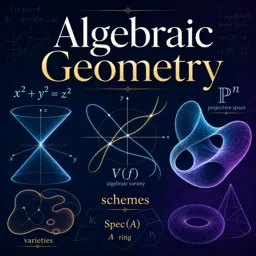
Duration of the online course: 10 hours and 43 minutes
New
Build powerful proof skills with this free algebraic geometry course—varieties, ideals, schemes, and cohomology explained clearly, with a certificate option.
Algebraic geometry is where equations start to behave like shapes. In this free online course, you will learn to translate polynomial problems into geometric intuition and then bring geometric ideas back into algebraic proofs. This perspective is one of the most valuable upgrades a student of algebra can make, because it unifies techniques that often feel separate in school math: solving systems, understanding curves, classifying solutions, and reasoning about structure rather than just computation.
You begin by grounding the subject in concrete objects such as algebraic sets, conic sections, and varieties, developing the habit of asking not only what the solutions are, but how they fit together. From there the course builds the central algebra–geometry dictionary: ideals describe geometric loci, coordinate rings encode functions on shapes, and foundational results connect these two worlds in a precise way. As your intuition strengthens, the Zariski topology reframes what it means for sets to be open and for properties to be generic, giving you a language for statements that hold in the right sense even when classical topology feels too rigid.
The course then moves toward modern geometry through localization, regular functions, and sheaves, emphasizing locality: complex global objects are understood by piecing together consistent local data. Ringed spaces and varieties become tools for seeing geometry as both a space and the algebra of functions that live on it. With projective space you learn how adding points at infinity resolves many artificial exceptions, making intersections and closures behave more naturally and preparing you for powerful constructions such as projective varieties, embeddings, and parameter spaces like Grassmannians.
As you advance, the material highlights transformation and classification ideas that show up across mathematics: birational maps, blowups, and tangent cones help you analyze and improve singularities; smoothness criteria connect geometry to derivatives via Jacobians; and duality phenomena reveal how families of tangent lines encode hidden structure. Finally, schemes broaden the notion of space so algebraic information is not lost, and you get a guided pathway into modules, quasi-coherent sheaves, differentials, and the topological analogy behind sheaf cohomology, ending with a glimpse of tropical geometry’s combinatorial viewpoint.
Whether you are preparing for higher mathematics, aiming to sharpen proof technique, or exploring a subject that underpins modern number theory, geometry, and algebra, this course offers a coherent route from intuitive examples to the conceptual framework used in advanced study.

Explore free online Topology courses and master essential concepts such as open and closed sets, continuity, compactness, connectedness, metric spaces, and algebraic topology. Learn at your own pace with expert-led lessons, build valuable mathematics skills, and earn a certificate upon completion—all at no cost.

Explore free online Algebraic Geometry courses designed to help you master varieties, schemes, morphisms, divisors, and modern geometric methods. Learn at your own pace with expert-led lessons, strengthen your advanced mathematics skills, and earn a certificate upon completion. Start studying Algebraic Geometry online for free today.

10 hours and 43 minutes of online video course

Digital certificate of course completion (Free)

Exercises to train your knowledge

100% free, from content to certificate
What does Hilbert’s Nullstellensatz say in algebraic geometry?
It links polynomial ideals over an algebraically closed field with the sets of common zeros they define, relating algebra to geometry.
How does the Zariski topology differ from the usual topology?
Its closed sets are algebraic sets defined by polynomial equations, so it is much coarser than the Euclidean topology.
What is the purpose of blowing up a point on an algebraic variety?
A blowup replaces a point with the set of tangent directions through it, often helping analyze or resolve singularities.
Ready to get started?Download the app and get started today.
Install the app now
to access the course
Over 5,000 free courses
Programming, English, Digital Marketing and much more! Learn whatever you want, for free.

Study plan with AI
Our app's Artificial Intelligence can create a study schedule for the course you choose.

From zero to professional success
Improve your resume with our free Certificate and then use our Artificial Intelligence to find your dream job.
You can also use the QR Code or the links below.



Free CourseBasics of Algebra
5

(9)

37m

5 exercises
Free CourseAlgebraic Topology Course
5
(1)
24h16m
46 exercises
Free CourseAlgebra Introduction
5
(5)
1h18m
6 exercises

Free CourseLinear Algebra Course
5
(3)
10h49m
46 exercises
Free CourseLinear algebra
4.9
(121)
27h55m
35 exercises
Free CourseAlgebra
4.8
(57)
3h18m
25 exercises
Free CourseIntermediate Algebra
4.8
(23)
54h38m
43 exercises
Free CoursePrealgebra
3.6

(56)
38h54m
44 exercises
Free CourseAdvanced Algebra Lessons
1
(1)
4h42m
12 exercises
Free CourseMath Fundamentals Algebra
New
2h09m
14 exercises
Carry knowledge in your pocket.
Download the Cursa app.
There are hundreds of free courses available, with a free certificate of completion that is saved in your mobile image gallery.
Download the app to access the Course Completion Certificate for Free.


+ 10 million
students

Free and Valid
Certificate

60 thousand free
exercises

4.8/5 rating in
app stores

Free courses in
video and ebooks