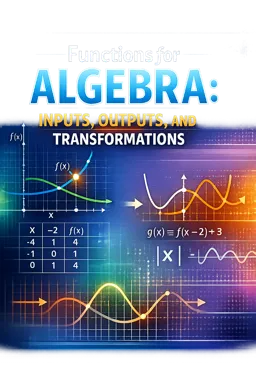
1) Interpreting f(x) as an output measure tied to an input measure
In algebraic modeling, a function rule is more than a calculation: it describes how two quantities are connected. The input x should be named with units (minutes, miles, dollars, items), and the output f(x) should be named with units that make sense for the situation. Interpreting a function means stating what x represents, what f(x) represents, and what the rule says about how the output changes when the input changes.
Modeling language template
- Input: “Let
xbe … (quantity and units).” - Output: “
f(x)is … (quantity and units).” - Meaning of the rule: “For each …, the model outputs …, which represents ….”
Example A: A linear rule as a cost model
Suppose C(m) = 12 + 0.08m.
- Interpretation: Let
mbe the number of miles driven.C(m)is the total cost in dollars. - Meaning of parts: The
12is a fixed starting cost (a baseline fee). The0.08madds $0.08 per mile.
Step-by-step interpretation of a specific output:
- Choose an input and keep units:
m = 50miles. - Compute:
C(50) = 12 + 0.08(50) = 12 + 4 = 16. - State meaning: “For 50 miles, the model predicts a total cost of $16.”
Example B: A quadratic rule as an area model
Suppose A(s) = s^2.
- Interpretation: Let
sbe the side length of a square (in meters).A(s)is the area (in square meters). - Meaning: Doubling the input does not double the output; it multiplies the output by 4 because area depends on the square of the side length.
Short interpretation prompts (precise language)
- If
H(t)models water height, write one sentence that namestwith units and one sentence that namesH(t)with units. - For
P(n) = 3n + 25, write a sentence explaining what the “25” could represent in context and what “3” means per unit ofn. - For
f(x) = x^2 + 10, describe what the “+10” means as a baseline in a real situation (without mentioning graph shifts).
2) Reading changes from graphs: increasing/decreasing and steepness as informal rate of change
When a function models a relationship, the graph shows how the output responds as the input changes. Two key questions are: (1) as x increases, does f(x) tend to increase or decrease? and (2) how quickly does it change? In algebra-level modeling, we describe “how quickly” informally using steepness: steeper means the output changes more per unit input.
- Listen to the audio with the screen off.
- Earn a certificate upon completion.
- Over 5000 courses for you to explore!

Download the app
Increasing and decreasing (context language)
- Increasing on an interval: as the input increases, the output increases. Context phrasing: “As time passes, the temperature rises.”
- Decreasing on an interval: as the input increases, the output decreases. Context phrasing: “As distance increases, the signal strength drops.”
Steepness as “change per 1 unit of input” (informal rate)
Compare two parts of a graph: if one segment is steeper upward than another, the output is increasing faster there. If a segment is steep downward, the output is decreasing quickly there. You can estimate this by comparing two points: “output change divided by input change” as an informal per-unit change.
Example: Estimating change from two points
A graph of p(t) (price in dollars) vs. t (weeks) passes through points approximately (2, 18) and (6, 30).
- Input change:
6 - 2 = 4weeks. - Output change:
30 - 18 = 12dollars. - Informal rate:
12/4 = 3dollars per week. - Interpretation sentence: “Between week 2 and week 6, the price increases by about $3 per week.”
Example: Reading “faster then slower” from curvature
If a graph is increasing and becomes steeper as x increases, the output is increasing faster over time (the per-unit change is growing). If it is increasing but becomes less steep, the output is still increasing but at a slowing pace.
Short interpretation prompts (graph behavior)
- Write a sentence that uses “as
xincreases…” to describe an interval where the graph goes downward. - The graph is increasing on
0 < x < 5but is steeper nearx = 5than nearx = 1. Write a sentence describing how the output’s change per 1 unit input compares in those regions. - A graph decreases steeply from
x=0tox=2and then decreases gently fromx=2tox=6. Write a context sentence that distinguishes “drops quickly” vs. “drops slowly.”
3) Connecting transformations to contextual changes (baseline shifts and other meaning)
In modeling, transformations are not just graph moves; they represent changes to the situation. A transformation changes what the output means for the same input, or changes which input value corresponds to a given situation. The key is to interpret the transformation in words tied to the quantities.
Output shift: adding a constant as a baseline change
If a model is changed from f(x) to f(x) + k, then every output is increased by k (if k>0) or decreased by |k| (if k<0). Context meaning: a fixed amount is added to the measured output for every input.
Example: If C(m)=12+0.08m models cost, then C(m)+5 could represent “the same trip cost plus a $5 service fee,” regardless of miles.
Output scaling: multiplying outputs as a per-output-unit change
Changing f(x) to a f(x) multiplies every output by a. Context meaning: the measured quantity is scaled, such as a price increase by a factor, a conversion factor, or a change in efficiency that affects all outputs proportionally.
Example: If E(h) is energy used in kWh after h hours, then 1.2E(h) could model a 20% increase in energy use at every hour due to a less efficient setting.
Input shift: changing the “starting point” of the input
Changing f(x) to f(x - h) means the same output behavior happens, but it is tied to inputs that are h units later. Context meaning: the event starts later, or the clock is reset, or the input measurement begins after an offset.
Example: If T(t) models temperature t hours after noon, then T(t-2) models the same temperature pattern but starting 2 hours later (so the value that used to occur at t=0 now occurs at t=2).
Input scaling: changing the “speed” of the input effect
Changing f(x) to f(bx) changes how quickly the output responds as x increases. Context meaning: the process happens faster or slower with respect to the input variable.
Example: If G(t) models growth over time, then G(2t) represents reaching the same growth levels in half the time (the input is effectively moving twice as fast).
Short interpretation prompts (transformation meaning)
- Suppose
W(t)is the amount of water in a tank (liters) aftertminutes. InterpretW(t)+30in a situation sentence. - Interpret
0.5R(x)ifR(x)is revenue (dollars) from sellingxitems. - Interpret
S(d-10)ifS(d)is the speed of a car (mph) after travelingdmiles from a starting point. - Interpret
P(3t)ifP(t)is the population of bacteria afterthours.
4) Selecting an appropriate function family for a described relationship using key features
Choosing a model family means matching the story’s key features to a function type. Instead of starting with an equation, start with how the quantities behave: constant change, turning point, symmetry, “distance from a target,” rapid change near zero, or leveling behavior over a restricted domain. Then select a family whose graph and rule naturally match those features.
Key features checklist
- Is the change per unit input constant? Suggests a linear model.
- Is there a single highest/lowest point (a turning point)? Suggests a quadratic model.
- Is the output based on distance from a preferred value (no negatives, V-shape behavior)? Suggests an absolute value model.
- Is there a restriction like “can’t go below 0” with a square-root-type start and then increasing? Suggests a radical model.
- Does the output blow up near an input value or show “inverse” behavior (large when input is small)? Suggests a reciprocal model.
Step-by-step: from description to family
- Name the variables with units. Identify what is changing and what is being measured.
- Identify the qualitative behavior. Increasing/decreasing, constant rate, turning point, symmetry, restrictions.
- Match to a family using key features. Use the checklist above.
- Decide what parameters mean. Baseline, rate, location of minimum/maximum, distance-from-target center, etc.
Mini-scenarios: choose a family and justify with one feature
| Scenario description | Likely family | Key feature to cite |
|---|---|---|
| Total pay is a base amount plus a fixed amount per hour worked. | Linear | Constant change per hour |
| Height of a tossed ball rises then falls, with one highest point. | Quadratic | Single maximum (turning point) |
| Cost depends on how far the temperature is from 20°C, regardless of above/below. | Absolute value | Depends on distance from a target value |
| Area of a circle depends on radius squared. | Quadratic (in r) | Output proportional to square of input |
| Time to finish a job decreases as the number of identical workers increases (idealized). | Reciprocal | Inverse relationship: more workers, less time |
| Distance you can see from a cliff increases with the square root of height (simplified). | Radical | Output grows like a square root; input must be nonnegative |
Short interpretation prompts (family selection with precise language)
- A quantity increases by 7 units every time the input increases by 1 unit. Which family fits best, and what does “7” mean in words?
- A model has a minimum value at
x=4, and values are the same atx=3andx=5. Which family is a strong candidate, and what feature supports that? - A model measures “error” as the distance between a measured value
xand a target of 100. Write a function form using absolute value and interpret the output in one sentence. - A relationship is described as “doubling the input makes the output about four times as large.” Which family does that suggest, and what phrase would you use to justify it?