Free Course Image Linear algebra

Free online courseLinear algebra

Duration of the online course: 27 hours and 55 minutes

4.91

StarStarStarStarStar

(120)

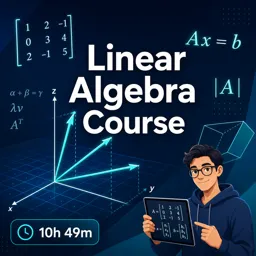
Boost problem-solving with linear algebra—matrices, vectors, eigenvalues and SVD—in a free online course with exercises to practice and improve fast.

In this free course, learn about

  • Solve linear systems via elimination; row operations, pivots, and when row exchanges are needed
  • Matrix multiplication rules (compatible sizes) and inverse/product identities like (AB)^{-1}=B^{-1}A^{-1}
  • Vector spaces/subspaces: span, union test, dimension, independence, bases in R^n
  • Rank, column space, nullspace, left nullspace; the four fundamental subspaces and their dimensions
  • Least-squares and projections: projection matrix P, effects of scaling b, and when b lies in Col(A)
  • Orthonormal columns and transposes: Q^TQ=I, orthogonal subspaces, angles, and Gram-Schmidt ideas
  • Determinants: meaning, 2x2 formula, properties, and role in invertibility and finding inverses
  • Eigenvalues/eigenvectors: definitions, diagonalization condition, and use in differential equations
  • Special matrices: symmetric (real eigenvalues, orthogonal eigenvectors), positive definite tests, similarity
  • Markov matrices: stochastic properties and steady-state behavior
  • Singular Value Decomposition (SVD): A=UΣV^T, rank info, and applications like compression
  • Fast Fourier Transform (FFT): key speed benefit for computing Fourier transforms efficiently
  • Linear transformations and matrix representations; applications to images/pixels and data

Course Description

Linear algebra is the language behind modern science and technology: it explains how search engines rank pages, how graphics and 3D scenes are rendered, how data is compressed, and why many algorithms in engineering, economics, and AI work at all. This free online course helps you build that language step by step, turning abstract symbols into practical tools you can use with confidence.

You will develop a clear understanding of vectors and matrices as ways to represent information, and of systems of equations as structured problems you can solve efficiently. Along the way, you will learn to reason about what solutions mean geometrically, when they exist, and how ideas like rank, independence, and dimension reveal the real degrees of freedom inside a problem.

The course connects computation with insight. You will work with core operations such as elimination and matrix multiplication while also learning how subspaces organize complicated spaces into simpler parts. Concepts like column space, null space, and orthogonality become useful guides for deciding what a matrix can and cannot do, and for recognizing when projection and least squares provide the best possible answer even when an exact solution is impossible.

As you progress, determinants and inverses stop being memorized procedures and become meaningful tests of invertibility and structure. From there, eigenvalues and eigenvectors open the door to understanding stability, long-term behavior, and diagonalization—ideas that appear in differential equations and iterative processes such as Markov chains.

Later topics tie the subject to real applications, including symmetric matrices, positive definiteness, similarity, and powerful factorizations such as the Singular Value Decomposition and the Fast Fourier Transform. Short exercises throughout help you check comprehension immediately and strengthen your intuition so you can apply linear algebra in exams, further math courses, or technical projects.

Course content

  • Video class: Lec 1 | MIT 18.06 Linear Algebra, Spring 2005 39m
  • Exercise: What is the point of origin in a line?
  • Video class: Lec 2 | MIT 18.06 Linear Algebra, Spring 2005 47m
  • Exercise: Which method is primarily used to solve systems of equations in the lecture?
  • Video class: Lec 3 | MIT 18.06 Linear Algebra, Spring 2005 46m
  • Exercise: What is the essential requirement for matrix multiplication?
  • Video class: Lec 4 | MIT 18.06 Linear Algebra, Spring 2005 50m
  • Exercise: What is the inverse of the product of two invertible matrices A and B?
  • Video class: Lec 5 | MIT 18.06 Linear Algebra, Spring 2005 47m
  • Exercise: What determines if a matrix operation requires row exchanges?
  • Video class: Lec 6 | MIT 18.06 Linear Algebra, Spring 2005 46m
  • Exercise: Can the union of two subspaces form another subspace?
  • Video class: Lec 7 | MIT 18.06 Linear Algebra, Spring 2005 43m
  • Exercise: What is the rank of a matrix in linear algebra?
  • Video class: Lec 8 | MIT 18.06 Linear Algebra, Spring 2005 47m
  • Exercise: What is the solution of AX=B in class eight?
  • Video class: Lec 9 | MIT 18.06 Linear Algebra, Spring 2005 50m
  • Exercise: What determines if a set of vectors are independent?
  • Video class: Lec 10 | MIT 18.06 Linear Algebra, Spring 2005 49m
  • Exercise: What is the fourth fundamental subspace in linear algebra?
  • Video class: Lec 11 | MIT 18.06 Linear Algebra, Spring 2005 45m
  • Exercise: What is the dimension of the subspace of three by three symmetric matrices?
  • Video class: Lec 12 | MIT 18.06 Linear Algebra, Spring 2005 47m
  • Exercise: What is the rank of the incidence matrix from the graph in the example?
  • Video class: Lec 13 | MIT 18.06 Linear Algebra, Spring 2005 47m
  • Exercise: Determine the possible dimensions of the subspace spanned by u, v, and w in R^7
  • Video class: Lec 14 | MIT 18.06 Linear Algebra, Spring 2005 49m
  • Exercise: What is the angle between 2 orthogonal subspaces?
  • Video class: Lec 15 | MIT 18.06 Linear Algebra, Spring 2005 48m
  • Exercise: What happens to the projection if vector 'b' is doubled?
  • Video class: Lec 16 | MIT 18.06 Linear Algebra, Spring 2005 48m
  • Exercise: What does the projection matrix P do when vector b is in the column space?
  • Video class: Lec 17 | MIT 18.06 Linear Algebra, Spring 2005 49m
  • Exercise: What property does a matrix with orthonormal columns have when multiplied by its transpose?
  • Video class: Lec 18 | MIT 18.06 Linear Algebra, Spring 2005 49m
  • Exercise: What is the determinant of a square matrix used for?
  • Video class: Lec 19 | MIT 18.06 Linear Algebra, Spring 2005 53m
  • Exercise: What is the determinant of a 2x2 matrix with elements a, b, c, d?
  • Video class: Lec 20 | MIT 18.06 Linear Algebra, Spring 2005 51m
  • Exercise: What is a property of the determinant used in finding the inverse of a matrix?
  • Video class: Lec 21 | MIT 18.06 Linear Algebra, Spring 2005 51m
  • Exercise: What is an eigenvector?
  • Video class: Lec 22 | MIT 18.06 Linear Algebra, Spring 2005 51m
  • Exercise: What is the condition for diagonalizing a matrix?
  • Video class: Lec 23 | MIT 18.06 Linear Algebra, Spring 2005 51m
  • Exercise: What is the significance of eigenvalues in solving differential equations?
  • Video class: Lec 24 | MIT 18.06 Linear Algebra, Spring 2005 51m
  • Exercise: What is a key property of Markov matrices?
  • Video class: Lec 24b | MIT 18.06 Linear Algebra, Spring 2005 48m
  • Exercise: What is the condition for a matrix to be invertible?
  • Video class: Lec 25 | MIT 18.06 Linear Algebra, Spring 2005 43m
  • Exercise: What is a characteristic of symmetric matrices that affects their eigenvalues and eigenvectors?
  • Video class: Lec 26 | MIT 18.06 Linear Algebra, Spring 2005 47m
  • Exercise: What is one key benefit of the Fast Fourier Transform (FFT)?
  • Video class: Lec 27 | MIT 18.06 Linear Algebra, Spring 2005 50m
  • Exercise: How can you determine if a matrix is positive definite?
  • Video class: Lec 28 | MIT 18.06 Linear Algebra, Spring 2005 45m
  • Exercise: What does it mean for two matrices to be similar?
  • Video class: Lec 29 | MIT 18.06 Linear Algebra, Spring 2005 41m
  • Exercise: What is the structure of the Singular Value Decomposition (SVD)?
  • Video class: Lec 30 | MIT 18.06 Linear Algebra, Spring 2005 49m
  • Exercise: What is a linear transformation?
  • Video class: Lec 31 | MIT 18.06 Linear Algebra, Spring 2005 50m
  • Exercise: What is a pixel?
  • Video class: Lec 32 | MIT 18.06 Linear Algebra, Spring 2005 47m
  • Exercise: What is special about eigenvalues of symmetric matrices?
  • Video class: Lec 33 | MIT 18.06 Linear Algebra, Spring 2005 41m
  • Exercise: What happens to the rank of a matrix when it is invertible?
  • Video class: Lec 34 | MIT 18.06 Linear Algebra, Spring 2005 43m
  • Exercise: What Characteristic of the Matrix A Ensures A Transpose A is Invertible?

This free course includes:

27 hours and 55 minutes of online video course

Digital certificate of course completion (Free)

Exercises to train your knowledge

100% free, from content to certificate

Ready to get started?Download the app and get started today.

Install the app now

to access the course
Icon representing technology and business courses

Over 5,000 free courses

Programming, English, Digital Marketing and much more! Learn whatever you want, for free.

Calendar icon with target representing study planning

Study plan with AI

Our app's Artificial Intelligence can create a study schedule for the course you choose.

Professional icon representing career and business

From zero to professional success

Improve your resume with our free Certificate and then use our Artificial Intelligence to find your dream job.

You can also use the QR Code or the links below.

QR Code - Download Cursa - Online Courses

Course comments: Linear algebra

AM

Abshir Maxamed

StarStarStarStarStar

real I'm happy to join Cursa online Courses

More free courses at Algebra

Free Ebook + Audiobooks! Learn by listening or reading!

Download the App now to have access to + 5000 free courses, exercises, certificates and lots of content without paying anything!

  • 100% free online courses from start to finish

    Thousands of online courses in video, ebooks and audiobooks.

  • More than 60 thousand free exercises

    To test your knowledge during online courses

  • Valid free Digital Certificate with QR Code

    Generated directly from your cell phone's photo gallery and sent to your email

Cursa app on the ebook screen, the video course screen and the course exercises screen, plus the course completion certificate