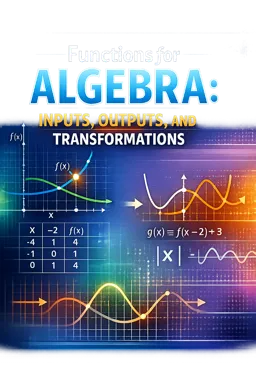
How to Use This Review Chapter
This chapter is a consolidation workspace. You will practice recognizing function notation, evaluating expressions, reasoning about domain/range, connecting tables/graphs/formulas, and describing transformations by both sketching and writing equations. For each section: (1) write your work clearly, (2) label key points (intercepts, vertices, asymptotes, endpoints), and (3) state domain/range using interval notation when possible.
1) Diagnostic Warm-Up (Notation, Evaluation, Domain/Range)
Do these quickly to identify what needs review. Show enough work to verify each answer.
A. Notation and meaning
- 1. If
f(2)=9, what does this statement mean in words? - 2. Explain the difference between
f(3)andf(x). - 3. If
g(x)=f(x)+2, describe how the outputs ofgcompare to the outputs offfor the same input.
B. Evaluate (substitute carefully)
- 4. Let
f(x)=2x^2-3x+1. Findf(-2). - 5. Let
h(x)=|x-5|. Findh(1)andh(9). - 6. Let
p(x)=\frac{1}{x-4}. Findp(6). State any input that is not allowed. - 7. Let
r(x)=\sqrt{x+3}. Findr(13). State the domain ofr.
C. Domain and range reasoning (no graph needed)
- 8. For
m(x)=\sqrt{7-x}, state the domain and range. - 9. For
q(x)=\frac{2}{x+1}-5, state the domain and range. - 10. For
s(x)=-(x-2)^2+4, state the domain and range.
2) Multi-Representation Tasks (Match Table, Graph Features, and Formula)
In each task, you will match items that represent the same function. Use specific evidence: constant rate of change, symmetry, vertex location, intercepts, asymptotes, or endpoint behavior.
Task 2.1: Match formulas to tables
Match each formula (A–D) to one table (1–4). Justify with one sentence of evidence (pattern, symmetry, or key values).
Formulas
- Listen to the audio with the screen off.
- Earn a certificate upon completion.
- Over 5000 courses for you to explore!

Download the app
- A.
f(x)=2x+1 - B.
g(x)=(x-1)^2 - C.
h(x)=|x+2| - D.
k(x)=\frac{1}{x}
Tables
| Table 1 | Table 2 | Table 3 | Table 4 |
|---|---|---|---|
x: -2 -1 0 1 2 y: -3 -1 1 3 5 | x: -1 0 1 2 3 y: 4 1 0 1 4 | x: -4 -3 -2 -1 0 y: 2 1 0 1 2 | x: -2 -1 1 2 y:-1/2 -1 1 1/2 |
Task 2.2: Match formulas to graph descriptions
Match each formula (E–H) to one graph description (i–iv). Use features (vertex, asymptotes, intercepts, end behavior).
Formulas
- E.
y=(x+3)^2-2 - F.
y=-|x-1|+4 - G.
y=\sqrt{x-5}+1 - H.
y=\frac{2}{x+1}
Graph descriptions
- i. A parabola opening up with vertex at
(-3,-2). - ii. A V-shape opening down with peak at
(1,4). - iii. A square-root curve starting at
(5,1)and increasing to the right. - iv. A reciprocal-type curve with vertical asymptote
x=-1and horizontal asymptotey=0.
Task 2.3: Build a table from a graph feature list
A function has these features: it is linear, crosses the y-axis at (0,-2), and rises 3 units for every 1 unit to the right. Create (a) an equation, and (b) a 5-row table of values including x=-1,0,1,2,3.
3) Transformation Sequences (Sketch from Parent + Write the Equation)
For each problem: (1) name the parent function family, (2) list transformations in order, (3) sketch by plotting key points/asymptotes/endpoints, and (4) write the final equation. Use function notation when helpful, e.g., y=a f(b(x-h))+k.
Transformation Toolkit (quick checklist)
- Horizontal shift:
f(x-h)shifts righth;f(x+h)shifts lefth. - Vertical shift:
f(x)+kshifts upk;f(x)-kshifts downk. - Vertical scale/reflection:
a f(x)stretches by|a|; ifa<0reflect across x-axis. - Horizontal scale/reflection:
f(bx)compresses by|b|if|b|>1; stretches if0<|b|<1; ifb<0reflect across y-axis.
Task 3.1: Quadratic sequence (from y=x^2)
Start with y=x^2. Apply transformations in order: (1) shift right 2, (2) reflect across the x-axis, (3) vertical stretch by factor 3, (4) shift up 5.
- a) Write the final equation.
- b) List the vertex and whether the parabola opens up or down.
- c) State the range.
Task 3.2: Absolute value sequence (from y=|x|)
Start with y=|x|. Apply: (1) shift left 4, (2) vertical compression by factor 1/2, (3) shift down 3.
- a) Write the final equation.
- b) Give the vertex and two additional points you would plot.
- c) State domain and range.
Task 3.3: Radical sequence (from y=\sqrt{x})
Start with y=\sqrt{x}. Apply: (1) shift right 1, (2) reflect across the x-axis, (3) shift up 2.
- a) Write the final equation.
- b) Identify the new starting point (endpoint) and the direction the curve moves.
- c) State domain and range.
Task 3.4: Reciprocal sequence (from y=\frac{1}{x})
Start with y=\frac{1}{x}. Apply: (1) shift left 2, (2) vertical stretch by factor 4, (3) shift down 1.
- a) Write the final equation.
- b) State the vertical and horizontal asymptotes.
- c) State domain and range.
Task 3.5: From an equation to transformations (reverse engineering)
For each function, identify the parent function and describe a clear transformation sequence.
- a)
y=(x+1)^2-9 - b)
y=2|x-3|+1 - c)
y=-\sqrt{x+4} - d)
y=\frac{-3}{x-2}+5
4) Reflection Prompts (Explain Recognition Using Features)
Answer in complete sentences. Use specific features (rate of change, symmetry, vertex, asymptotes, endpoint, intercept behavior).
- 1. When you see a graph with a single endpoint and then a curve that increases slowly, what family do you suspect first, and what feature supports that?
- 2. What two features most quickly distinguish an absolute value graph from a quadratic graph?
- 3. If a graph has a vertical asymptote at
x=4and a horizontal asymptote aty=-2, what general form of equation do you look for? - 4. Describe how you can tell from an equation whether a horizontal shift is left or right without graphing.
- 5. In your own words, explain how the sign and size of a coefficient outside a function (like
a f(x)) affects the graph.
Final Mixed Problem Set (All Skills Integrated)
Section A: Notation, evaluation, and interpretation
- A1. If
f(x)=x^2-4x, computef(0),f(4), andf(-1). - A2. If
g(x)=\frac{x+2}{x-3}, evaluateg(5)and state the excluded input(s). - A3. A function
psatisfiesp(2)=-1andp(6)=7. Interpret these as points on a graph.
Section B: Domain and range
- B1. Find the domain of
y=\sqrt{2x-8}. - B2. Find the domain and range of
y=\frac{1}{x+5}. - B3. Find the range of
y=-(x-3)^2+10.
Section C: Match representations
Match each equation to the correct key feature list.
Equations
- C1.
y=|x+1|-2 - C2.
y=(x-2)^2+1 - C3.
y=\frac{2}{x-4} - C4.
y=\sqrt{x+3}
Feature lists
- F1. Vertex at
(-1,-2), V-shape opening up. - F2. Vertex at
(2,1), parabola opening up. - F3. Vertical asymptote
x=4, horizontal asymptotey=0. - F4. Endpoint at
(-3,0), defined only forx\ge -3.
Section D: Transformations (write equation + key features)
- D1. Start with
y=|x|. Reflect across the x-axis, shift right 5, then shift up 2. Write the equation and state the vertex. - D2. Start with
y=x^2. Shift left 3 and down 4, then apply a vertical stretch by 2. Write the equation and state the vertex. - D3. Start with
y=\frac{1}{x}. Reflect across the y-axis, shift up 3, then shift left 1. Write the equation and state both asymptotes. - D4. Start with
y=\sqrt{x}. Compress horizontally by factor 2 (i.e., make it steeper), then shift right 4. Write the equation and state the endpoint.
Section E: Short explanation items
- E1. A function has a vertex at
(-2,6)and opens downward. Write one possible equation and explain how you know it opens downward. - E2. Explain how you can confirm from a table whether a function is likely linear or not (without graphing).
Answer Key Plan (Final Answers + Brief Transformation Reasoning)
Use this plan to check your work: record (1) final numeric answers, (2) domain/range in interval notation, and (3) for transformations, a one-line identification of each change (shift/reflection/scale) tied to the equation structure.
Warm-Up Answers
- 1. Input 2 produces output 9 (point
(2,9)is on the graph). - 2.
f(3)is a number (the output at input 3);f(x)is the output expression for a general inputx. - 3.
goutputs are always 2 more thanfat the same input (vertical shift up 2). - 4.
f(-2)=2(4)-3(-2)+1=8+6+1=15. - 5.
h(1)=|1-5|=4,h(9)=|9-5|=4. - 6.
p(6)=1/(6-4)=1/2; excluded input:x\ne 4. - 7.
r(13)=\sqrt{16}=4; domain:x\ge -3i.e.,[-3,\infty). - 8. Domain:
7-x\ge 0 \Rightarrow x\le 7so(-\infty,7]; range:[0,\infty). - 9. Domain:
x\ne -1; range:y\ne -5(reciprocal shift down 5). - 10. Domain:
(-\infty,\infty); range: maximum at 4 so(-\infty,4].
Multi-Representation Answers
- 2.1 Matches: A→Table 1 (constant +2 change), B→Table 2 (symmetric squares around
x=1), C→Table 3 (V with vertex atx=-2), D→Table 4 (reciprocal pairs). - 2.2 Matches: E→i (vertex
(-3,-2)), F→ii (downward V peak(1,4)), G→iii (endpoint(5,1)), H→iv (asymptotesx=-1,y=0). - 2.3 Equation:
y=3x-2; table:x=-1,0,1,2,3givesy=-5,-2,1,4,7.
Transformation Task Answers
- 3.1
y=-3(x-2)^2+5; vertex(2,5); opens down; range(-\infty,5]. Reasoning:(x-2)right 2, negative reflects, 3 stretches, +5 up. - 3.2
y=\tfrac12|x+4|-3; vertex(-4,-3); example points: atx=-3,y=-2.5; atx=-5,y=-2.5; domain(-\infty,\infty), range[-3,\infty). - 3.3
y=-\sqrt{x-1}+2; endpoint(1,2); moves rightward while decreasing; domain[1,\infty), range(-\infty,2]. - 3.4
y=\frac{4}{x+2}-1; asymptotesx=-2,y=-1; domainx\ne -2, rangey\ne -1. - 3.5 a) Parent
x^2; left 1, down 9. b) Parent|x|; right 3, vertical stretch 2, up 1. c) Parent\sqrt{x}; left 4, reflect across x-axis. d) Parent1/x; right 2, reflect+stretch by 3 (negative outside), up 5.
Final Mixed Problem Set Answers
Section A
- A1.
f(0)=0,f(4)=16-16=0,f(-1)=1+4=5. - A2.
g(5)=(7)/(2)=7/2; excluded input:x\ne 3. - A3. Points
(2,-1)and(6,7)lie on the graph ofp.
Section B
- B1.
2x-8\ge 0 \Rightarrow x\ge 4; domain[4,\infty). - B2. Domain
x\ne -5; rangey\ne 0. - B3. Maximum 10 at
x=3; range(-\infty,10].
Section C
- C1→F1, C2→F2, C3→F3, C4→F4.
Section D
- D1.
y=-|x-5|+2; vertex(5,2). Reasoning: negative reflects,(x-5)right 5, +2 up. - D2.
y=2(x+3)^2-4; vertex(-3,-4). Reasoning:(x+3)left 3, -4 down, factor 2 stretch. - D3.
y=\frac{1}{-(x+1)}+3=-\frac{1}{x+1}+3; asymptotesx=-1,y=3. Reasoning: reflect in y-axis viax\to -x, then shifts. - D4.
y=\sqrt{2(x-4)}; endpoint(4,0). Reasoning:f(2x)is horizontal compression by 2; then right 4 gives2(x-4)inside.
Section E
- E1. Example:
y=-(x+2)^2+6; opens downward because the coefficient on the squared term is negative (reflection across x-axis). - E2. Linear tables show constant first differences in
ywhenxincreases by equal steps; non-constant differences suggest non-linear behavior (e.g., quadratic has constant second differences).