One Function, Three Views
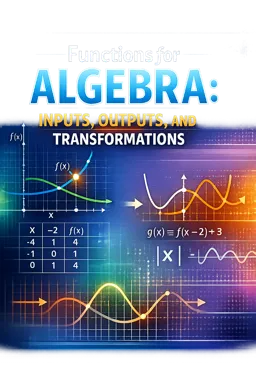
A function can be described by a formula (a rule), a table (sample input–output pairs), and a graph (a picture of all pairs). These are not different functions—they are different representations of the same relationship. The key skill is moving between representations while keeping them consistent.
In this chapter you will practice a workflow: formula → table → graph, then the reverse: graph → likely formula type, and finally cross-checking that all representations agree on sample points.
(1) Generating a Table from a Formula Using Selected Inputs
How to choose inputs
When building a table, you pick a set of x-values that make the function’s behavior easy to see. Good choices include:
- Small integers around 0 (like −2, −1, 0, 1, 2)
- Values that make radicals or fractions simple (like 0, 1, 4, 9 for square roots)
- Values on both sides of key features (near intercepts, near a vertex, near an asymptote)
Example A: Linear formula → table
Let f(x) = 2x - 3. Choose inputs x = -2, -1, 0, 1, 2 and compute outputs.
| x | f(x)=2x−3 |
|---|---|
| −2 | −7 |
| −1 | −5 |
| 0 | −3 |
| 1 | −1 |
| 2 | 1 |
Notice the output increases by 2 each time x increases by 1. That constant change is a clue you should expect a straight-line graph.
- Listen to the audio with the screen off.
- Earn a certificate upon completion.
- Over 5000 courses for you to explore!

Download the app
Example B: Quadratic formula → table (include symmetry)
Let g(x) = (x - 1)^2 - 4. Because the expression is centered at x=1, choose x-values symmetric around 1: -1, 0, 1, 2, 3.
| x | g(x)=(x−1)^2−4 |
|---|---|
| −1 | 0 |
| 0 | −3 |
| 1 | −4 |
| 2 | −3 |
| 3 | 0 |
The outputs mirror around x=1 (same y-values at equal distances left/right). That symmetry is a strong quadratic signal.
Example C: Reciprocal-type formula → table (avoid forbidden inputs)
Let h(x) = 1/(x+2). The input x = -2 is not allowed (division by zero). Choose values on both sides of −2 to see the behavior: -4, -3, -1, 0, 2.
| x | h(x)=1/(x+2) |
|---|---|
| −4 | −1/2 |
| −3 | −1 |
| −1 | 1 |
| 0 | 1/2 |
| 2 | 1/4 |
Values jump from negative to positive across the excluded input, and outputs get close to 0 for larger |x|. That suggests a reciprocal curve with an asymptote.
Example D: Square root formula → table (use perfect squares)
Let p(x) = sqrt(x - 1). Choose inputs that make x-1 a perfect square: 1, 2, 5, 10, 17 (so x-1 is 0, 1, 4, 9, 16).
| x | p(x)=sqrt(x−1) |
|---|---|
| 1 | 0 |
| 2 | 1 |
| 5 | 2 |
| 10 | 3 |
| 17 | 4 |
This table starts at a left endpoint (here at x=1) and then increases slowly, which matches the typical square root curve.
(2) Plotting Points from a Table to Sketch a Graph
Step-by-step: table → graph
- Step 1: Draw axes and choose a scale that fits your table values.
- Step 2: Plot each ordered pair
(x, y)from the table. - Step 3: Decide whether to connect points with a line or a smooth curve. (Most algebraic functions are continuous on allowed intervals, so you sketch a smooth curve through the points.)
- Step 4: Extend the sketch using the pattern you see (constant change, symmetry, approaching an axis, starting at an endpoint, etc.).
Sketching cues by function type
- Linear: points lie on a straight line; extend in both directions.
- Quadratic: points form a U-shape (or upside-down U); use symmetry about a vertical line through the vertex.
- Reciprocal-type: points form two branches separated by a vertical asymptote; do not connect across the excluded x-value.
- Square root: curve begins at an endpoint and continues to the right (for typical
sqrt(x-a)forms).
Mini-activity: plot and describe
Use the table for g(x)=(x-1)^2-4 above.
- Plot the five points.
- Identify the lowest point from the table and mark it as the vertex.
- Use symmetry: the points at x=0 and x=2 have the same y-value; x=−1 and x=3 match too. Sketch a smooth parabola through them.
(3) Recognizing a Formula Type from a Graph’s General Shape
Often you see a graph first and need to decide what kind of formula could produce it. You are not guessing randomly—you use visible features like straightness, curvature, symmetry, intercepts, and how fast y grows.
Shape guide: what to look for
| Graph shape | Key visual features | Common formula family |
|---|---|---|
| Line | Constant slope; no bending | y = mx + b |
| Parabola | U-shape; symmetric about a vertical line; has a vertex | y = a(x-h)^2 + k or y=ax^2+bx+c |
| Reciprocal curve | Two branches; approaches axes or lines; breaks at a vertical asymptote | y = a/(x-h) + k |
| Square root curve | Starts at an endpoint; increases while flattening out | y = a*sqrt(x-h) + k |
Using intercepts, symmetry, and growth behavior
- Intercepts: Where the graph crosses the axes can help you solve for constants in a formula. For a line, the y-intercept is
b. - Symmetry: A parabola has mirror symmetry about a vertical line. If the axis of symmetry is
x=h, the formula often fits(x-h)^2. - Growth behavior: Lines grow at a constant rate; parabolas grow faster as |x| increases; square roots grow but slow down; reciprocal curves approach a value (often 0 or a horizontal shift) rather than growing without bound.
Quick identification practice (no calculations yet)
For each description, name the likely formula type:
- A graph is a straight line slanting upward left-to-right. Type: linear.
- A graph is U-shaped with a lowest point and mirror symmetry. Type: quadratic.
- A graph has two separate branches and never touches a vertical line at
x=-2. Type: reciprocal-type. - A graph begins at a point and exists only to the right of that point, rising slowly. Type: square root.
(4) Checking Consistency Across Representations by Verifying Sample Points
When you have a formula, a table, and a graph, they must agree on the same ordered pairs. Consistency checks prevent common errors like plotting a point incorrectly, using the wrong scale, or misreading a graph.
Step-by-step: consistency check
- Step 1: Pick 2–4 x-values (including an easy one like 0 if allowed).
- Step 2: Compute y from the formula.
- Step 3: Confirm the table contains the same pair (or add it).
- Step 4: On the graph, locate the x-value and see whether the plotted curve passes through the matching y-value.
Example: verify across all three
Suppose you are told a graph and table represent f(x)=2x-3. Verify two points:
- At
x=0, the formula givesf(0)=-3. The table should include(0,-3), and the graph should cross the y-axis at −3. - At
x=2, the formula givesf(2)=1. The table should include(2,1), and the graph should pass through that point.
If either point does not match, at least one representation is wrong or belongs to a different function.
Guided Matching Activities (Formula ↔ Table ↔ Graph)
Activity 1: Match by intercepts and constant change (linear)
Formulas:
- A:
y = 3x + 1 - B:
y = -3x + 1 - C:
y = 3x - 1
Tables:
| Table | x | y |
|---|---|---|
| 1 | −1, 0, 1 | −2, 1, 4 |
| 2 | −1, 0, 1 | 2, −1, −4 |
| 3 | −1, 0, 1 | −4, −1, 2 |
Graph descriptions:
- Graph I: line rising left-to-right, crosses y-axis at 1
- Graph II: line falling left-to-right, crosses y-axis at 1
- Graph III: line rising left-to-right, crosses y-axis at −1
Tasks:
- Match each formula to a table by checking the y-value when
x=0(the y-intercept) and the change in y when x increases by 1 (the slope). - Then match each formula to a graph description using slope direction (rising/falling) and y-intercept.
Reasoning hints: In each table, compare y-values from x=−1 to 0 to 1. If y increases by 3 each step, slope is 3; if it decreases by 3, slope is −3. The y-value at x=0 is the intercept.
Activity 2: Match by symmetry and vertex (quadratic)
Formulas:
- A:
y = (x+1)^2 - 4 - B:
y = (x-2)^2 + 1 - C:
y = - (x-1)^2 + 3
Tables:
| Table | Selected points |
|---|---|
| 1 | (−1,−4), (0,−3), (−2,−3), (1,0), (−3,0) |
| 2 | (2,1), (1,2), (3,2), (0,5), (4,5) |
| 3 | (1,3), (0,2), (2,2), (−1,−1), (3,−1) |
Graph descriptions:
- Graph I: opens upward, vertex at (−1, −4)
- Graph II: opens upward, vertex at (2, 1)
- Graph III: opens downward, vertex at (1, 3)
Tasks:
- Match each formula to a graph description by reading the vertex from the form
(x-h)^2+kand noting whether it opens up (a>0) or down (a<0). - Match each formula to a table by locating the vertex point and checking symmetry: points equally spaced from the axis of symmetry should have equal y-values.
Reasoning hints: For (x-h)^2+k, the axis of symmetry is x=h. For example, if h=-1, then x=0 and x=−2 should share the same y-value.
Activity 3: Match by asymptote behavior (reciprocal-type)
Formulas:
- A:
y = 1/(x-1) - B:
y = 1/(x+2) - C:
y = -1/(x-1)
Tables:
| Table | Selected points |
|---|---|
| 1 | (0,−1), (2,1), (3,1/2) |
| 2 | (−3,−1), (−1,1), (0,1/2) |
| 3 | (0,1), (2,−1), (3,−1/2) |
Graph descriptions:
- Graph I: vertical asymptote at x=1; branch in quadrant I for x>1 and in quadrant III for x<1
- Graph II: vertical asymptote at x=−2; values positive just to the right of −2 and negative just to the left
- Graph III: vertical asymptote at x=1; branch in quadrant IV for x>1 and in quadrant II for x<1
Tasks:
- Match each formula to a graph description by identifying the vertical asymptote (
x=1orx=-2) and the sign pattern (whether the branches flip due to a negative sign). - Match each formula to a table by checking which x-value is missing (the asymptote) and whether outputs are positive/negative on each side.
Reasoning hints: For 1/(x-h), the vertical asymptote is x=h. Multiplying by −1 reflects the graph across the x-axis, swapping positive and negative y-values.
Activity 4: Match by endpoint and slow growth (square root)
Formulas:
- A:
y = sqrt(x) - B:
y = sqrt(x-4) - C:
y = 2*sqrt(x)
Tables:
| Table | Selected points |
|---|---|
| 1 | (0,0), (1,1), (4,2), (9,3) |
| 2 | (4,0), (5,1), (8,2), (13,3) |
| 3 | (0,0), (1,2), (4,4), (9,6) |
Graph descriptions:
- Graph I: starts at (0,0) and rises; passes through (4,2)
- Graph II: starts at (4,0) and rises; same shape as Graph I but shifted right
- Graph III: starts at (0,0) and rises more steeply than Graph I
Tasks:
- Match each formula to a graph description using the starting point (endpoint) and steepness.
- Match each formula to a table by checking which x-value gives y=0 (the endpoint) and comparing outputs at the same x-values (vertical stretch).
Reasoning hints: sqrt(x-4) begins at x=4. Multiplying by 2 doubles all y-values, making the curve steeper while keeping the same endpoint.
Mixed Practice: Build One Representation from Another
From formula to table to graph (practice set)
- 1)
y = -2x + 4: make a table for x=0,1,2,3; plot and sketch. - 2)
y = (x+2)^2: choose x-values symmetric around −2; make a table; sketch using symmetry. - 3)
y = 1/(x-3): choose x-values on both sides of 3 (but not 3); make a table; sketch two branches. - 4)
y = sqrt(x+1): choose x so x+1 is a perfect square; make a table; sketch starting at the endpoint.
From graph features to a likely formula family (practice prompts)
- A graph crosses the y-axis at 5 and decreases 2 units in y for every 1 unit increase in x. Identify the family and a possible formula.
- A graph is symmetric about x=−3 and has a minimum at (−3, 2). Identify the family and a possible formula in vertex form.
- A graph has a vertical asymptote at x=4 and approaches y=0 for large |x|. Identify the family and a possible formula.
- A graph begins at (−2, 0) and increases slowly to the right. Identify the family and a possible formula.
Consistency check drill
For each situation, decide whether the representations could describe the same function. If not, identify what conflicts.
- 1) Formula
y=3x+2, table includes (0,2) and (1,6), graph crosses y-axis at 2. (Check the point at x=1.) - 2) Formula
y=(x-1)^2, table includes (0,1), (1,0), (2,1), graph shows a vertex at (1,0). (Check symmetry.) - 3) Formula
y=1/(x+1), table includes (−1,0). (Check whether x=−1 is allowed.) - 4) Formula
y=sqrt(x-9), graph shows the curve starting at (0,0). (Check the endpoint.)