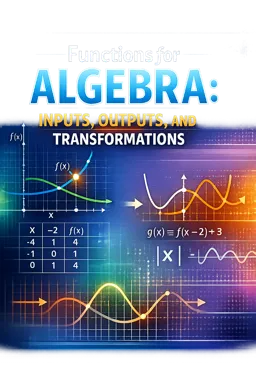
What a Function Is: One Input, Exactly One Output
A function is a rule (or process) that assigns each input to exactly one output. You can think of it like a machine: you put something in, and the machine produces one result.
We often name a function with a letter such as f. If the input is x, the output is written as f(x), read “f of x.” This notation emphasizes the input–output idea: x goes in, f(x) comes out.
Function Notation as an Input–Output Statement
xis the input.f(x)is the output produced by the rule.- The statement
f(3) = 10means: “When the input is 3, the output is 10.”
Example (verbal rule): “Take the input, double it, then add 1.” If the function is named f, then f(x) = 2x + 1. For input 4: f(4) = 2(4) + 1 = 9.
(1) Key Vocabulary
- Input: the value you choose to put into the function (often
x). - Output: the value the function produces from that input (often
yorf(x)). - Independent variable: the input variable; it can vary freely (commonly
x). - Dependent variable: the output variable; it depends on the input (commonly
yorf(x)). - Domain: the set of allowed inputs.
- Range: the set of possible outputs.
In many algebra settings, you will see y = f(x). This means y is the output of the function f when the input is x.
Function Notation and Mapping Diagrams
A mapping diagram shows inputs pointing to outputs. Each input must point to exactly one output for the relationship to be a function.
- Listen to the audio with the screen off.
- Earn a certificate upon completion.
- Over 5000 courses for you to explore!

Download the app
Inputs (x)        Outputs (f(x))
  1   --------->      3
  2   --------->      5
  3   --------->      7
This diagram represents the rule f(x) = 2x + 1 for inputs 1, 2, and 3.
(2) Multiple Representations of the Same Function
The same function can be represented in different ways: a verbal rule, an equation, a table, or a mapping diagram. Being able to move between these representations is a key algebra skill.
Example Function: “Square the input, then subtract 1”
Verbal rule: “Square the input, then subtract 1.”
Equation (function notation): f(x) = x^2 - 1
Table:
| Input x | Output f(x) = x^2 − 1 |
|---|---|
| -2 | 3 |
| -1 | 0 |
| 0 | -1 |
| 1 | 0 |
| 2 | 3 |
Mapping idea (for selected inputs):
-2 -> 3
-1 -> 0
 0 -> -1
 1 -> 0
 2 -> 3
Step-by-Step: Evaluating a Function Value
To find an output like f(5) when f(x) = x^2 - 1:
- Replace
xwith 5:f(5) = 5^2 - 1 - Compute:
f(5) = 25 - 1 = 24
To find f(-3):
- Substitute:
f(-3) = (-3)^2 - 1 - Square first:
(-3)^2 = 9 - Finish:
f(-3) = 9 - 1 = 8
(3) Deciding Whether a Relationship Is a Function
The rule “each input has exactly one output” is the test. A relationship is not a function if any single input is paired with two or more different outputs.
Example A: x → x² (This IS a function)
Rule: input x, output x^2.
- If
x = 2, output is4. - If
x = -2, output is also4.
It is okay for different inputs to share the same output. What matters is that each single input produces only one output.
Example B: x → ±√x (This is NOT a function)
Rule: input x, output is “plus or minus the square root of x.”
Try input x = 9:
+√9 = 3-√9 = -3
The same input 9 leads to two outputs (3 and −3), so this relationship is not a function.
Real-World Style Checks
- Person → birthdate: function (each person has exactly one birthdate).
- Birthdate → person: not a function (many people can share the same birthdate).
- Student → student ID number: function (each student has one ID).
- Student → phone number: may not be a function (a student could have multiple phone numbers, or none).
Table Check: Is It a Function?
A table represents a function if no input value appears with two different outputs.
| x | y |
|---|---|
| 1 | 4 |
| 2 | 5 |
| 2 | 7 |
This is not a function because the input 2 maps to both 5 and 7.
(4) Guided Practice: Translating Between Words and Notation
A. Words → Function Notation
1) Verbal rule: “Add 6 to the input.”
- Let the input be
x. - Output is
x + 6. - Function:
f(x) = x + 6
2) Verbal rule: “Multiply the input by 3, then subtract 2.”
- Multiply by 3:
3x - Subtract 2:
3x - 2 - Function:
g(x) = 3x - 2
3) Verbal rule: “Take half the input, then square the result.”
- Half the input:
x/2 - Square:
(x/2)^2 - Function:
h(x) = (x/2)^2
B. Function Notation → Words
1) Expression: f(x) = x^2 + 5
- Words: “Square the input, then add 5.”
2) Expression: p(x) = 4 - x
- Words: “Start with 4, then subtract the input.”
3) Expression: m(t) = 2t + 10
- Words: “Multiply the input by 2, then add 10.”
C. Using f(x) Statements to Describe Inputs and Outputs
Suppose f(x) = 2x - 3.
f(0) = 2(0) - 3 = -3(input 0 gives output −3)f(4) = 2(4) - 3 = 5(input 4 gives output 5)- If
f(x) = 9, then solve2x - 3 = 9to find the input:2x = 12, sox = 6. That meansf(6) = 9.
Check for Understanding
- In the statement
f(7) = 20, identify the input and the output. - Let
g(x) = x^2 - 4. Findg(3)andg(-3). - Write a function in notation for the rule: “Subtract 8 from the input, then multiply by 5.”
- Decide whether the relationship is a function: “Input
xmaps to output±x.” Explain using the one-input/one-output rule. - A table shows pairs
(1, 2),(2, 2),(3, 5),(2, 2). Is it a function? Why? - Translate into words:
h(x) = (x + 1)/3. - If
f(x) = 4x + 1, write an equation you would solve to find the input that produces output 29.