
Singular homology is the homology of a chain complex generated by continuous maps from standard simplices into a topological space.

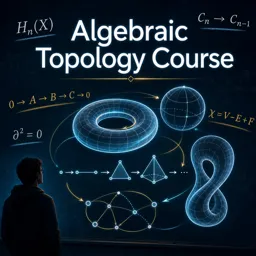
Duration of the online course: 24 hours and 16 minutes
5

(1)
Build a deeper intuition for shapes using singular homology. Join this free online course and learn key tools for proofs, computations, and math study.
Algebraic topology is where geometry meets algebra: you translate the features of spaces into algebraic objects that can be computed and compared. This free online course guides you through that translation with singular homology as the central tool, helping you move from pictures and intuition to rigorous, reusable methods. If you want a clearer way to distinguish spaces, detect holes, and understand when two shapes are essentially the same, this course gives you the framework to do it with confidence.
You start by building the language of singular homology from the ground up, including the role of simplices and the chain-level viewpoint that turns continuous problems into algebra. From there, the course develops relative homology so you can analyze a space together with a subspace, a perspective that becomes indispensable in real computations and in proofs that compare constructions. Along the way, you learn why axioms matter: the Eilenberg-Steenrod approach shows which properties characterize a homology theory and how these properties unlock results such as the homology of spheres and functorial behavior under maps.
A major theme is learning to navigate the machinery that makes homology powerful rather than mysterious. You work with induced maps, exactness, and core homological tools such as the snake lemma and the 5-lemma, gaining the ability to pass information through diagrams and conclude isomorphisms when direct computation would be difficult. Key structural principles like homotopy invariance clarify which features of a space are truly topological, while excision and the small simplices perspective explain why local modifications often do not change homology, paving the way for practical decompositions.
As your understanding matures, the course emphasizes computational strategy and conceptual connections. Degree zero homology provides a crisp algebraic lens on connectedness, while the Hurewicz viewpoint links homology with more geometric invariants and offers intuition for what homology is measuring. You also meet the triple sequence and see how relative homology can be reframed as absolute homology in suitable settings, improving flexibility when you tackle examples.
To tie everything together, Mayer-Vietoris becomes a central method: it shows how to compute the homology of a complicated space from simpler overlapping pieces, including versions suited to pushouts. By the end, you will be better equipped to read and write proofs in algebraic topology, understand standard theorems in a principled way, and approach new spaces with a reliable toolbox for breaking them apart and extracting invariant information.

24 hours and 16 minutes of online video course

Digital certificate of course completion (Free)

Exercises to train your knowledge

100% free, from content to certificate
How is singular homology defined using singular simplices?
Singular homology is the homology of a chain complex generated by continuous maps from standard simplices into a topological space.
What is the homology of the circle S¹?
With integer coefficients, H₀(S¹) ≅ ℤ, H₁(S¹) ≅ ℤ, and Hₙ(S¹) = 0 for n > 1.
What is the Mayer-Vietoris sequence used for in algebraic topology?
It computes the homology of a space from two overlapping subspaces and the homology of their intersection.
Ready to get started?Download the app and get started today.
Install the app now
to access the course
Over 5,000 free courses
Programming, English, Digital Marketing and much more! Learn whatever you want, for free.

Study plan with AI
Our app's Artificial Intelligence can create a study schedule for the course you choose.

From zero to professional success
Improve your resume with our free Certificate and then use our Artificial Intelligence to find your dream job.
You can also use the QR Code or the links below.



Free CourseBasics of Algebra
5
(9)

37m

5 exercises
Free CourseAlgebra Introduction
5
(5)
1h18m
6 exercises
Free CourseLinear Algebra Course
5
(3)
10h49m
46 exercises
Free CourseLinear algebra
4.9
(121)
27h55m
35 exercises
Free CourseAlgebra
4.8
(57)
3h18m
25 exercises
Free CourseIntermediate Algebra
4.8
(23)
54h38m
43 exercises
Free CoursePrealgebra
3.6

(56)
38h54m
44 exercises
Free CourseAdvanced Algebra Lessons
1
(1)
4h42m
12 exercises
Free CourseMath Fundamentals Algebra
New
2h09m
14 exercises
Free CourseAdvanced Linear Algebra
New
23h01m
30 exercises
Carry knowledge in your pocket.
Download the Cursa app.
There are hundreds of free courses available, with a free certificate of completion that is saved in your mobile image gallery.
Download the app to access the Course Completion Certificate for Free.


+ 10 million
students

Free and Valid
Certificate

60 thousand free
exercises

4.8/5 rating in
app stores

Free courses in
video and ebooks
Course comments: Algebraic Topology Course
Venkata sree Rama murty maddula
if u add the applications of it in classical and quantum computing very helpful