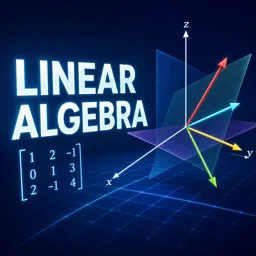
Free Course Image Linear Algebra Course

Free online courseLinear Algebra Course

Duration of the online course: 10 hours and 49 minutes

5

StarStarStarStarStar

(2)

Build confidence with linear algebra—solve systems, master matrices and eigenvalues in a free online course with practice and a certificate option.

In this free course, learn about

  • Model and solve linear systems; interpret consistent vs inconsistent cases
  • Apply elementary row operations; compute echelon and reduced row echelon forms
  • Describe solution sets using pivots and free variables; parametric vector form
  • Use vector equations and linear combinations to represent and solve Ax=b
  • Handle homogeneous and non-homogeneous systems; general solution structure
  • Set up linear systems for applications: input-output economics and network flows
  • Test linear independence; relate independence, span, basis, and dimension
  • Perform matrix operations (add, scale, multiply, transpose) and track dimensions
  • Understand invertible matrices; compute inverses and use the Invertible Matrix Theorem
  • Compute determinants (cofactor expansion) and use determinant properties
  • Work with vector spaces and subspaces; null space, column space, row space, rank
  • Find and interpret eigenvalues/eigenvectors via the characteristic equation
  • Use inner products: length, distance, orthogonality, projections, decompositions
  • Solve least-squares problems; interpret projections and best approximations

Course Description

Linear algebra is one of the fastest ways to level up your problem-solving skills in school math and unlock tools used in science, engineering, data analysis, and economics. In this free online course, you will learn to think in a clear, structured way about vectors and matrices, turning complicated-looking problems into step-by-step procedures you can actually trust.

You will start by making sense of systems of linear equations and the logic behind row operations. Instead of memorizing tricks, you will understand what each transformation does to a system, how augmented matrices encode information, and how echelon forms reveal whether a system has one solution, infinitely many, or no solution at all. Along the way, you will get comfortable interpreting solution sets, identifying free variables, and connecting algebraic steps to meaning.

As the course progresses, you will move naturally from equations to vector thinking: expressing relationships as vector equations, building linear combinations, and using the matrix equation Ax=b to model real situations. This foundation leads into core matrix operations, invertibility, and the practical reasons inverses matter when solving problems efficiently. Determinants and their properties add another powerful lens, giving you reliable tests and insights about matrices beyond simple computation.

You will also develop a deeper conceptual understanding through vector spaces, subspaces, bases, dimension, rank, and the relationships among row space, column space, and null space. These ideas bring structure to what can feel like scattered techniques, helping you recognize patterns and choose methods with confidence. Later topics such as eigenvalues and eigenvectors, inner products, orthogonality, projections, and least squares show how linear algebra supports geometry, optimization, and best-fit modeling.

With embedded practice questions, you can check your understanding as you go and build the habits needed for exams and further study. By the end, you will not only perform calculations—you will understand what they mean and when to use them, leaving you better prepared for advanced mathematics and real-world applications.

Course content

  • Video class: Linear Algebra 1.1.1 Systems of Linear Equations 18m
  • Exercise: In linear algebra, when solving a system of linear equations using an augmented matrix, which operation is NOT an acceptable elementary row operation?
  • Video class: Linear Algebra 1.1.2 Solve Systems of Linear Equations in Augmented Matrices Using Row Operations 23m
  • Exercise: Which of the following row operations is correctly applied to transform a given matrix?
  • Video class: Linear Algebra 1.2.1 Row Reduction and Echelon Forms 17m
  • Exercise: What is the key difference between a matrix in echelon form and one in reduced row echelon form?
  • Video class: Linear Algebra 1.2.2 Solution Sets and Free Variables 14m
  • Exercise: Consider a system of linear equations represented by an augmented matrix in row-echelon form. If you find that the last row of the matrix is [0 0 0 | 5], what does this indicate about the system?
  • Video class: Linear Algebra 1.3.1 Vector Equations 12m
  • Exercise: Which of the following statements accurately describes a vector in R2?
  • Video class: Linear Algebra 1.3.2 Linear Combinations 24m
  • Exercise: What is a linear combination of vectors?
  • Video class: Linear Algebra 1.4.1 The Matrix Equation Ax=b 11m
  • Exercise: Given the matrix A with dimensions 1 by n and a vector X with dimensions n by 1, if A * X results in a vector with all entries zero, what can be said about the vector X?
  • Video class: Linear Algebra 1.4.2 Computation of Ax 09m
  • Exercise: What is the result of multiplying matrix A = [[2, 1], [-4, 2]] by vector X = [3, -1] using the row vector rule for computing AX?
  • Video class: Linear Algebra 1.5.1 Homogeneous System Solutions 17m
  • Exercise: What does it mean for a solution to be non-trivial in a homogeneous system of linear equations?
  • Video class: Linear Algebra 1.5.2 Non-Homogeneous System Solutions 11m
  • Exercise: In the context of linear algebra, what does the general solution to a non-homogeneous system of equations in the form Ax = B typically involve?
  • Video class: Linear Algebra 1.6.1 Applications of Linear Systems - Economic Sectors 06m
  • Exercise: In a simplified economy with two sectors, goods and services, suppose goods sell 80% of their output to services, and services sell 70% of their output to goods. Using linear systems to find equilibrium, how would the income be matched to expenditures?
  • Video class: Linear Algebra 1.6.2 Applications of Linear Systems - Network Flow 08m
  • Exercise: In a network flow system, the balance equations for nodes indicate the relationship between incoming and outgoing flows. Given a network where the inflows and outflows are described by the following equations: 1. x1 + x3 = 20 2. x2 - x3 - x4 = 0 3. x1 + x2 = 80 4. x4 = 60 What is the correct expression for the flow pattern for x2 in terms of x3?
  • Video class: Linear Algebra 1.7.1 Linear Independence 11m
  • Exercise: A set of vectors \( \{\mathbf{v_1}, \mathbf{v_2}, \mathbf{v_3}\} \) is given. Which condition will guarantee that the set is linearly independent?
  • Video class: Linear Algebra 1.7.2 Special Ways to Determine Linear Independence 08m
  • Exercise: Which of the following statements is true regarding a set of vectors and linear independence?
  • Video class: Linear Algebra 1.8.1 Matrix Transformations 13m
  • Exercise: In the context of matrix transformations, which of the following statements is true?
  • Video class: Linear Algebra 1.8.2 Introduction to Linear Transformations 09m
  • Exercise: What is the geometric interpretation of a linear transformation represented by the matrix A = [0 -1; 1 0] when applied to vectors in R²?
  • Video class: Linear Algebra 2.1.1 Matrix Operations - Sums and Scalar Multiples 13m
  • Exercise: Which of the following describes a square matrix?
  • Video class: Linear Algebra 2.1.2 Matrix Operations - Multiplication and Transpose 28m
  • Exercise: Given two matrices A and B, with A being a 3x4 matrix and B being a 4x2 matrix, what is the size of the resulting matrix after multiplying A by B?
  • Video class: Linear Algebra 2.2.1 The Inverse of a Matrix 14m
  • Exercise: Which of the following statements is true regarding the inverse of a 2x2 matrix?
  • Video class: Linear Algebra 2.2.2 Solving 2x2 Systems with the Inverse and Inverse Properties 14m
  • Exercise: If A is an invertible matrix, what can be said about the inverse of its transpose?
  • Video class: Linear Algebra 2.2.3 Elementary Matrices And An Algorithm for Finding A Inverse 30m
  • Exercise: What is the defining property of an identity matrix in regard to matrix multiplication?
  • Video class: Linear Algebra 2.3.1 Characterizations of Invertible Matrices 06m
  • Exercise: Which of the following is a characterization of an invertible matrix according to the invertible matrix theorem?
  • Video class: Linear Algebra 3.1.1 Introduction to Determinants 12m
  • Exercise: What is the determinant of the 3x3 matrix A given below using the cofactor expansion method? Matrix A: 2 3 1 0 5 -2 4 1 0
  • Video class: Linear Algebra 3.1.2 Co-factor Expansion 16m
  • Exercise: What does the method of cofactor expansion allow you to do when calculating the determinant of a matrix?
  • Video class: Linear Algebra 3.2.1 Properties of Determinants 25m
  • Exercise: If a 2x2 matrix A has a determinant of 6 and a scalar multiplication by 3 is applied to the matrix, resulting in a new matrix 3A, what will be the determinant of matrix 3A?
  • Video class: Linear Algebra 4.1.1 Vector Spaces 18m
  • Exercise: Consider a set of vectors in a space with defined operations of addition and scalar multiplication. Which of the following conditions does NOT need to be verified to determine if the space is a vector space?
  • Video class: Linear Algebra 4.1.2 Subspace of a Vector Space 17m
  • Exercise: Which of the following statements must be true for a subset H of a vector space V to be considered a subspace of V?
  • Video class: Linear Algebra 4.2.1 Null Spaces 16m
  • Exercise: What is the null space of an M by N matrix A?
  • Video class: Linear Algebra 4.2.2 Column Spaces 19m
  • Exercise: Which statement is true regarding the column space of a matrix A?
  • Video class: Linear Algebra 4.3.1 Linearly Independent Sets and Bases 15m
  • Exercise: Which of the following is true about a linearly independent set of vectors in a vector space?
  • Video class: Linear Algebra 4.3.2 The Spanning Set Theorem 18m
  • Exercise: Which of the following statements about the spanning set theorem is true?
  • Video class: Linear Algebra 4.5.1 The Dimension of a Vector Space 09m
  • Exercise: Consider a vector space V that is spanned by the vectors [2, 3, 1], [4, 6, 2], and [1, -1, 0]. Determine the dimension of the vector space V.
  • Video class: Linear Algebra 4.5.2 Subspaces of a Finite Dimensional Space 09m
  • Exercise: Given a finite-dimensional vector space V with a subspace H, which of the following statements is true according to the theorem about subspaces?
  • Video class: Linear Algebra 4.6.1 The Row Space 12m
  • Exercise: Which of the following statements correctly describes the row space of a matrix A?
  • Video class: Linear Algebra 4.6.2 Rank 05m
  • Exercise: Consider a 6 by 8 matrix A. If the null space of A has a dimension of 2, what is the rank of A?
  • Video class: Linear Algebra 5.1.1 Eigenvectors and Eigenvalues 19m
  • Exercise: If a square matrix A has eigenvalue λ = 4, and a corresponding eigenvector is X = [2, -1], which of the following is true for matrix A when multiplied by X?
  • Video class: Linear Algebra 5.1.2 More About Eigenvectors and Eigenvalues 09m
  • Exercise: What does the theorem state about eigenvectors corresponding to distinct eigenvalues?
  • Video class: Linear Algebra 5.2.1 Determinants and the IMT 09m
  • Exercise: Given a 2x2 matrix A, if the eigenvalues of A are 3 and 5, what would be the determinant of A?
  • Video class: Linear Algebra 5.2.2 The Characteristic Equation 08m
  • Exercise: Given a 4x4 matrix A, the determinant of (A - λI) is expanded into the characteristic polynomial λ^4 - 10λ^3 + 35λ^2 - 50λ + 24. What are the eigenvalues of the matrix A?
  • Video class: Linear Algebra 6.1.1 Inner Product, Vector Length and Distance 12m
  • Exercise: If the vector U is (5, -2, 3) and the vector V is (1, 4, 0), what is the dot product of U and V?
  • Video class: Linear Algebra 6.1.2 Orthogonal Vectors 07m
  • Exercise: Which calculation demonstrates that two vectors are orthogonal?
  • Video class: Linear Algebra 6.2.1 Orthogonal Sets 13m
  • Exercise: What determines if a set of vectors is orthogonal?
  • Video class: Linear Algebra 6.2.2 Orthogonal Projections 08m
  • Exercise: What does the orthogonal projection of a vector Y onto a vector U represent in geometric terms?
  • Video class: Linear Algebra 6.3.1 Orthogonal Decomposition Theorem 07m
  • Exercise: According to the orthogonal decomposition theorem, how can any vector Y be expressed in terms of vectors from a subspace W and its orthogonal complement W perp?
  • Video class: Linear Algebra 6.3.2 The Best Approximation Theorem 11m
  • Exercise: What does the Best Approximation Theorem state about the relationship between a vector Y in R^n and its projection Y hat onto a subspace W?
  • Video class: Linear Algebra 6.5.1 Least Squares Problems 18m
  • Exercise: In the context of the least squares method in linear algebra, if matrix A is inconsistent with vector B for the equation Ax = B, what does the vector B-hat represent?

This free course includes:

10 hours and 49 minutes of online video course

Digital certificate of course completion (Free)

Exercises to train your knowledge

100% free, from content to certificate

Ready to get started?Download the app and get started today.

Install the app now

to access the course
Icon representing technology and business courses

Over 5,000 free courses

Programming, English, Digital Marketing and much more! Learn whatever you want, for free.

Calendar icon with target representing study planning

Study plan with AI

Our app's Artificial Intelligence can create a study schedule for the course you choose.

Professional icon representing career and business

From zero to professional success

Improve your resume with our free Certificate and then use our Artificial Intelligence to find your dream job.

You can also use the QR Code or the links below.

QR Code - Download Cursa - Online Courses

More free courses at Algebra

Free Ebook + Audiobooks! Learn by listening or reading!

Download the App now to have access to + 5000 free courses, exercises, certificates and lots of content without paying anything!

  • 100% free online courses from start to finish

    Thousands of online courses in video, ebooks and audiobooks.

  • More than 60 thousand free exercises

    To test your knowledge during online courses

  • Valid free Digital Certificate with QR Code

    Generated directly from your cell phone's photo gallery and sent to your email

Cursa app on the ebook screen, the video course screen and the course exercises screen, plus the course completion certificate