Row-reduce the augmented matrix: a pivot in every variable gives one solution, a contradictory row gives none, and free variables give infinitely many solutions.

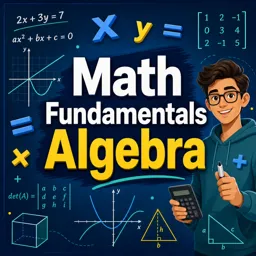
Duration of the online course: 2 hours and 9 minutes
New
Strengthen algebra skills with a free online course: equations, matrices, determinants and Gauss method, plus exercises to practice and improve fast.
Build a solid algebra foundation and gain confidence solving problems step by step in this free online course focused on the essentials you need for school, exams, and future STEM studies. Whether you feel stuck with equations or want to understand what is really happening behind common procedures, this training helps you move from memorizing rules to reasoning clearly and checking your results with certainty.
You will start by sharpening your handling of algebraic equations, including quadratic equations and the meaning of the discriminant when analyzing the number and type of solutions. From there, you will develop a clear approach to linear equations, learning how to transform them into equivalent forms without changing their solution set. This ability becomes crucial when you move from single equations to systems, where identifying the nature of solutions matters as much as calculating them.
Next, you will work with structured techniques for solving linear systems, especially the Gauss method, including situations with parameters where solutions can change depending on given values. This is a practical skill that supports problem solving across science, economics, and technology. You will then connect these ideas to matrices: what they are, how to operate with them correctly, what makes a matrix regular or invertible, and how matrix equations are formulated and solved in a consistent way.
As you progress, determinants and rank provide the tools to understand when a system has a unique solution, infinitely many, or none, and why. You will also explore inverse matrices, adjoints, and Cramer’s rule, gaining an intuitive view of what conditions guarantee solvability in matrix form. Throughout the course, the included exercises reinforce learning by prompting you to interpret results, avoid common mistakes, and strengthen mathematical maturity.

2 hours and 9 minutes of online video course

Digital certificate of course completion (Free)

Exercises to train your knowledge

100% free, from content to certificate
How does the Gauss method determine whether a linear system has one, none, or infinitely many solutions?
Row-reduce the augmented matrix: a pivot in every variable gives one solution, a contradictory row gives none, and free variables give infinitely many solutions.
What does a negative discriminant mean in a quadratic equation?
For real coefficients, a negative discriminant means the quadratic has no real roots; it has two complex conjugate roots.
When can Cramer's rule be used to solve a system of equations?
It can be used for a square system when the determinant of the coefficient matrix is nonzero, ensuring a unique solution.
Ready to get started?Download the app and get started today.
Install the app now
to access the course
Over 5,000 free courses
Programming, English, Digital Marketing and much more! Learn whatever you want, for free.

Study plan with AI
Our app's Artificial Intelligence can create a study schedule for the course you choose.

From zero to professional success
Improve your resume with our free Certificate and then use our Artificial Intelligence to find your dream job.
You can also use the QR Code or the links below.



Free CourseBasics of Algebra
5

(9)

37m

5 exercises
Free CourseAlgebra Introduction
5
(5)
1h18m
6 exercises

Free CourseLinear Algebra Course
5
(2)
10h49m
46 exercises
Free CourseAlgebraic Topology Course
5
(1)
24h16m
46 exercises
Free CourseLinear algebra
4.9
(121)
27h55m
35 exercises
Free CourseAlgebra
4.8
(57)
3h18m
25 exercises
Free CourseIntermediate Algebra
4.8
(23)
54h38m
43 exercises
Free CoursePrealgebra
3.6

(56)
38h54m
44 exercises
Free CourseLinear Algebra Essentials
New
3h00m
16 exercises
Free CourseUndergraduate Linear Algebra Full Course
New
29h54m
34 exercises
Carry knowledge in your pocket.
Download the Cursa app.
There are hundreds of free courses available, with a free certificate of completion that is saved in your mobile image gallery.
Download the app to access the Course Completion Certificate for Free.


+ 10 million
students

Free and Valid
Certificate

60 thousand free
exercises

4.8/5 rating in
app stores

Free courses in
video and ebooks