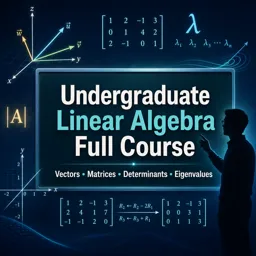
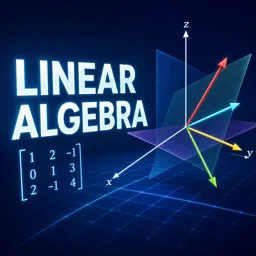
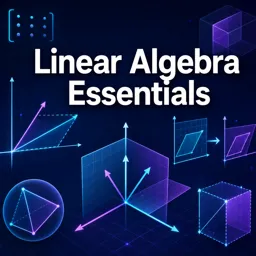
Free Course Image Undergraduate Linear Algebra Full Course

Free online courseUndergraduate Linear Algebra Full Course

Duration of the online course: 29 hours and 54 minutes

New

Master vectors, matrices, and eigenvalues with a free online linear algebra course, practice exercises included, and boost math skills for STEM study.

In this free course, learn about

  • Vector arithmetic in R^n: addition, scalar mult., direction, and geometric interpretation
  • Dot product: formula, angles, orthogonality, and projections of one vector onto another
  • Matrix operations: addition rules, multiplication dimensions, and limits of cancellation
  • Solving linear systems via Gaussian elimination, pivots, and classifying solution sets
  • Gauss-Jordan elimination to reach RREF; detecting inconsistency from RREF form
  • Equivalent systems, rank, and row space; testing membership in the row space
  • Computing inverses of n×n matrices using row reduction on [A | I]
  • Determinants: computation, row-operation effects, and det(AB)=det(A)det(B) properties
  • Eigenvalues/eigenvectors: finding eigenvalues and conditions that ensure diagonalizability
  • Vector spaces and subspaces: axioms, subspace test, and examples like polynomial spaces
  • Span, linear independence, and building bases; simplifying spanning sets via row reduction
  • Coordinates in a basis and transition matrices for changing coordinates between bases
  • Linear transformations: definition, matrix representation in given bases, and change of basis
  • Dimension theorem (rank-nullity) and isomorphisms; criteria for injectivity (one-to-one)

Course Description

Linear algebra is the language behind data science, engineering, physics, computer graphics, economics, and countless modern technologies. This free online course helps you build real fluency in that language, moving step by step from the geometric intuition of vectors to the powerful abstraction of vector spaces and linear transformations. Instead of memorizing disconnected rules, you will learn how the ideas fit together so you can recognize patterns, choose the right method, and explain your reasoning with confidence.

You will start by developing a solid foundation with vector operations and the dot product, including projections and the geometric meaning of algebraic formulas. From there, you will work with matrices as tools for organizing information and performing computations efficiently. As the course progresses, you will see how matrix multiplication encodes composition, why certain properties behave differently from real-number arithmetic, and how these differences matter when solving real problems.

A key focus is solving linear systems using Gaussian elimination and reduced row echelon form, with careful attention to what each row operation does and what solution outcomes are possible. You will connect system equivalence, rank, and row space to a clearer understanding of when solutions exist and how many degrees of freedom you truly have. This prepares you to handle both computational tasks and the conceptual questions that often appear in exams.

The course also develops determinant intuition, not as a mysterious formula, but as a quantity tied to structure and invertibility, and as a practical tool alongside row reduction. From there, you will tackle eigenvalues and diagonalization, learning how to test whether a number is an eigenvalue and what conditions allow a matrix to be diagonalized, with an eye toward simplifying complex computations.

In the final stretch, the perspective widens to vector spaces, subspaces, span, linear independence, and bases, giving you a rigorous framework for understanding dimension and coordinate systems. You will learn how vectors are represented relative to different bases, how transition matrices work, and how linear transformations can be represented by matrices in chosen coordinate systems. The course culminates with the Dimension Theorem and isomorphisms, tying together kernel, image, and structure in a way that makes later math and applications far more approachable.

Throughout, exercises reinforce each concept and help you diagnose gaps early, making this a strong option for self-study, course review, or preparation for more advanced subjects. By the end, you should be able to compute accurately, reason abstractly, and interpret results in a way that makes linear algebra genuinely useful rather than purely procedural.

Course content

  • Video class: Course Introduction - Linear Algebra - Lecture 0 (of 23) 09m
  • Exercise: Which set of broad sections best matches the course outline?
  • Video class: Fundamental Operations with Vectors - Linear Algebra - Lecture 1 (of 23) 1h02m
  • Exercise: Which statement correctly defines when two vectors are in the same direction?
  • Video class: The Dot Product - Linear Algebra - Lecture 2a (of 23) 54m
  • Exercise: Which formula correctly defines the dot product of vectors x and y in R^n?
  • Video class: The Dot Product - Linear Algebra - Lecture 2b (of 23) 45m
  • Exercise: Which formula gives the projection of vector b onto a nonzero vector a in \(\mathbb{R}^n\)?
  • Video class: Fundamental Operations with Matrices - Linear Algebra - Lecture 3 (of 23) 1h17m
  • Exercise: When is the sum A + B of two matrices defined?
  • Video class: Matrix Multiplication - Linear Algebra - Lecture 4a (of 23) 58m
  • Exercise: If A is an M×N matrix and B is an N×P matrix, what are the dimensions of the product AB (assuming it is defined)?
  • Video class: Matrix Multiplication - Linear Algebra - Lecture 4b (of 23) 30m
  • Exercise: Which statement is true about the cancellation law for matrix multiplication?
  • Video class: Solving Linear Systems Using Gaussian Elimination - Linear Algebra - Lecture 5a (of 23) 1h06m
  • Exercise: Which set lists all possible sizes of the solution set for a linear system?
  • Video class: Solving Linear Systems Using Gaussian Elimination - Linear Algebra - Lecture 5b (of 23) 1h11m
  • Exercise: In Gaussian elimination, which row operation is primarily used to create zeros below a pivot?
  • Video class: Gauss-Jordan and Reduced Row Echelon Form (RREF) - Linear Algebra - Lecture 6 (of 23) 56m
  • Exercise: Which condition guarantees that a linear system has no solution when its augmented matrix is in reduced row echelon form (RREF)?
  • Video class: Equivalent Systems, Rank, and Row Space - Linear Algebra - Lecture 7a (of 23) 57m
  • Exercise: What does it mean for two systems of linear equations to be equivalent?
  • Video class: Equivalent Systems, Rank, and Row Space - Linear Algebra - Lecture 7b (of 23) 28m
  • Exercise: How can you check whether a vector x is in the row space of a matrix A?
  • Video class: Inverses of Matrices - Linear Algebra - Lecture 8 (of 23 1h09m
  • Exercise: How can you find the inverse of a general n×n matrix A (n>2) using row operations?
  • Video class: Introduction to Determinants - Linear Algebra - Lecture 9 (of 23) 57m
  • Exercise: In the 3×3 basket weaving method for determinants, which diagonals are added with a positive sign?
  • Video class: Determinants and Row Reduction - Linear Algebra - Lecture 10 (of 23) 46m
  • Exercise: How does the determinant change when two rows of a matrix are swapped?
  • Video class: Additional Properties of Determinants - Linear Algebra - Lecture 11 (of 23) 1h09m
  • Exercise: Which statement correctly describes the determinant of a product of two n×n matrices?
  • Video class: Eigenvalues 55m
  • Exercise: How can you determine whether a real number \(\lambda\) is an eigenvalue of an \(n\times n\) matrix \(A\)?
  • Video class: Eigenvalues 42m
  • Exercise: Which condition guarantees that an $n\times n$ matrix $A$ is diagonalizable?
  • Video class: Introduction of Vector Spaces - Linear Algebra - Lecture 13 (of 23) 1h08m
  • Exercise: Which condition is necessary for the set \(P_n\) to form a vector space under polynomial addition and scalar multiplication?
  • Video class: Subspaces - Linear Algebra - Lecture 14 (of 23) 58m
  • Exercise: Which condition is sufficient to prove that a non-empty subset W of a vector space V is a subspace of V (using the same operations as V)?
  • Video class: Span - Linear Algebra - Lecture 15a (of 23) 54m
  • Exercise: Which statement best defines the span of a non-empty subset S of a vector space V?
  • Video class: Span - Linear Algebra - Lecture 15b (of 23) 34m
  • Exercise: How can you find a simplified set of vectors that spans the same subspace as a finite set S ⊂ ℝⁿ?
  • Video class: Linear Independence - Linear Algebra - Lecture 16a (of 23) 54m
  • Exercise: Which condition guarantees that a finite non-empty set S = {v1, ..., vn} is linearly independent?
  • Video class: Linear Independence - Linear Algebra - Lecture 16b (of 23) 27m
  • Exercise: Which statement correctly characterizes when a (possibly infinite) subset S of a vector space V is linearly independent?
  • Video class: Basis 59m
  • Exercise: Which pair of conditions must a subset B satisfy to be a basis for a vector space V?
  • Video class: Basis 25m
  • Exercise: If S is a finite subset of a finite-dimensional vector space V and S spans V, what must be true?
  • Video class: Constructing Special Bases - Linear Algebra - Lecture 18 (of 23) 43m
  • Exercise: In the simplified span method for finding a basis of span(S), how are the vectors from S placed into the test matrix, and how is the basis read off after row reduction?
  • Video class: Coordinatization - Linear Algebra - Lecture 19a (of 23) 58m
  • Exercise: What is the coordinatization of a vector w with respect to an ordered basis B = (v1, v2, ..., vn) if w = a1v1 + a2v2 + ... + anvn?
  • Video class: Coordinatization - Linear Algebra - Lecture 19b (of 23) 36m
  • Exercise: What is the key property that defines the transition matrix from an ordered basis B to an ordered basis C?
  • Video class: Introduction to Linear Transformations - Linear Algebra - Lecture 20 (of 23) 1h06m
  • Exercise: Which pair of properties must a function f: V → W satisfy to be a linear transformation?
  • Video class: The Matrix of a Linear Transformation - Linear Algebra - Lecture 21a (of 23) 1h04m
  • Exercise: How is the matrix of a linear transformation (with respect to ordered bases B in V and C in W) constructed?
  • Video class: The Matrix of a Linear Transformation - Linear Algebra - Lecture 21b (of 23) 22m
  • Exercise: How do you compute the matrix of a linear transformation after changing bases in the domain and codomain?
  • Video class: The Dimension Theorem - Linear Algebra - Lecture 22a (of 23) 49m
  • Exercise: Which statement correctly expresses the Dimension Theorem for a linear transformation L: V → W with V finite-dimensional?
  • Video class: The Dimension Theorem - Linear Algebra - Lecture 22b (of 23) 47m
  • Video class: Isomorphism - Linear Algebra - Lecture 23 (of 23) 1h06m
  • Exercise: Which condition is sufficient to conclude a linear transformation L is one-to-one (injective)?

This free course includes:

29 hours and 54 minutes of online video course

Digital certificate of course completion (Free)

Exercises to train your knowledge

100% free, from content to certificate

Ready to get started?Download the app and get started today.

Install the app now

to access the course
Icon representing technology and business courses

Over 5,000 free courses

Programming, English, Digital Marketing and much more! Learn whatever you want, for free.

Calendar icon with target representing study planning

Study plan with AI

Our app's Artificial Intelligence can create a study schedule for the course you choose.

Professional icon representing career and business

From zero to professional success

Improve your resume with our free Certificate and then use our Artificial Intelligence to find your dream job.

You can also use the QR Code or the links below.

QR Code - Download Cursa - Online Courses

More free courses at Algebra

Free Ebook + Audiobooks! Learn by listening or reading!

Download the App now to have access to + 5000 free courses, exercises, certificates and lots of content without paying anything!

  • 100% free online courses from start to finish

    Thousands of online courses in video, ebooks and audiobooks.

  • More than 60 thousand free exercises

    To test your knowledge during online courses

  • Valid free Digital Certificate with QR Code

    Generated directly from your cell phone's photo gallery and sent to your email

Cursa app on the ebook screen, the video course screen and the course exercises screen, plus the course completion certificate