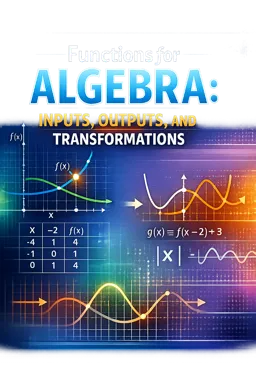
1) Vertical Shifts: f(x)+k Changes Outputs
A vertical shift changes the output of a function without changing the input. If the original function is y=f(x), then the transformed function
y = f(x) + k
adds the constant k to every output value. This moves the graph straight up if k>0 and straight down if k<0.
Effect on outputs (function values)
For any input x:
- Original output:
f(x) - New output:
f(x)+k
So the change in output is always the same: +k.
- Listen to the audio with the screen off.
- Earn a certificate upon completion.
- Over 5000 courses for you to explore!

Download the app
Effect on range
If the range of f is some set of outputs, then the range of f(x)+k is that entire set shifted by k. In interval language:
- If
range(f) = [a, b], thenrange(f+k) = [a+k, b+k]. - If
range(f) = [a, \infty), thenrange(f+k) = [a+k, \infty).
Example (range shift): Suppose a function has minimum output 2 (so its range is [2, \infty)). Then f(x)-5 has minimum output 2-5=-3, so its range becomes [-3, \infty).
Quick check with a point
If a point (x, y) is on y=f(x), then after a vertical shift by k, the new point is:
(x, y) \rightarrow (x, y+k)
2) Horizontal Shifts: f(x-h) Changes Inputs
A horizontal shift changes the input to the function. If the original function is y=f(x), then the transformed function
y = f(x-h)
replaces x with x-h. This moves the graph horizontally, but the direction can feel “backwards” because the shift is happening inside the function.
Why the graph moves opposite the sign
To see the direction, compare inputs that produce the same output. Suppose f(a)=b. In the transformed function:
f(x-h)=b happens when x-h=a, so x=a+h.
That means the output b that used to occur at input a now occurs at input a+h. So every feature moves right by h.
f(x-h)shifts the graph right byh.f(x+h)shifts the graph left byh.
Point mapping for horizontal shifts
If a point (x, y) is on y=f(x), then after a horizontal shift by h to the right (using f(x-h)), the new point is:
(x, y) \rightarrow (x+h, y)
Notice: the y-value stays the same; only the x-value changes.
3) Finding New Key Points Using Point Mapping (Instead of Re-Plotting)
When sketching a transformed graph, you often do not need to recompute lots of values. Instead, take key points from the original graph (intercepts, vertex, corners) and map them to new locations.
Core mapping rules
Start with a known point on y=f(x): (x, y).
| Transformation | New function | Point mapping |
|---|---|---|
Vertical shift up by k | y=f(x)+k | (x, y) \rightarrow (x, y+k) |
Vertical shift down by k | y=f(x)-k | (x, y) \rightarrow (x, y-k) |
Horizontal shift right by h | y=f(x-h) | (x, y) \rightarrow (x+h, y) |
Horizontal shift left by h | y=f(x+h) | (x, y) \rightarrow (x-h, y) |
Combining a horizontal and vertical shift
For y = f(x-h) + k, apply both moves:
(x, y) \rightarrow (x+h, y+k)
Step-by-step sketching method (recommended):
- Pick 3–5 key points on the original graph of
f. - Map each point using the appropriate rule(s).
- Plot the new points.
- Draw the same shape through the new points (same curvature/corners), just shifted.
Mini-example with mapping
Suppose f has known points (-1, 2), (0, 0), and (2, 3). Sketch g(x)=f(x-4)-1.
- Right 4:
xincreases by 4. - Down 1:
ydecreases by 1.
Map each point:
(-1, 2) \rightarrow (3, 1)(0, 0) \rightarrow (4, -1)(2, 3) \rightarrow (6, 2)
Plot (3,1), (4,-1), (6,2), then draw the same overall shape as f, shifted.
4) Applying Shifts Consistently Across Function Families
The notation rules do not change with the family. Whether the base function is linear, quadratic, or absolute value, the same shift logic applies: +k moves outputs; (x-h) moves inputs.
Linear example
Let f(x)=2x-3.
Vertical shift up 5:
g(x)=f(x)+5 = (2x-3)+5 = 2x+2
Horizontal shift right 4:
h(x)=f(x-4)=2(x-4)-3=2x-8-3=2x-11
Both (right 4, up 5):
p(x)=f(x-4)+5 = 2(x-4)-3+5 = 2x-6
Key-point mapping idea: If you know two points on the line (for example, intercepts), shift those points and draw the new line through them.
Quadratic example (vertex is a key point)
Let f(x)=x^2. Useful key points include (-2,4), (-1,1), (0,0), (1,1), (2,4).
Define g(x)=f(x-3)+2=(x-3)^2+2.
- Right 3, up 2.
- Vertex
(0,0)maps to(3,2). (1,1)maps to(4,3);(-1,1)maps to(2,3).
Plot the mapped points and sketch the same parabola shape opening upward.
Absolute value example (corner point is key)
Let f(x)=|x|. Useful key points: (-2,2), (-1,1), (0,0), (1,1), (2,2).
Define g(x)=f(x+2)-3=|x+2|-3.
x+2means left 2.-3means down 3.- Corner
(0,0)maps to(-2,-3). (2,2)maps to(0,-1);(-2,2)maps to(-4,-1).
Plot the mapped corner and points, then draw the same V-shape.
Exercises: Write the Transformed Equation and Sketch Using Mapped Key Points
A. Write the transformed function
In each problem, start with the given base function f(x). Write the new function g(x) after the described shift. Use function notation (do not expand unless asked).
Base:
f(x). Shift the graph up 7 units. Writeg(x)=Base:
f(x). Shift the graph down 4 units. Writeg(x)=Base:
f(x). Shift the graph right 5 units. Writeg(x)=Base:
f(x). Shift the graph left 3 units. Writeg(x)=Base:
f(x). Shift right 2 and up 6. Writeg(x)=Base:
f(x). Shift left 4 and down 1. Writeg(x)=
B. Use point mapping to sketch (do not re-plot from scratch)
For each problem, the listed points lie on y=f(x). Map them to points on the transformed graph and sketch by connecting with the same shape.
Transformation:
g(x)=f(x)+3. Original points:(-2,-1),(0,2),(3,0). List the new points.Transformation:
g(x)=f(x-4). Original points:(-1,5),(2,1),(4,-2). List the new points.Transformation:
g(x)=f(x+2)-6. Original points:(0,0),(1,3),(-2,4). List the new points.Transformation:
g(x)=f(x-1)+2. Original points:(-3,2),(0,-1),(2,4). List the new points.
C. Apply shifts to specific families (consistent method)
Linear: Start with
f(x)=3x+1. Write the equation of the graph shifted left 2 and down 5.Quadratic: Start with
f(x)=x^2. Write the equation of the graph shifted right 4 and up 1. Then list the transformed locations of the key points(-1,1),(0,0),(1,1).Absolute value: Start with
f(x)=|x|. Write the equation of the graph shifted left 3 and up 2. Then list the transformed locations of(0,0),(2,2), and(-2,2).Mixed check (interpretation): A graph of
y=f(x)is moved down 2 and right 7 to createy=g(x). Writeg(x)in terms off.