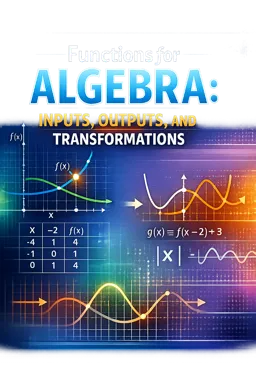
Domain and Range: The Allowed Inputs and Possible Outputs
Domain is the set of all input values (often x) you are allowed to plug into a relation or function. Range is the set of all output values (often y) you actually get from those allowed inputs.
Think of domain as “what can go in” and range as “what can come out.” The key skill is to identify both from different representations: ordered pairs, tables, and formulas.
1) Domain and Range from Ordered Pairs and Tables
When you are given data (ordered pairs or a table), the domain is the set of all first coordinates (inputs), and the range is the set of all second coordinates (outputs).
From a Set of Ordered Pairs
Example: {(-2, 5), (0, 1), (3, 5), (4, -1)}
- Domain: collect all
x-values:{-2, 0, 3, 4} - Range: collect all
y-values:{5, 1, -1}(note5appears twice but is listed once in a set)
Step-by-step method:
- Listen to the audio with the screen off.
- Earn a certificate upon completion.
- Over 5000 courses for you to explore!

Download the app
- List all inputs from the first coordinate of each pair.
- Remove duplicates.
- List all outputs from the second coordinate of each pair.
- Remove duplicates.
From a Table
| x | y |
|---|---|
| -1 | 2 |
| 0 | 2 |
| 2 | 6 |
| 5 | 11 |
- Domain:
{-1, 0, 2, 5} - Range:
{2, 6, 11}
Important detail: In tables, the domain is not “all real numbers” unless the problem says the rule applies to all real inputs. A table typically represents only the listed inputs.
2) Domain Restrictions from Formulas (Rule-Based Restrictions)
When you are given a formula, the default domain is usually “all real numbers” except values that make the expression undefined (in real numbers). Two common sources of restrictions are:
- Denominators cannot be zero.
- Even roots require a nonnegative radicand (for real-valued functions).
2a) Rational Expressions: Denominator Not Zero
Example: f(x) = (x+1)/(x-3)
Step-by-step:
- Find where the denominator is zero:
x - 3 = 0sox = 3. - Exclude that value from the domain.
Domain in set form: {x | x ≠ 3}
Domain in interval notation: (-∞, 3) ∪ (3, ∞)
Example with a factored denominator: g(x) = (x^2 - 1)/(x^2 - 4)
- Denominator:
x^2 - 4 = 0→(x-2)(x+2)=0→x=2orx=-2 - Domain: all real numbers except
-2and2
Interval notation: (-∞, -2) ∪ (-2, 2) ∪ (2, ∞)
2b) Even Roots: Radicand Must Be Nonnegative
Example: h(x) = √(x - 5)
Step-by-step:
- Require the radicand to be nonnegative:
x - 5 ≥ 0 - Solve:
x ≥ 5
Domain: [5, ∞)
Example: p(x) = √(9 - x^2)
- Require
9 - x^2 ≥ 0 - Then
x^2 ≤ 9 - So
-3 ≤ x ≤ 3
Domain: [-3, 3]
2c) Combining Restrictions
Example: q(x) = √(x+2)/(x-1)
- Square root restriction:
x + 2 ≥ 0→x ≥ -2 - Denominator restriction:
x - 1 ≠ 0→x ≠ 1
Domain: [-2, 1) ∪ (1, ∞)
Focused Skill: Rule-Based Restrictions vs Externally Imposed Restrictions
Sometimes the formula allows many inputs, but the problem context or a given input set limits what you are allowed to use. It is essential to state which restriction is coming from the algebraic rule and which is imposed externally.
Example A: Rule-Based Restriction Only
f(x) = 1/(x-4)
- Rule-based domain restriction:
x ≠ 4 - If no other information is given, domain is
(-∞, 4) ∪ (4, ∞)
Example B: External Restriction on Inputs
Same rule: f(x) = 1/(x-4), but you are told the input is limited to 0 ≤ x ≤ 10.
- External restriction:
0 ≤ x ≤ 10 - Rule-based restriction:
x ≠ 4 - Actual domain is the intersection:
[0, 10] \ {4}
In interval notation, that is: [0, 4) ∪ (4, 10]
Example C: Domain from a Listed Input Set
Rule: g(x) = √(x-1), but inputs are restricted to the set {-1, 0, 1, 2, 5}.
- Rule-based requirement:
x ≥ 1 - External input set:
{-1, 0, 1, 2, 5} - Actual domain: choose allowed inputs from the set:
{1, 2, 5} - Range: compute outputs:
g(1)=0,g(2)=1,g(5)=2so range is{0, 1, 2}
3) Interval Notation and Set-Builder Notation (Consistent Conventions)
You should be able to express domain and range in multiple formats. Here are the conventions used in this chapter.
Interval Notation
- Parentheses
( )mean the endpoint is not included. - Brackets
[ ]mean the endpoint is included. ∞and-∞always use parentheses:(-∞, 2], never[-∞, 2].- Use union
∪to combine intervals:(-∞, 1) ∪ (1, ∞).
Examples:
x ≥ -3becomes[-3, ∞)-2 < x ≤ 5becomes(-2, 5]x ≠ 0becomes(-∞, 0) ∪ (0, ∞)
Set-Builder Notation
Set-builder notation describes a set using a variable and a condition.
{x | x ≥ 2}means “the set of all real numbersxsuch thatxis at least 2.”- Use
∈for membership:{x ∈ ℝ | x ≠ 3}.
Examples:
(-∞, 4) ∪ (4, ∞)can be written as{x ∈ ℝ | x ≠ 4}[-1, 2]can be written as{x ∈ ℝ | -1 ≤ x ≤ 2}
4) Determining Range for Basic Functions and After Simple Restrictions
Finding range depends on what inputs are allowed (the domain) and how the rule behaves. In this section, you will practice range for common function types and see how restrictions can change it.
4a) Linear Functions
Example: f(x) = 3x - 7
- If domain is all real numbers, a non-constant linear function outputs all real numbers.
- Range:
(-∞, ∞)
With a restricted domain, the range may become an interval.
Example: f(x) = 3x - 7 with domain [0, 4]
Step-by-step (for linear on a closed interval):
- Evaluate endpoints:
f(0)=-7,f(4)=5 - Because the function is increasing (slope
3 > 0), outputs fill the interval between them.
Range: [-7, 5]
4b) Quadratic Basics (Using the Vertex Idea)
Example: g(x) = (x-2)^2 + 1
(x-2)^2is always≥ 0- So
g(x) ≥ 1
If domain is all real numbers, range is [1, ∞).
With a restricted domain, the minimum or maximum might occur at an endpoint instead of at the vertex.
Example: g(x) = (x-2)^2 + 1 with domain [4, 6]
- On
[4,6], the smallest input is 4, and the vertex atx=2is not allowed. - Compute endpoint outputs:
g(4)=5,g(6)=17
Range: [5, 17]
4c) Square Root Functions
Example: h(x) = √(x - 5)
- Domain:
x ≥ 5 - Square roots are never negative, so
h(x) ≥ 0
Range: [0, ∞)
Example with external restriction: h(x) = √(x - 5) with domain [5, 14]
- Minimum output at
x=5:0 - Maximum output at
x=14:√9 = 3
Range: [0, 3]
4d) Rational Functions: Range by Solving for y (Basic Case)
Example: r(x) = 1/(x-2)
- Domain:
x ≠ 2 - To find range, set
y = 1/(x-2)and solve forxin terms ofy.
Step-by-step:
y = 1/(x-2)- Multiply:
y(x-2)=1 x-2 = 1/yx = 2 + 1/y
This requires y ≠ 0 (because 1/y must be defined). So the range is all real numbers except 0:
Range: (-∞, 0) ∪ (0, ∞)
Now add an external restriction: domain [3, ∞).
- For
x ≥ 3,x-2 ≥ 1, sor(x)=1/(x-2)is positive and at most 1. - At
x=3, output is1. - As
x → ∞, output approaches0but never equals it.
Range becomes: (0, 1]
Practice Exercises (Answer in Multiple Formats)
For each problem, find the domain and range. When asked, give answers in (i) set notation, (ii) interval notation, and (iii) set-builder notation. If the domain is a finite set, list it with braces.
- Ordered pairs:
{(-3, 2), (-1, 0), (0, 0), (4, 7), (4, 2)}Find domain and range. - Table:
Find domain and range.x y -2 5 1 -1 3 5 6 8 - Formula:
f(x) = (2x+1)/(x+5)Find the domain in interval notation and set-builder notation. - Formula:
g(x) = (x-4)/(x^2-9)Find the domain in interval notation. - Formula:
h(x) = √(3x - 12)Find the domain in inequality form and interval notation. - Formula:
p(x) = √(10 - x)Find the domain and range (assume real outputs). - Formula:
q(x) = (x-1)^2with domain all real numbers. Find the range in interval notation and set-builder notation. r(x) = (x-1)^2with restricted domain[3, 6]. Find the range in interval notation.s(x) = 1/(x-2). (a) Find the range with domain all real numbers except 2. (b) Find the range if the domain is restricted to(2, ∞).- Distinguish restriction sources:
t(x) = √(x+1)/(x-3)with external restriction-1 ≤ x ≤ 10. (a) State the rule-based restrictions. (b) State the external restriction. (c) Give the actual domain in interval notation. - Finite input set:
u(x) = √(x-2)with allowed inputs{-2, 0, 2, 3, 6, 11}. (a) Actual domain (list). (b) Range (list). - Multiple formats: Solve for the domain of
v(x) = √(x^2 - 16)and express it in (i) interval notation and (ii) set-builder notation.