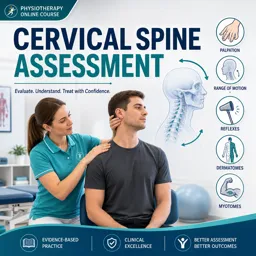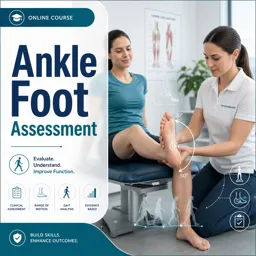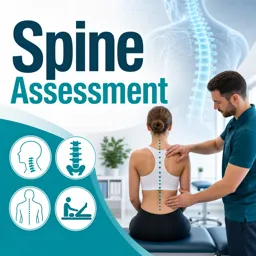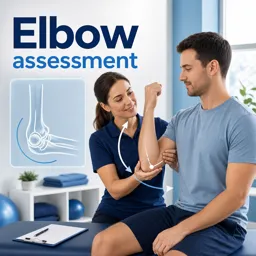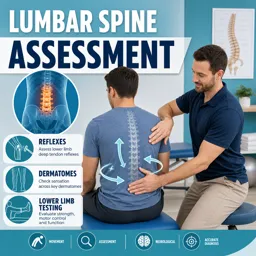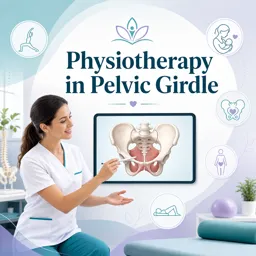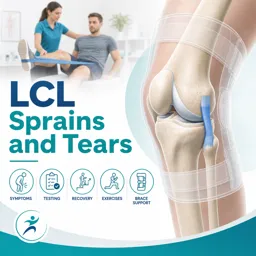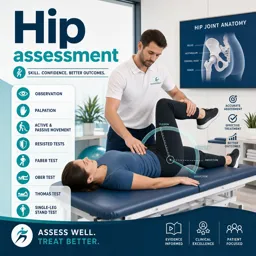


Reach overhead, turn your head to check a blind spot, or bend down to tie a shoe. Each movement depends on how far your joints can travel. In physiotherapy, that distance is called range of motion (ROM), and measuring it is one of the first steps in understanding an injury, tracking recovery and planning exercise. This article explains what ROM is, the three main ways to assess it, and why the differences matter.
What Is Range of Motion?
Range of motion is the full movement potential of a joint, usually described in degrees. Each joint has its own expected movements: a knee mainly bends and straightens, while a shoulder can lift forward, lift to the side, rotate inward and rotate outward. Healthcare professionals often use a tool called a goniometer, a protractor-like device with two arms, to measure the angle of a joint at the start and end of a movement. Some also estimate it by eye or compare one side of the body with the other.
What counts as “normal” varies from person to person, which is why comparing with the person’s unaffected side and following change over time are often more useful than chasing a single number.
Three Ways to Move a Joint
The key idea is who or what produces the movement. That gives three types of ROM.
Active range of motion (AROM)
In active ROM, the person moves the joint using their own muscles, with no outside help. If you lift your arm to the side as high as you can, you are showing your active range. It tells us how far the joint can go and also reflects muscle strength, coordination and willingness to move through pain.
Passive range of motion (PROM)
In passive ROM, the person relaxes and someone else, or a device, moves the joint for them. The muscles around the joint do not work. This shows how far the joint itself and the surrounding soft tissues allow movement. For example, a therapist may gently lift a relaxed arm to see how far it travels.
Active-assisted range of motion (AAROM)
Here the person starts the movement with their muscles, and help is added to finish it. The helper might be a therapist, the other hand, a towel, a stick or a pulley. It sits between the other two types and is common when muscles are weak but the joint should keep moving.
| Type | Who moves the joint? | Muscles working? | Common purpose |
|---|---|---|---|
| Active (AROM) | The person alone | Yes | Check function and strength-linked movement |
| Passive (PROM) | A helper or device | No (relaxed) | Check joint and soft-tissue limits |
| Active-assisted (AAROM) | The person plus help | Partly | Gently progress movement when muscles are weak |
Why Compare Active and Passive?
Testing both can point toward the source of a problem. In general terms:
- If a joint moves much further passively than actively, the limit may come from weakness, pain during muscle contraction or a problem with the muscles and nerves that drive the movement.
- If the joint is limited in both active and passive movement, the cause is more likely in the joint or tissues around it, such as stiffness or swelling.
- If both are similar and full, movement is probably not the main issue.
These are clues, not diagnoses. A trained professional combines them with questions, observation and other tests before drawing conclusions.
What Limits Range of Motion?
Several factors can reduce how far a joint moves:
- Pain, which makes the body protect the area.
- Swelling inside or around a joint.
- Muscle tightness or shortened muscles.
- Stiff connective tissue, including scar tissue after injury or surgery.
- Weakness or reduced nerve control.
- Long periods of immobility, such as wearing a cast or lying in bed.
How ROM Guides Recovery
After an injury or surgery, a physiotherapist often records ROM at the first visit as a baseline. Later measurements show whether the joint is improving, staying the same or getting worse. This helps set goals, such as being able to reach a high shelf or climb stairs comfortably, and helps decide when to move from gentle movement to strengthening exercises.
Treatment plans often progress in steps: passive or assisted movement first when active effort is not yet possible or safe, then active movement, and then strengthening and functional training. The exact order depends on the condition and the advice of the treating professional.
Safe Habits for Moving Your Joints
If you are healthy and simply want to keep your joints moving well, a few general principles apply:
- Move slowly and smoothly rather than bouncing or forcing the end of a movement.
- Warm up first with light activity.
- Stay within a comfortable range. A gentle stretching sensation is different from sharp pain, and sharp pain is a signal to stop.
- Compare both sides of the body to notice differences early.
- Move regularly, because joints that are used through their full range tend to stay more mobile than those that are not.
If you have an injury, recent surgery, numbness, marked swelling or a joint that locks or gives way, do not push through it. Seek advice from a doctor or physiotherapist before starting a program, and follow their guidance on which type of movement is appropriate for you.
Conclusion
Range of motion is a simple idea with a lot of practical value. Active ROM shows what you can do on your own, passive ROM shows what the joint allows, and active-assisted ROM bridges the two when muscles need help. Understanding the difference helps you follow your own rehabilitation and read professional advice with more confidence. If you want to learn more about the body and how it moves, you can explore the related anatomy, physiology and physiotherapy courses available at Cursa.