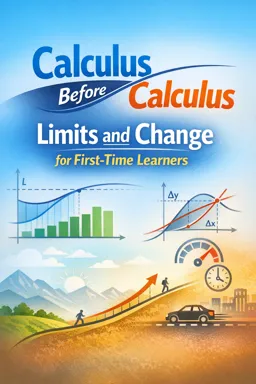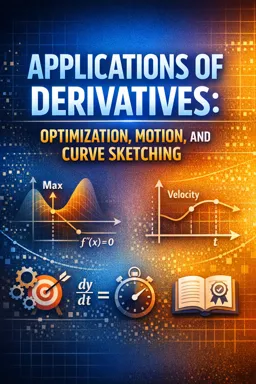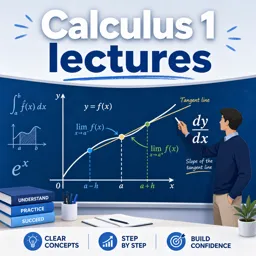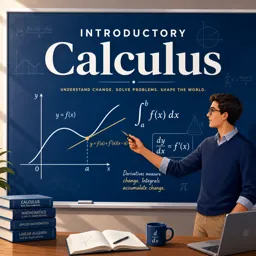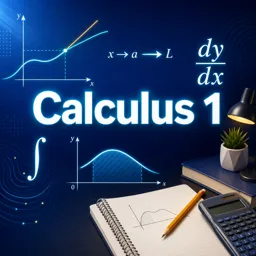

Free ebook on calculus derivatives: limits, tangent slopes, differentiation rules, graph interpretation, and real-world rates.
Free ebook content
-

Derivatives from Scratch: Slopes, Graphs, and the Idea of Instantaneous Rate
+ Exercise: Which statement best describes how to estimate the instantaneous rate of change of a function at x = a using secant lines?
-
From Average to Instantaneous: The Limit Definition of the Derivative
+ Exercise: Why do we simplify the difference quotient for h≠0 before taking the limit as h→0 when using the limit definition of the derivative?
-
Tangent Lines and Local Linearity: Using Derivatives to Approximate
+ Exercise: You know f(2)=5 and f'(2)=-3. Which equation correctly gives the tangent line (linearization) to y=f(x) at x=2?
-
Derivative Meaning in Context: Velocity, Growth, and Marginal Change
+ Exercise: A company’s revenue is modeled by R(q)=40q−0.1q^2 (dollars), where q is units sold. What does a marginal revenue of R'(250) = −10 dollars/unit mean in context?


-
Differentiation Rules: Power Rule and Constant/Linearity Rules
+ Exercise: Using the power rule and linearity, what is the derivative of f(x) = 4x^3 - 2/x^2 + 7√x - 9?
-
Product and Quotient Rules: Differentiating Multiplication and Division
+ Exercise: Which statement best explains why you generally cannot compute the derivative of a product by multiplying the derivatives of its factors?
-
Chain Rule: Derivatives of Compositions and Nested Functions
+ Exercise: When differentiating a composition y = f(g(x)), which expression correctly applies the chain rule?
-
Putting Rules Together: Multi-Step Differentiation and Simplification
+ Exercise: When differentiating m(x)=sqrt(x^2+1)/x, which set of differentiation rules is the most appropriate after rewriting sqrt(x^2+1) as (x^2+1)^(1/2)?
-
Reading Derivatives from Graphs and Data: Sign, Magnitude, and Shapes
+ Exercise: A function f is smooth and has a local maximum at x = -2, then decreases until a local minimum at x = 1, then increases after that. Which sign pattern for f'(x) matches this behavior?
-
Common Pitfalls in Differentiation: Notation, Domains, and Concept Checks
+ Exercise: For g(x) = sqrt(x-5), which statement correctly describes where g is defined and where g'(x) = 1/(2sqrt(x-5)) is defined?
-
Derivatives in Real-World Rates: Modeling, Interpretation, and Communication
+ Exercise: In the braking-distance model d(v)=0.08v^2 (v in m/s, d in m), what does d'(20)=3.2 m per (m/s) mean in context?
About the free ebook
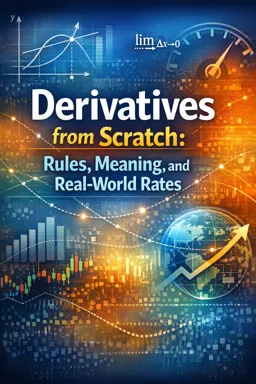
Derivatives from Scratch: Rules, Meaning, and Real-World Rates
This free ebook introduces derivatives as a practical way to describe how quantities change. Rather than treating differentiation as a list of formulas to memorize, it develops the connection between slopes, graphs, limits, and instantaneous rates of change.
Build a clear calculus foundation
Start with the difference between an average rate of change and a rate at one exact moment. The ebook explains how the limit definition turns a secant slope into a tangent slope, giving precise meaning to derivative notation. Visual reasoning and algebra work together so that symbols such as f'(x) represent an idea, not just a procedure.
Differentiate with confidence
Learn how standard differentiation rules arise and how to apply them accurately. The material guides you through powers, sums, products, quotients, and nested functions, with attention to the simplification steps that often cause errors. It also highlights notation, domains, and common conceptual pitfalls.
Connect derivatives to the world
Derivatives describe velocity, population growth, changing costs, and other real-world rates. You will practice interpreting the sign and size of a derivative from equations, graphs, and data, then communicate what the result means in context. Local linearity is used to show how derivatives can provide useful nearby approximations.
What you will gain
- An intuitive understanding of instantaneous change
- Reliable methods for applying differentiation rules
- Skill in reading derivative information from graphs and data
- Confidence interpreting rates with correct units and context
Use this ebook as a focused calculus reference for school study, review, or independent learning.
What is the difference between an average rate of change and a derivative?
An average rate measures change over an interval; a derivative measures the instantaneous rate at a specific point.
When should I use the chain rule?
Use the chain rule when one function is nested inside another, such as (3x² + 1)^5.
How does a derivative relate to velocity?
If position is a function of time, its derivative is velocity: the instantaneous rate at which position changes.
This ebook includes:

11 content chapters

Digital certificate of course completion (Free)

Exercises to train your knowledge

100% free, from content to certificate
Ready to get started?

 recommended
In the app you will also find...

Over 5,000 free courses
Programming, English, Digital Marketing and much more! Learn whatever you want, for free.

Study plan with AI
Our app's Artificial Intelligence can create a study schedule for the course you choose.

From zero to professional success
Improve your resume with our free Certificate and then use our Artificial Intelligence to find your dream job.
You can also use the QR Code or the links below.