A vector represents a geometric direction or displacement, while a covector is a linear function that takes a vector as input and returns a scalar.

Duration of the online course: 3 hours and 6 minutes
New
Build intuition for tensor calculus fast with a free online course: vectors, covectors, metrics, and index notation explained clearly, plus practice questions.
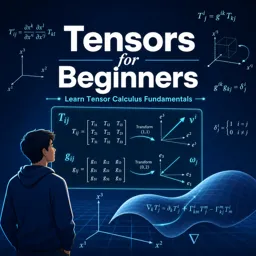
This free online course helps you build a clear, usable understanding of tensor calculus fundamentals without getting lost in heavy formalism. If you have met vectors in calculus or physics and wondered why tensors appear in topics like changing coordinates, curved spaces, or advanced mechanics, this course connects the motivation to practical definitions that actually work when you compute. You will learn to recognize what stays the same under a change of basis and what changes, which is the central idea behind tensors.
Instead of treating tensors as mysterious arrays, you develop intuition step by step: starting from coordinate descriptions, then moving through vectors and their transformation rules, and on to covectors as objects that eat vectors and return numbers. That perspective makes later ideas feel natural, because you can see how dual bases, components, and transformations fit together. Along the way, you practice distinguishing forward and backward transformations so you can reliably translate between old and new coordinate systems.
As the course progresses, tensors appear as structured combinations of vector and covector behavior. You explore linear maps as (1,1)-tensors and understand how their components transform, which clarifies when a matrix representation is tied to a specific basis. You then meet bilinear forms and the metric tensor, learning why they matter for computing lengths and angles correctly in non-orthonormal coordinates and for moving between upstairs and downstairs indices through raising and lowering operations.
You will also gain a conceptual handle on tensor products, how they differ from the Kronecker product in purpose and meaning, and why higher-type tensors can become ambiguous if you only think in terms of symbols rather than multilinear maps. Short exercises throughout reinforce the transformation rules and definitions so you finish with confidence reading index notation, checking whether an expression is coordinate-consistent, and setting yourself up for applications in multivariable calculus, differential geometry, physics, computer graphics, and machine learning.

3 hours and 6 minutes of online video course

Digital certificate of course completion (Free)

Exercises to train your knowledge

100% free, from content to certificate
What is the difference between a vector and a covector in tensor calculus?
A vector represents a geometric direction or displacement, while a covector is a linear function that takes a vector as input and returns a scalar.
How do tensor components transform when the coordinate basis changes?
Contravariant vector components transform with the inverse basis transformation, while covector components transform with the forward transformation. General tensors follow the corresponding rule for each index.
How does the metric tensor raise and lower indices?
The metric tensor lowers vector indices via v_i = g_ij v^j, and its inverse raises covector indices via v^i = g^ij v_j.
Ready to get started?Download the app and get started today.
Install the app now
to access the course
Over 5,000 free courses
Programming, English, Digital Marketing and much more! Learn whatever you want, for free.

Study plan with AI
Our app's Artificial Intelligence can create a study schedule for the course you choose.

From zero to professional success
Improve your resume with our free Certificate and then use our Artificial Intelligence to find your dream job.
You can also use the QR Code or the links below.



Free CourseCalculus I entire course
5

(1)

14h52m

45 exercises
Free CourseCalculus 1 for beginners
5
(1)
10h40m
6 exercises
Free CourseCalculus 1 lectures
5
(1)
22h27m
22 exercises
Free CourseIntroductory Calculus
5
(4)
58m
5 exercises
Free CourseCalculus 3
4.8
(15)
75h24m
17 exercises
Free CourseCalculus 2
4.8
(9)
50h03m
24 exercises
Free CourseCalculus 1
4.6

(61)
44h56m
30 exercises

Free CourseDiscrete Math
4.6
(5)
9h38m
43 exercises
Free CourseIntroductory Calculus
3.7
(3)
40h09m
49 exercises
Free CourseCalculus 1
New
7h37m
28 exercises
Carry knowledge in your pocket.
Download the Cursa app.
There are hundreds of free courses available, with a free certificate of completion that is saved in your mobile image gallery.
Download the app to access the Course Completion Certificate for Free.


+ 10 million
students

Free and Valid
Certificate

60 thousand free
exercises

4.8/5 rating in
app stores

Free courses in
video and ebooks