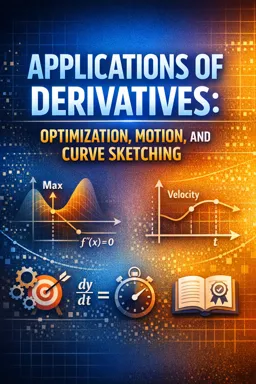

Free ebook on derivative applications: optimization, motion, related rates, concavity, and curve sketching in calculus.
Free ebook content
-

Using Derivatives to Model Change and Make Decisions
+ Exercise: A car’s position is s(t) in meters, with time t in seconds. Over the interval [10,12], the average velocity is 20 m/s, but s'(11)=5 m/s. Which statement best explains how both can be true and what describes the speed at exactly 11 seconds?
-
Critical Points and Increasing/Decreasing Behavior for Optimization
+ Exercise: When finding absolute extrema of a differentiable function on a closed interval [a,b], which set of x-values must be checked using the “candidates + compare values” workflow?
-
Concavity, Second Derivatives, and Inflection Points in Curve Sketching
+ Exercise: A function has f''(c)=0. Which statement best describes what you can conclude about x=c?
-
Complete Curve Sketching with Derivative-Based Features
+ Exercise: When curve sketching with derivatives, why should you evaluate at least one function value in each interval created by asymptotes, critical points, and inflection points?


-
Motion Along a Line: Position, Velocity, Speed, and Acceleration
+ Exercise: An object moves along a line. At a certain time t, the velocity is negative and the acceleration is positive. Which description is correct at that instant?
-
Related Rates: Translating Word Problems into Equations
+ Exercise: In a related rates problem, why should you differentiate the relationship equation with respect to time before substituting the given numerical values?
-
Optimization Problems: Building the Objective Function
+ Exercise: In a fixed-perimeter rectangle area maximization setup, which statement correctly describes why endpoint values must be checked?
-
Optimization with Constraints Stated in Plain Language
+ Exercise: A shop’s profit includes a fixed setup cost that is charged only if it produces a positive quantity. When finding the best production level, which comparison is essential even if calculus gives an interior maximum for the positive-quantity formula?
-
Interpreting Results: Units, Sensitivity, and Reasonableness Checks
+ Exercise: An optimization model suggests an optimal production level of q* = 1200 items/day, but the factory capacity is at most 900 items/day. What is the most appropriate interpretation and next step?
-
Capstone Practice: Mixed Application Sets and Full Solutions
+ Exercise: In the ladder related-rates setup with constraint x^2 + y^2 = 100, why should numerical values like x=6 and dx/dt=2 be substituted after differentiating rather than before?
About the free ebook
Applications of Derivatives: Optimization, Motion, and Curve Sketching
This free online ebook shows how derivatives turn calculus into a practical tool for analyzing change, modeling motion, optimizing quantities, and understanding the shape of graphs. It connects derivative rules to the decisions and interpretations required in real mathematical applications.
Analyze functions with confidence
Learn how to identify critical points, determine where a function increases or decreases, and use concavity and second derivatives to locate possible extrema and inflection points. These ideas support accurate curve sketches that reveal key features of a function beyond a simple graphing-calculator view.
Model motion and changing quantities
Explore position, velocity, speed, and acceleration for objects moving along a line. The ebook emphasizes the meaning of signs, units, and rates of change so you can interpret motion mathematically and in context.
Build and solve optimization models
Practice translating verbal constraints into equations, defining an objective function, and using derivatives to find maximum or minimum values. You will also examine whether answers are reasonable by checking units, constraints, and sensitivity to changing conditions.
Develop problem-solving habits
- Translate word problems into mathematical relationships.
- Use first- and second-derivative tests appropriately.
- Interpret derivative-based results in context.
- Check solutions against the original conditions.
Worked application practice brings together curve sketching, motion, related rates, and optimization, helping students prepare for calculus assignments, assessments, and more advanced quantitative study.
How are critical points used in optimization problems?
Critical points are candidates for maximum or minimum values. Test them with derivative behavior, endpoints, or the second derivative.
What is the difference between velocity and speed in calculus?
Velocity includes direction and can be negative; speed is the nonnegative magnitude of velocity.
How do related rates problems use derivatives?
They relate changing quantities through an equation, then differentiate with respect to time and substitute known values.
This ebook includes:

10 content chapters

Digital certificate of course completion (Free)

Exercises to train your knowledge

100% free, from content to certificate
Ready to get started?

 recommended
In the app you will also find...

Over 5,000 free courses
Programming, English, Digital Marketing and much more! Learn whatever you want, for free.

Study plan with AI
Our app's Artificial Intelligence can create a study schedule for the course you choose.

From zero to professional success
Improve your resume with our free Certificate and then use our Artificial Intelligence to find your dream job.
You can also use the QR Code or the links below.