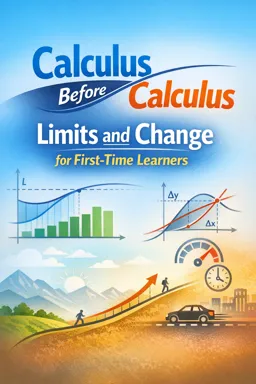
Examine the y-values that f(x) approaches as x gets close to the target x-value from both the left and right. If they approach the same value, that value is the limit.

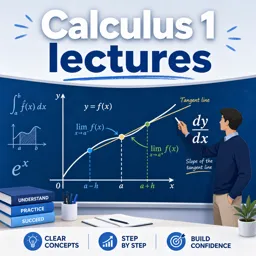
Duration of the online course: 22 hours and 27 minutes
5

(1)
Build strong Calculus 1 skills with a free online course: master limits, derivatives, optimization, and integrals through clear lectures and practice.
Strengthen your foundation in Calculus 1 with a free online course designed to turn intimidating concepts into tools you can use with confidence. If limits, derivatives, and integrals have felt like a collection of rules to memorize, this course helps you connect ideas, understand why procedures work, and recognize which technique fits a problem. It is ideal for high school and college students, self-learners preparing for exams, or anyone who needs calculus for STEM pathways.
You will begin by developing real intuition for limits using graphical and numerical reasoning, then refine that understanding with formal definitions, continuity, one-sided limits, and infinite limits. From there, the focus shifts to derivatives: interpreting them as slopes, instantaneous rates of change, and tangible answers to real questions about motion, change, and sensitivity. As you progress, you will learn to differentiate efficiently and accurately, including product, quotient, and chain rules, as well as implicit differentiation for relationships that cannot be solved neatly for one variable.
To move beyond computation, you will apply derivatives to decision-making. You will analyze increasing and decreasing behavior, extrema on intervals, and concavity, using key theorems that power curve sketching and justify results. You will also practice optimization and numerical approximation with Newton’s method, gaining problem-solving habits that transfer to physics, economics, engineering, and data-driven fields.
The course continues with exponential and logarithmic functions, building comfort with common forms seen in applications. You will also see how calculus models change over time through introductory differential equation ideas like growth and decay. Reviews placed throughout help you consolidate what you learned and prepare strategically for major exams. With lecture support and targeted exercises, you can study at your own pace and leave with a clearer, more reliable grasp of Calculus 1.

22 hours and 27 minutes of online video course

Digital certificate of course completion (Free)

Exercises to train your knowledge

100% free, from content to certificate
How do you find a limit from a graph or numerical table in Calculus 1?
Examine the y-values that f(x) approaches as x gets close to the target x-value from both the left and right. If they approach the same value, that value is the limit.
What derivative rules are covered in these Calculus 1 lectures?
The course covers basic differentiation, rates of change, and the product, quotient, chain, and implicit differentiation rules.
How is Newton's Method used to approximate a root of a function?
Starting with an estimate x_n, repeatedly use x_(n+1) = x_n - f(x_n)/f'(x_n) to generate closer approximations to a solution of f(x)=0.
Ready to get started?Download the app and get started today.
Install the app now
to access the course
Over 5,000 free courses
Programming, English, Digital Marketing and much more! Learn whatever you want, for free.

Study plan with AI
Our app's Artificial Intelligence can create a study schedule for the course you choose.

From zero to professional success
Improve your resume with our free Certificate and then use our Artificial Intelligence to find your dream job.
You can also use the QR Code or the links below.



Free CourseCalculus I entire course
5
(1)

14h52m

45 exercises
Free CourseCalculus 1 for beginners
5
(1)
10h40m
6 exercises
Free CourseIntroductory Calculus
5
(4)
58m
5 exercises
Free CourseCalculus 3
4.8
(15)
75h24m
17 exercises
Free CourseCalculus 2
4.8
(9)
50h03m
24 exercises
Free CourseCalculus 1
4.6

(61)
44h56m
30 exercises
Free CourseDiscrete Math
4.6
(5)
9h38m
43 exercises
Free CourseIntroductory Calculus
3.7
(3)
40h09m
49 exercises
Free CourseCalculus 1
New
7h37m
28 exercises
Free CourseCalculus basics
New
2h42m
17 exercises
Carry knowledge in your pocket.
Download the Cursa app.
There are hundreds of free courses available, with a free certificate of completion that is saved in your mobile image gallery.
Download the app to access the Course Completion Certificate for Free.


+ 10 million
students

Free and Valid
Certificate

60 thousand free
exercises

4.8/5 rating in
app stores

Free courses in
video and ebooks