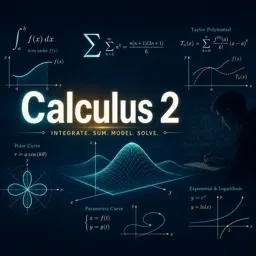
Free Course Image Calculus 2

Free online courseCalculus 2

Duration of the online course: 50 hours and 3 minutes

4.78

StarStarStarStarStar

(9)

Master Calculus 2 with this comprehensive free online course. Topics include logarithmic functions, trigonometric integrals, differential equations, series, and more.

In this free course, learn about

  • Logarithmic and Exponential Functions
  • Indeterminate Forms and Basic Integration Techniques
  • Advanced Integration Techniques
  • Differential Equations and Sequences
  • Infinite Series and Convergence Tests
  • Power Series and Taylor Series
  • Parametric and Polar Coordinates

Course Description

Calculus 2 is a comprehensive course designed for students who have completed introductory calculus and are ready to delve deeper into the subject. Spanning a total duration of 50 hours and 3 minutes, this course is perfect for those looking to solidify their understanding of advanced calculus concepts or for anyone aspiring to excel in higher-level mathematics.

Rated an impressive 5 stars out of 5, Calculus 2 is highly regarded among students for its clarity, depth, and well-structured content. The course provides a solid foundation in calculus and is part of the Basic Studies category, specifically under the Calculus subcategory. This makes it suitable for a wide range of learners, from undergraduates looking to bolster their math skills to professionals seeking to refresh their knowledge.

The curriculum of this course is meticulously crafted to cover an array of subjects that are crucial for a deep understanding of calculus. It begins with the fundamental properties and usage of the natural logarithm function, extending into the derivatives of inverse functions. This paves the way to an exploration of the derivatives and integrals of exponential functions, both basic and general types.

Students will also encounter the calculus of inverse trigonometric functions, and engage in a rich discussion on hyperbolic functions. Building upon these foundations, the course covers advanced techniques for evaluating the limits of indeterminate forms and explores various integration methods such as integration by parts, trigonometric integrals, trigonometric substitution, and partial fractions.

Further into the course, students will learn about improper integrals and gain hands-on experience in solving first-order differential equations using separation of variables. The journey continues with an in-depth look at the convergence and divergence of sequences and series, including geometric and harmonic series, and various convergence tests such as the integral, comparison, limit comparison, and alternating series tests.

The course also delves into absolute convergence, ratio tests, and root tests for series, and explains the calculus of power series, providing students with the tools to understand and manipulate these series effectively. Additionally, the representation of functions using Taylor and Maclaurin series, as well as the approximation of functions by Taylor polynomials, are thoroughly discussed.

In its final segments, Calculus 2 introduces parametric equations and their calculus, along with a comprehensive study of polar coordinates and equations. The course culminates with numerical integration techniques, specifically the trapezoidal and Simpson's rule, equipping students with practical skills for real-world applications.

Overall, Calculus 2 is an exceptional course that provides a robust education in advanced calculus, all delivered through engaging lectures and practical examples. Students who complete this course will find themselves well-prepared for further studies in mathematics and related fields.

Course content

  • Video class: Calculus 2 Lecture 6.1: The Natural Log Function 2h22m
  • Exercise: Integration Techniques: Which substitution method is relevant for the integral ∫(tan x) dx?
  • Video class: Calculus 2 Lecture 6.2: Derivatives of Inverse Functions 44m
  • Exercise: _What does it take for a function to have an inverse?
  • Video class: Calculus 2 Lecture 6.3: Derivatives and Integrals of Exponential Functions 1h30m
  • Exercise: What is the value of the number e?
  • Video class: Calculus 2 Lecture 6.4: Derivatives and Integrals of General Exponential Functions 1h15m
  • Video class: Calculus 2 Lecture 6.5: Calculus of Inverse Trigonometric Functions 1h52m
  • Exercise: What condition must a function meet to have an inverse?
  • Video class: Calculus 2 Lecture 6.6: A Discussion of Hyperbolic Functions 1h16m
  • Exercise: _What are hyperbolic functions?
  • Video class: Calculus 2 Lecture 6.7: Evaluating Limits of Indeterminate Forms 1h40m
  • Exercise: What is L'Hôpital's Rule used for?
  • Video class: Calculus 2 Lecture 7.1: Integration By Parts 1h54m
  • Exercise: What is the reduction formula used in the video for simplifying the integral of sin to a power greater than or equal to two?
  • Video class: Calculus 2 Lecture 7.2: Techniques For Trigonometric Integrals 2h21m
  • Exercise: What is the integral of sine to the power of 6 of x, dx?
  • Video class: Calculus 2 Lecture 7.3: Integrals By Trigonometric Substitution 2h09m
  • Exercise: What is an alternative method to solve integrals with complex square roots?
  • Video class: Calculus 2 Lecture 7.4: Integration By Partial Fractions 2h55m
  • Exercise: How many distinct cases are there for solving integrals using the method of partial fractions, as described in the transcript?
  • Video class: Calculus 2 Lecture 7.6: Improper Integrals 2h48m
  • Exercise: Identifying Improper Integrals and Their Types
  • Video class: Numerical Integration With Trapezoidal and Simpson's Rule 27m
  • Exercise: _What is the trapezoidal rule in numerical integration?
  • Video class: Calculus 2 Lecture 8.1: Solving First Order Differential Equations By Separation of Variables 2h49m
  • Exercise: What is the first order differential equation based on the video transcript example?
  • Video class: Calculus 2 Lecture 9.1: Convergence and Divergence of Sequences 2h27m
  • Exercise: What is a key characteristic of a monotonic sequence?
  • Video class: Calculus 2 Lecture 9.2: Series, Geometric Series, Harmonic Series, and Divergence Test 2h01m
  • Exercise: Determine the convergence of a series using the Monta-Bott theorem
  • Video class: Calculus 2 Lecture 9.3: Using the Integral Test for Convergence/Divergence of Series, P-Series 1h11m
  • Exercise: _What is the basic idea behind the integral test for convergence or divergence of a series?
  • Video class: Calculus 2 Lecture 9.4: The Comparison Test for Series and The Limit Comparison Test 1h34m
  • Exercise: What is the result of using the Limit Comparison Test when the limit exists?
  • Video class: Calculus 2 Lecture 9.5: Showing Convergence With the Alternating Series Test, Finding Error of Sums 1h19m
  • Exercise: _What is an alternating series?
  • Video class: Calculus 2 Lecture 9.6: Absolute Convergence, Ratio Test and Root Test For Series 1h46m
  • Exercise: What principle is used to handle non-alternating negative series terms?
  • Video class: Calculus 2 Lecture 9.7: Power Series, Calculus of Power Series, Ratio Test for Int. of Convergence 2h29m
  • Exercise: What is the radius of convergence for the power series where the function is only defined at the center?
  • Video class: Calculus 2 Lecture 9.8: Representation of Functions by Taylor Series and Maclauren Series 3h01m
  • Exercise: What is the general formula for a Taylor series centered at a point C?
  • Video class: Calculus 2 Lecture 9.9: Approximation of Functions by Taylor Polynomials 1h34m
  • Video class: Calculus 2 Lecture 10.2: Introduction to Parametric Equations 1h38m
  • Exercise: What is the concept behind parametric equations?
  • Video class: Calculus 2 Lecture 10.3: Calculus of Parametric Equations 1h34m
  • Video class: Calculus 2 Lecture 10.4: Using Polar Coordinates and Polar Equations 2h01m
  • Exercise: What is the primary function of polar coordinates?
  • Video class: Calculus 2 Lecture 10.5: Calculus of Polar Equations 1h12m
  • Exercise: _What is the formula for finding the area bounded by a polar curve?

This free course includes:

50 hours and 3 minutes of online video course

Digital certificate of course completion (Free)

Exercises to train your knowledge

100% free, from content to certificate

Ready to get started?Download the app and get started today.

Install the app now

to access the course
Icon representing technology and business courses

Over 5,000 free courses

Programming, English, Digital Marketing and much more! Learn whatever you want, for free.

Calendar icon with target representing study planning

Study plan with AI

Our app's Artificial Intelligence can create a study schedule for the course you choose.

Professional icon representing career and business

From zero to professional success

Improve your resume with our free Certificate and then use our Artificial Intelligence to find your dream job.

You can also use the QR Code or the links below.

QR Code - Download Cursa - Online Courses

More free courses at Calculus

Download the App now to have access to + 3300 free courses, exercises, certificates and lots of content without paying anything!

  • 100% free online courses from start to finish

    Thousands of online courses in video, ebooks and audiobooks.

  • More than 48 thousand free exercises

    To test your knowledge during online courses

  • Valid free Digital Certificate with QR Code

    Generated directly from your cell phone's photo gallery and sent to your email

Cursa app on the ebook screen, the video course screen and the course exercises screen, plus the course completion certificate

+ 9 million
students

Free and Valid
Certificate

60 thousand free
exercises

4.8/5 rating in
app stores

Free courses in
video and ebooks