The limit is 4. Factor x² - 4 as (x - 2)(x + 2), cancel x - 2, then evaluate x + 2 at 2.

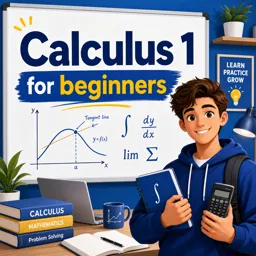
Duration of the online course: 10 hours and 40 minutes
5

(1)
Build confidence in calculus with this free online course: master limits and derivatives through clear explanations and practice questions, and earn a certificate.
Calculus can feel intimidating at first, especially when symbols, functions, and unfamiliar rules appear all at once. This free online course is designed to help you start calmly and build real understanding step by step, even if you are just beginning. You will learn how to think like a calculus student: focus on what a function is doing, what happens near a point, and how to describe change with simple, reliable methods.
The course puts special emphasis on limits, because limits are the foundation behind many ideas in Calculus 1. You will practice evaluating limits as x approaches specific values and as x grows without bound, developing an intuition for end behavior and local behavior. Along the way, you will see how algebraic simplification resolves expressions that look undefined at first glance, and you will learn to interpret common limit forms with confidence.
Once that foundation is in place, you will move into derivatives and discover how they describe instantaneous rate of change. The course guides you through core derivative skills, including working with products and combining algebra with trigonometric functions. Rather than memorizing rules in isolation, you will practice choosing an approach, carrying out the steps carefully, and checking whether your result makes sense.
Practice is built into the experience through targeted exercises that mirror typical school and exam questions. This helps you turn passive watching into active problem solving, so you can spot patterns, avoid common mistakes, and improve speed without sacrificing understanding. If you are preparing for school assessments, returning to math after a break, or aiming to strengthen prerequisites for science, engineering, or economics, this course provides a clear, supportive path into Calculus 1.
By the end, you should feel more comfortable reading calculus notation, evaluating limits, and differentiating functions, with stronger intuition about what the mathematics is saying. Learn at your own pace, revisit tricky ideas as needed, and build a solid starting point for more advanced topics.

10 hours and 40 minutes of online video course

Digital certificate of course completion (Free)

Exercises to train your knowledge

100% free, from content to certificate
What is the limit of (x² - 4)/(x - 2) as x approaches 2?
The limit is 4. Factor x² - 4 as (x - 2)(x + 2), cancel x - 2, then evaluate x + 2 at 2.
How do you differentiate x² sin(x)?
Use the product rule: d/dx[x²sin(x)] = 2xsin(x) + x²cos(x).
What is the limit of (x - 1)/(x² - 1) as x approaches 1?
The limit is 1/2. Factor x² - 1 as (x - 1)(x + 1), cancel x - 1, then substitute 1.
Ready to get started?Download the app and get started today.
Install the app now
to access the course
Over 5,000 free courses
Programming, English, Digital Marketing and much more! Learn whatever you want, for free.

Study plan with AI
Our app's Artificial Intelligence can create a study schedule for the course you choose.

From zero to professional success
Improve your resume with our free Certificate and then use our Artificial Intelligence to find your dream job.
You can also use the QR Code or the links below.



Free CourseCalculus I entire course
5
(1)

14h52m

45 exercises
Free CourseCalculus 1 lectures
5
(1)
22h27m
22 exercises
Free CourseIntroductory Calculus
5
(4)
58m
5 exercises
Free CourseCalculus 3
4.8
(15)
75h24m
17 exercises
Free CourseCalculus 2
4.8
(9)
50h03m
24 exercises
Free CourseCalculus 1
4.6

(61)
44h56m
30 exercises
Free CourseDiscrete Math
4.6
(5)
9h38m
43 exercises
Free CourseIntroductory Calculus
3.7
(3)
40h09m
49 exercises
Free CourseCalculus 1
New
7h37m
28 exercises
Free CourseCalculus basics
New
2h42m
17 exercises
Carry knowledge in your pocket.
Download the Cursa app.
There are hundreds of free courses available, with a free certificate of completion that is saved in your mobile image gallery.
Download the app to access the Course Completion Certificate for Free.


+ 10 million
students

Free and Valid
Certificate

60 thousand free
exercises

4.8/5 rating in
app stores

Free courses in
video and ebooks
Course comments: Calculus 1 for beginners
Derrick Phalo
cal1