The dot product produces a scalar and measures alignment between vectors; the cross product produces a perpendicular vector whose magnitude relates to the area of the parallelogram they form.

Duration of the online course: 75 hours and 24 minutes
4.8

(15)
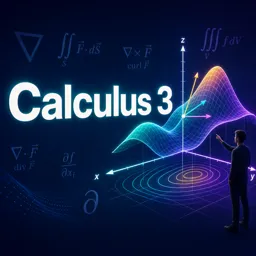
Build confidence in vectors and multivariable calculus with this free online course—master gradients, multiple integrals, and vector fields for STEM success.
Strengthen the calculus skills that power physics, engineering, computer graphics, data-driven modeling, and advanced mathematics. This free online course takes you beyond single-variable techniques and helps you think in 3D and higher dimensions, where vectors, surfaces, and vector fields become the language for describing real systems. Instead of treating topics as disconnected formulas, you will learn how geometric intuition and algebra work together to solve meaningful problems.
You will begin by developing a solid grasp of vectors in three-dimensional coordinate systems, including operations that reveal structure in space such as dot and cross products. From there, you will connect lines, planes, and common surfaces to a geometric toolkit that makes spatial reasoning faster and more reliable. As the course moves into vector functions, you will learn to describe motion with parameterizations and interpret derivatives as velocity and acceleration, building the bridge between calculus and dynamics.
The course then expands into multivariable functions, where limits, continuity, and partial derivatives help you analyze how outputs change when several inputs vary at once. You will learn how differentials support approximation, how the multivariable chain rule links composed systems, and how gradients and directional derivatives explain steepest ascent in a precise way. With this foundation, you will be able to form tangent planes, normal lines, and optimize functions of two variables, including constrained optimization using Lagrange multipliers.
Integration becomes more powerful as you progress to double and triple integrals, including strategies for setting up iterated integrals and choosing coordinate systems that simplify geometry. You will learn how polar, cylindrical, and spherical coordinates can turn complicated regions into manageable ones, and how change of variables with the Jacobian supports flexible modeling. Applications like mass, moments, and volume reinforce why these methods matter.
Finally, you will work with vector fields and the calculus of circulation and flux: divergence, curl, and line integrals, along with the key theorems that connect local behavior to global results. With videos and practice questions throughout, you will build the conceptual clarity and problem-solving habits needed for exams, future coursework, and technical careers.

75 hours and 24 minutes of online video course

Digital certificate of course completion (Free)

Exercises to train your knowledge

100% free, from content to certificate
How do dot and cross products differ in Calculus 3?
The dot product produces a scalar and measures alignment between vectors; the cross product produces a perpendicular vector whose magnitude relates to the area of the parallelogram they form.
When should cylindrical or spherical coordinates be used in multiple integrals?
Use cylindrical coordinates for regions with circular symmetry around an axis and spherical coordinates for spheres, balls, cones, or radially symmetric 3-D regions.
What do divergence and curl tell you about a vector field?
Divergence measures local outward or inward flow, while curl measures the field’s tendency to rotate around a point.
Ready to get started?Download the app and get started today.
Install the app now
to access the course
Over 5,000 free courses
Programming, English, Digital Marketing and much more! Learn whatever you want, for free.

Study plan with AI
Our app's Artificial Intelligence can create a study schedule for the course you choose.

From zero to professional success
Improve your resume with our free Certificate and then use our Artificial Intelligence to find your dream job.
You can also use the QR Code or the links below.



Free CourseCalculus I entire course
5
(1)

14h52m

45 exercises
Free CourseCalculus 1 for beginners
5
(1)
10h40m
6 exercises
Free CourseCalculus 1 lectures
5
(1)
22h27m
22 exercises
Free CourseIntroductory Calculus
5
(4)
58m
5 exercises
Free CourseCalculus 2
4.8
(9)
50h03m
24 exercises
Free CourseCalculus 1
4.6

(61)
44h56m
30 exercises

Free CourseDiscrete Math
4.6
(5)
9h38m
43 exercises
Free CourseIntroductory Calculus
3.7
(3)
40h09m
49 exercises
Free CourseCalculus 1
New
7h37m
28 exercises
Free CourseCalculus basics
New
2h42m
17 exercises
Carry knowledge in your pocket.
Download the Cursa app.
There are hundreds of free courses available, with a free certificate of completion that is saved in your mobile image gallery.
Download the app to access the Course Completion Certificate for Free.


+ 10 million
students

Free and Valid
Certificate

60 thousand free
exercises

4.8/5 rating in
app stores

Free courses in
video and ebooks