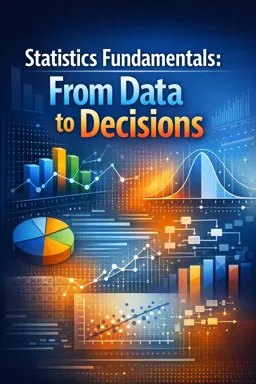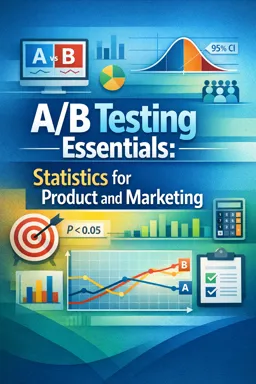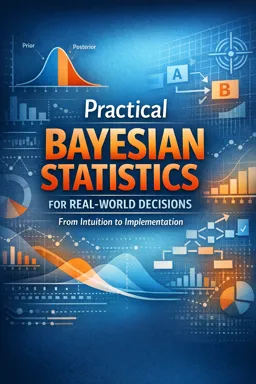


Free ebook on practical Bayesian statistics for updating beliefs, testing experiments, modeling uncertainty, and making real-world decisions.
Free ebook + audiobook content
-

Bayesian Thinking as a Decision Toolkit
+ Exercise: Which approach best reflects Bayesian decision-making when choosing between rolling out a feature now or delaying? 19 minutes
-
From Beliefs to Evidence: Priors, Likelihood, and Posteriors
+ Exercise: In Bayesian updating, what does a posterior predictive distribution primarily help you answer? 17 minutes
-
Interpreting Uncertainty: Credible Intervals and Decision-Relevant Probabilities
+ Exercise: Which statement best explains why decision-making often benefits from computing P(θ > δ) in addition to reporting a 95% credible interval? 19 minutes
-
Mini Case Study: Updating a Belief with a Simple Beta–Binomial Calculation
+ Exercise: In a Beta–Binomial decision setup, which quantity should be compared to a rule like ship only if there is at least an 80% probability that p exceeds 0.08? 24 minutes


-
Building Practical Bayesian Models for Proportions and Rates
+ Exercise: In a Bayesian model for event counts observed over different exposure amounts, what is the main purpose of including exposure in the Poisson likelihood as y ~ Poisson(E * lambda)? 21 minutes
-
Mini Case Study: Estimating Conversion Rate with Posterior Mean and Credible Interval
+ Exercise: In this mini case study, why is a 95% credible interval useful in addition to reporting the posterior mean conversion rate? 14 minutes
-
Bayesian A/B Testing Beyond p-Values
+ Exercise: Which decision rule best reflects a Bayesian A/B testing approach focused on practical impact rather than a p-value-like gate? 16 minutes
-
Decision Metrics for Experiments: Probability of Superiority, Expected Loss, and Thresholds
+ Exercise: Which choice best describes what expected loss L(B) measures when deciding to ship variant B over A? 19 minutes
-
Stopping Rules and Sequential Learning Without Statistical Gymnastics
+ Exercise: Which stopping rule design best reduces the risk of acting on noisy early results while still supporting timely decisions in sequential Bayesian monitoring? 15 minutes
-
Mini Case Study: Choosing a Variant Using Expected Loss and a Business Cost Model
+ Exercise: In a Bayesian A/B decision using expected loss and a profit per visitor model, what is the core rule for choosing between Variant A and Variant B? 17 minutes
-
Regression with Uncertainty: Predictive Distributions and Actionable Forecasts
+ Exercise: In Bayesian regression, why is the posterior predictive distribution typically the right object for operational decisions like staffing or inventory? 18 minutes
-
Choosing Priors That Help Rather Than Harm
+ Exercise: Which approach best checks whether a proposed prior will produce plausible real-world outcomes before analyzing any observed data? 16 minutes
-
Weakly Informative Priors and When Priors Dominate the Data
+ Exercise: In logistic regression, which situation suggests that a seemingly broad Normal(0, 10) prior on coefficients is not actually weakly informative? 18 minutes
-
Stress-Testing Assumptions: Prior Sensitivity Analysis for Real Decisions
+ Exercise: In decision-focused prior sensitivity analysis, what should you compare across alternative priors to judge robustness? 18 minutes
-
Mini Case Study: How Different Priors Change a Product Decision Under Sparse Data
+ Exercise: In this sparse-data onboarding pilot (3 activations out of 20 for Variant B), which posterior pattern most strongly supports the action run a bigger test rather than ship now or stop work? 20 minutes
-
Hierarchical Modeling for Small Samples and Many Groups
+ Exercise: Why is a hierarchical (partial pooling) model often preferred when you have many groups with small samples per group? 17 minutes
-
Partial Pooling in Practice: Multi-Store Sales, Cohorts, and Class Performance
+ Exercise: In an operational setting with groups of unequal sample sizes, what is the main practical benefit of partial pooling compared with ranking groups by raw averages? 19 minutes
-
Mini Case Study: Ranking Stores with Shrinkage and Quantified Uncertainty
+ Exercise: Why does a hierarchical shrinkage approach help when ranking stores by complaints per 1,000 orders? 15 minutes
-
Model Checking and Calibration You Can Actually Use
+ Exercise: A posterior predictive check shows that observed day-to-day conversion variability is much larger than what a Binomial model with constant conversion probability simulates. What is the most appropriate next step? 19 minutes
-
Posterior Predictive Checks, Outliers, and Detecting Overfitting
+ Exercise: What does it most strongly suggest if in-sample posterior predictive checks look good, but held-out posterior predictive checks show poor coverage and larger errors than expected? 21 minutes
-
Mini Case Study: Diagnosing a Miscalibrated Model with Posterior Predictive Simulations
+ Exercise: A Bayesian Poisson ticket-volume model matches average daily counts but repeatedly fails to warn about 60+ ticket spikes. Which posterior predictive check most directly tests whether the model can generate spikes of the observed magnitude? 21 minutes
-
Computation in Plain Language: MCMC and Variational Inference Concepts
+ Exercise: When a decision depends on an accurate tail probability (for example, a rare-event risk), which approach is typically the safer default and why? 21 minutes
-
Reading Diagnostics Without Heavy Math: Chains, Convergence, and Effective Sample Size
+ Exercise: If R-hat is near 1 but your key posterior summaries still feel unstable, what diagnostic should you prioritize next and why? 17 minutes
-
Practical Python Pseudocode Patterns for Bayesian Workflows
+ Exercise: What is the main benefit of treating posterior predictive generation as a pure function in a Bayesian workflow? 14 minutes
-
Reporting Bayesian Results for Non-Technical Stakeholders
+ Exercise: Which reporting approach best helps non-technical stakeholders act on Bayesian results? 18 minutes
-
Decision Memo Templates: What to Say, What to Show, and Common Pitfalls
+ Exercise: Which decision memo practice best turns reported uncertainty into an actionable plan? 17 minutes
-
Ethical Communication of Uncertainty and Avoiding Manipulative Framing
+ Exercise: Which communication approach best follows ethical Bayesian uncertainty reporting when recommending an action? 16 minutes
-
Capstone Project: Designing a Bayesian Experiment Plan and Writing a One-Page Decision Memo
+ Exercise: What is the main purpose of setting an information target in a Bayesian experiment plan? 18 minutes
About the free ebook with audio
Practical Bayesian Statistics for Real-World Decisions: From Intuition to Implementation
This free ebook presents Bayesian statistics as a practical framework for making better decisions when evidence is incomplete, uncertain, or constantly changing. Rather than treating analysis as a search for a single “correct” answer, it shows how to combine prior knowledge with observed data and communicate what the results mean for action.
Turn uncertainty into useful evidence
Learn how priors, likelihoods, and posteriors work together to update beliefs. The ebook explains credible intervals, predictive distributions, and decision-relevant probabilities in clear terms, with an emphasis on questions decision-makers actually need answered.
- Estimate rates and proportions with Bayesian models.
- Evaluate experiments using probability of superiority and expected loss.
- Use regression forecasts while retaining uncertainty.
- Handle small groups with hierarchical models and partial pooling.
Build models that support decisions
Through focused case studies, this ebook connects Bayesian methods to conversion rates, A/B tests, product choices, store rankings, and forecasting. You will see how assumptions can affect a recommendation, how sensitivity analysis reveals risk, and how model checks can identify overfitting or poor calibration.
Communicate findings responsibly
Bayesian analysis is valuable only when its results are understandable and actionable. The ebook covers computational ideas such as MCMC and variational inference without unnecessary heavy math, introduces practical Python-style workflow patterns, and offers guidance for writing concise decision memos. It also emphasizes ethical communication of uncertainty, helping you avoid overstating evidence or framing results in misleading ways.
For applied statistics work
Use this resource to develop a repeatable workflow: define a decision, state reasonable assumptions, update with data, test the model, compare actions, and explain the trade-offs with appropriate confidence.
How does Bayesian A/B testing differ from p-value testing?
It estimates probabilities for outcomes such as one variant outperforming another and can compare expected losses between choices.
What is a credible interval in Bayesian statistics?
It is an interval that contains a stated probability mass of the posterior distribution, given the model and data.
Why use hierarchical models for store or cohort comparisons?
They partially pool related groups, reducing unstable estimates for small samples while preserving meaningful group differences.
This ebook/audiobook includes:

8 hours and 36 minutes of audio content

Digital certificate of course completion (Free)

Exercises to train your knowledge

100% free, from content to certificate
Ready to get started?

 recommended
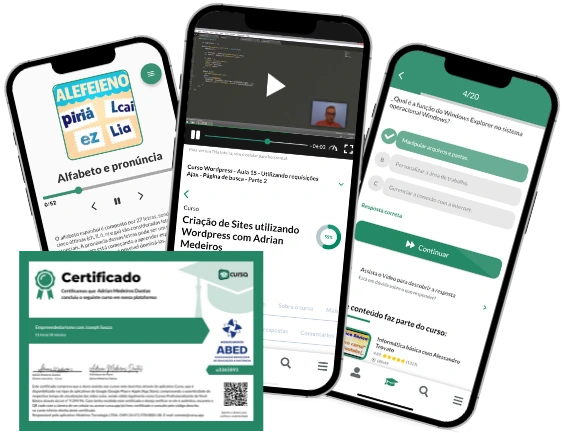
In the app you will also find...

Over 5,000 free courses
Programming, English, Digital Marketing and much more! Learn whatever you want, for free.

Study plan with AI
Our app's Artificial Intelligence can create a study schedule for the course you choose.

From zero to professional success
Improve your resume with our free Certificate and then use our Artificial Intelligence to find your dream job.
You can also use the QR Code or the links below.