The course covers core statistics topics used in data science, including data summaries, probability, distributions, inference, hypothesis testing, and regression fundamentals.

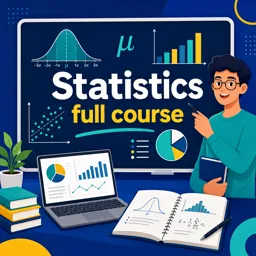
Duration of the online course: 8 hours and 15 minutes
5

(1)
Build job-ready data skills with a free statistics course: master probability, inference, and clear data insights, with a certificate-style learning path.
Understanding statistics is one of the fastest ways to improve how you study, work, and make decisions. This free online course gives you a full, university-style introduction to statistics focused on practical data science foundations, helping you turn raw numbers into reliable insights. Whether you are a student aiming to boost grades, a professional who wants to read reports with confidence, or someone preparing for analytics and tech roles, you will gain a clear framework for thinking with data instead of guessing.
Rather than relying on memorized formulas, you will build intuition for uncertainty and learn how to describe patterns accurately. You will explore how to summarize datasets, interpret distributions, and understand variation so your conclusions match what the data truly supports. You will also develop the ability to evaluate charts and claims you see in news, research, or business dashboards, spotting common mistakes and knowing when results are meaningful versus misleading.
As you progress, you will strengthen your probability thinking and connect it to real decisions, from estimating outcomes to interpreting risk. You will learn the logic behind statistical inference, including how sampling works and why sample size, bias, and variability affect results. By the end, you should feel comfortable moving from questions to data-backed answers, communicating results clearly, and choosing appropriate statistical approaches with confidence.
This course is a great fit if you want a solid base before learning machine learning, A/B testing, econometrics, psychology research methods, or any field that depends on evidence. It is also ideal for self-learners who want a structured path that feels like a complete classroom experience, but with the flexibility of online study. If you are looking for a practical way to upgrade your data literacy and open doors to analytics-focused opportunities, this course is a strong starting point.

8 hours and 15 minutes of online video course

Digital certificate of course completion (Free)

Exercises to train your knowledge

100% free, from content to certificate
What statistical concepts are covered in a full university-level data science course?
The course covers core statistics topics used in data science, including data summaries, probability, distributions, inference, hypothesis testing, and regression fundamentals.
How does statistics support data science and machine learning?
Statistics helps interpret data, measure uncertainty, test assumptions, identify patterns, and evaluate whether model results are reliable.
What is the difference between descriptive and inferential statistics?
Descriptive statistics summarize observed data, while inferential statistics use sample data to draw conclusions about a larger population.
Ready to get started?Download the app and get started today.
Install the app now
to access the course
Over 5,000 free courses
Programming, English, Digital Marketing and much more! Learn whatever you want, for free.

Study plan with AI
Our app's Artificial Intelligence can create a study schedule for the course you choose.

From zero to professional success
Improve your resume with our free Certificate and then use our Artificial Intelligence to find your dream job.
You can also use the QR Code or the links below.



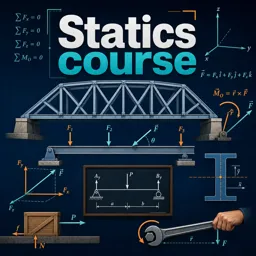
Free CourseStatics course
5
(2)

21h45m

35 exercises
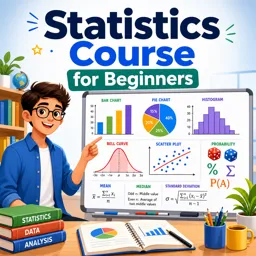
Free CourseStatistics Course for Beginners
5
(2)
9h48m
36 exercises
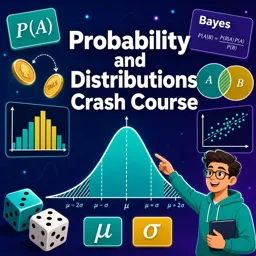
Free CourseProbability and Distributions Crash Course
5
(1)
10h37m
43 exercises
Free CourseStatistics
4.8
(31)
12h44m
32 exercises
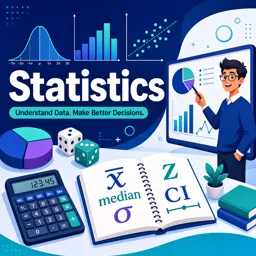
Free CourseStatistics
4.8
(33)
31h55m
25 exercises
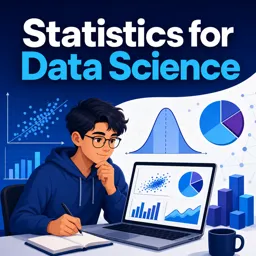
Free CourseStatistics for Data Science
4.5

(2)
8h15m
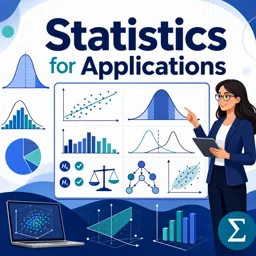
Free CourseStatistics for Applications
New
28h00m
22 exercises
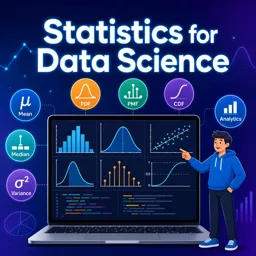
Free CourseStatistics for Data Science
New
10h53m
8 exercises
Free CourseApplied Statistics
New
16h30m
47 exercises
Free CourseBayesian statistics: a comprehensive course
New
5h03m
45 exercises
Carry knowledge in your pocket.
Download the Cursa app.
There are hundreds of free courses available, with a free certificate of completion that is saved in your mobile image gallery.
Download the app to access the Course Completion Certificate for Free.


+ 10 million
students

Free and Valid
Certificate

60 thousand free
exercises

4.8/5 rating in
app stores

Free courses in
video and ebooks