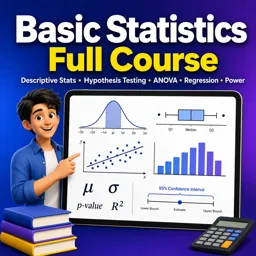
Free online course Basic Statistics Full Course: Descriptive Stats, Hypothesis Testing, ANOVA, Regression and Power
Duration of the online course: 8 hours and 46 minutes
New
Build real statistical skills fast in a free online course with quizzes: confidence intervals, hypothesis tests, ANOVA, regression, power, and better decisions.
In this free course, learn about
Distinguish population vs sample; link sample statistics to population parameters
Compute and choose mean/median/mode; handle skewness and outliers appropriately
Summarize spread: range, IQR, box plots; compute variance and standard deviation
Explain why sample variance uses n−1; interpret degrees of freedom
Use normal distribution concepts, z-scores (standardizing), and the central limit theorem
Differentiate SD vs SEM; compute and interpret standard errors
Build and interpret confidence intervals (z- and t-based) and relate them to tests
Run hypothesis tests: p-values, alpha, one- and two-tailed decisions, basic workflow
Apply t-tests (one-sample, paired, unpaired) and choose based on design/assumptions
Use ANOVA (one-way, repeated-measures); interpret the F statistic and calculations
Test proportions/categorical data: z-tests, chi-square (GOF/independence/homogeneity), McNemar
Use nonparametric tests: Mann–Whitney U, Wilcoxon signed-rank; interpret U and ranks
Understand Type I/II errors, power, and how sample size affects power
Analyze relationships: correlation (Pearson/Spearman) and regression (simple/multiple, R², assumptions)
About the free online course
Statistics can feel like a set of disconnected formulas until you see how each idea supports better decisions. This free online course guides you from the first building blocks of descriptive statistics to the reasoning behind modern inference, so you can confidently interpret data instead of memorizing steps. You will learn how to summarize data with meaningful measures of center and spread, recognize skewness and outliers, and understand why tools like standard deviation, variance, and the normal distribution matter in everyday analysis.
From there, the course focuses on the logic of uncertainty: sampling, the central limit theorem, standard error, and confidence intervals. Rather than treating these topics as abstract theory, you develop an intuition for what estimates mean, how precision changes with sample size, and how to communicate results in a clear, defensible way. You also move into hypothesis testing and p-values with an emphasis on interpreting outcomes correctly, including how confidence intervals and tests connect, what degrees of freedom represent, and what it really means to reject or fail to reject a null hypothesis.
As your skills grow, you will practice choosing appropriate methods for real scenarios, including comparisons between groups and before-and-after designs. You will understand when to use different t-tests, how one-way and repeated-measures ANOVA answer questions across multiple groups, and how categorical data methods like chi-square, z-tests for proportions, and exact tests fit into sound analysis. Nonparametric alternatives are introduced to help you handle situations where common assumptions are not a good match.
The course also develops your ability to model relationships in data. You will learn to interpret correlation, decide between Pearson and Spearman approaches, and build an understanding of linear regression from the idea of best fit through inference, residual reasoning, and model interpretation. By the end, concepts like Type I and Type II errors, statistical power, and sample size become practical tools for planning studies and evaluating results. With practice questions throughout, you finish with a structured, decision-oriented statistics foundation you can apply in school, projects, and entry-level data work.
Course content
Video class: Population vs Sample06m
Exercise: Which notation correctly matches a sample statistic with its corresponding population parameter for the mean?
Video class: Mean, median and mode09m
Exercise: For a skewed distribution with extreme values (outliers), which measure of central tendency is generally the most appropriate?
Video class: Range, interquartile range (IQR) and box plots08m
Exercise: How is the interquartile range (IQR) defined?
Video class: Standard deviation | how to calculate the SD and variance08m
Exercise: Why is the sample variance (and sample standard deviation) calculated using n − 1 in the denominator instead of n?
Video class: Why do we divide by n-1 and not n? | shown with a simple example | variance and sd10m
Exercise: Why do we divide by n−1 (instead of n) when computing the sample variance using the sample mean?
Video class: The normal distribution | how to interpret and use it15m
Exercise: What does standardizing a value x from a normal distribution (with mean μ and standard deviation σ) produce?
Video class: The central limit theorem | Explained with a simple example09m
Video class: The standard error of the mean (SEM)| how to calculate and interpret | SE vs SD09m
Exercise: Which statement best describes the standard error of the mean (SEM)?
Video class: Confidence intervals - simply explained12m
Exercise: How do you construct a 95% confidence interval for a population mean when the population standard deviation is known (or the sample is large)?
Video class: The t-distribution - why we need it | explained with confidence intervals15m
Exercise: When the population standard deviation is unknown and the sample size is small, what should be used to build a 95% confidence interval for the mean?
Video class: The one-sample t-test and p-values10m
Exercise: In a one-sample t-test, what does the p-value represent (under the assumption of no real effect)?
Video class: t-test VS confidence intervals11m
Exercise: How do a 95% confidence interval and a two-tailed one-sample t-test (α = 0.05) lead to the same decision about a hypothesized mean μ0?
Video class: The degrees of freedom - explained with a simple example02m
Exercise: In many basic statistical calculations, what is the simplified interpretation of degrees of freedom when estimating one parameter?
Video class: The basic steps of hypothesis testing08m
Exercise: In hypothesis testing, when do you reject the null hypothesis (H0) using a significance level α?
Video class: The unpaired t-test | Independent samples t-test16m
Exercise: In an unpaired (independent two-sample) t-test, what is the null hypothesis typically stating?
Video class: The paired t-test | explained with a simple example11m
Exercise: Which key assumption is most important for a paired t-test when the sample size is small?
Video class: Paired vs unpaired t-test05m
Exercise: In a study measuring the same individuals’ body weight before and after a diet, which t-test is appropriate and why?
Video class: One-way ANOVA: the basics14m
Exercise: What does the F statistic (F ratio) in a one-way ANOVA represent?
Video class: One-way ANOVA: the calculations - step-by-step13m
Video class: The repeated-measures ANOVA | explained with a simple example13m
Video class: The geometric mean07m
Exercise: Why is the geometric mean preferred over the arithmetic mean for averaging yearly percentage changes (growth rates)?
Video class: Variables and scales in statistics05m
Exercise: Which statement best describes the difference between a variable and a parameter?
Video class: One-proportion Z-test and the corresponding confidence interval12m
Exercise: In a one-proportion z-test, what does the denominator of the z-statistic represent?
Video class: The Chi-square goodness of fit test | and the difference to the one-proportion Z-test10m
Exercise: In a chi-square goodness-of-fit test, how are the degrees of freedom determined?
Video class: The two proportion z-test and the Chi-square test of homogeneity12m
Exercise: In a two-proportion z-test, why does a 95% confidence interval for (p1 − p2) that includes 0 lead to the same conclusion as a two-sided p-value greater than 0.05?
Video class: The Chi-square test of independence VS homogeneity and goodness of fit06m
Exercise: What is the key feature of a chi-square test of independence compared with a chi-square test of homogeneity?
Video class: The McNemar test04m
Exercise: What part of the 2×2 table is used to compute the McNemar test statistic?
Video class: The Mann Whitney U test (Wilcoxon Mann Whitney test) part 1/212m
Exercise: What does the Wilcoxon Mann–Whitney test primarily assess when comparing two independent groups?
Video class: The Mann Whitney U test (Wilcoxon Mann Whitney test) part 2/2 | exact p-value10m
Exercise: In the Wilcoxon–Mann–Whitney test, what does the U statistic represent in terms of comparisons between two groups?
Video class: The Wilcoxon signed-rank test10m
Exercise: In the Wilcoxon signed-rank test, what is used as the test statistic?
Video class: The basics of type 1 and 2 errors | explained with a simple example12m
Exercise: Which situation is a Type I error in hypothesis testing?
Video class: The probability of making a type 1 error06m
Exercise: When the null hypothesis is true, what does the significance level (alpha) represent?
Video class: The probability of making a type 2 error | explained with a simple example (part 1/2)14m
Exercise: In a one-sided left-tailed z-test (α = 0.05) for whether a diet reduces mean weight, what does the probability of a Type II error (β) represent?
Video class: The probability of making a type 2 error | explained with a simple example (part 2/2)08m
Exercise: In a two-sided hypothesis test, what does the probability of a Type II error (β) correspond to?
Video class: Statistical power and sample size calculations15m
Exercise: How is statistical power related to the Type II error probability (β)?
Video class: p-values - a deeper understanding | alpha | t-statistics13m
Video class: Correlation - the basics | Pearson correlation12m
Exercise: What does a Pearson correlation coefficient close to 0 indicate?
Video class: Correlation | hypothesis testing | assumptions07m
Exercise: When testing whether a Pearson correlation is significantly different from zero, what degrees of freedom are used for the t-test?
Video class: Spearman's rank correlation | Pearson VS Spearman08m
Exercise: Which statement best describes how Spearman’s rank correlation differs from Pearson’s correlation?
Video class: Linear regression | the basics - for beginners14m
Exercise: In simple linear regression for predicting used car price from age, which variable should be placed on the y-axis?
Video class: Least squares - explained with a simple numeric example11m
Exercise: In the method of least squares for simple linear regression, which line is considered the best fit to the data?
Video class: Linear regression | hypothesis testing09m
Exercise: In simple linear regression, what t-test is typically used to test whether the explanatory variable has a significant linear effect on the response?
Video class: Linear regression | the R-squared value08m
Exercise: What does the R-squared (coefficient of determination) represent in a linear regression model?
Video class: Assumptions in Linear Regression - explained | residual analysis16m
Video class: Multiple linear regression - explained with two simple examples15m
Exercise: In multiple linear regression with predictors age and mileage for car price, how should the coefficient for age be interpreted when mileage is included in the model?
Video class: Permutations Combinations and the Hypergeometric distribution13m
Video class: Fisher's test and how to calculate the exact p-value13m
Exercise: When is Fisher’s exact test typically preferred over the chi-square test for a 2×2 table?
Video class: How to choose an appropriate statistical test18m
Exercise: Which test is the non-parametric alternative to a one-way ANOVA when comparing more than two independent groups?
What is the difference between standard deviation and standard error of the mean?
Standard deviation describes variability among individual observations; standard error describes the precision of the sample mean as an estimate of the population mean.
When should I use a paired t-test instead of an independent t-test?
Use a paired t-test when measurements come from the same people or matched pairs, such as before-and-after results; use an independent t-test for separate groups.
What does R-squared mean in linear regression?
R-squared is the proportion of variation in the response variable explained by the regression model.
Ready to get started?Download the app and get started today.