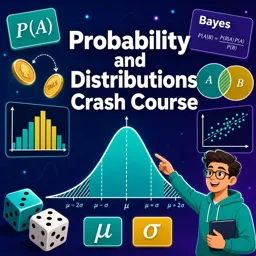
Free online course Probability and Distributions Crash Course
Duration of the online course: 10 hours and 37 minutes
New
Master probability fast with a free online course: distributions, Bayes, normal and Poisson, plus exercises to build confidence and earn a certificate.
In this free course, learn about
Probability vs statistics; sample spaces, events, and set operations in probability
Counting & combinatorics for probabilities (factorials, combinations, poker hands)
Rules: addition rule, complements (birthday problem), conditional probability, total probability
Bayes’ theorem for updating beliefs; applied example with drug-testing base rates
Independence and its consequences for event probabilities and joint distributions
Random variables; PMF/PDF/CDF concepts; computing probabilities from distributions
Moment generating functions: moments via derivatives; additivity for sums; tail-sum formula
About the free online course
Turn uncertainty into clear, workable numbers. This free online course is designed for anyone who wants a solid, practical grip on probability and statistical distributions without getting lost in jargon. You will learn how to describe random phenomena, compute meaningful probabilities, and choose the right distribution for a situation, skills that support success in school subjects, exams, data-driven projects, and everyday decision-making.
You start by building intuition: what probability measures, how it differs from statistics, and how counting ideas like coin flips, dice, and combinatorics translate into reliable calculations. From there, the course develops a precise language for uncertainty using sample spaces, events, and core rules such as addition and conditioning. You will see why problems that feel complex, like the birthday paradox or inspection and quality control scenarios, often become simpler once you frame them correctly.
As the course progresses, conditional probability and independence become tools you can actually use, not just definitions to memorize. Bayes’ theorem is treated as a practical update rule for beliefs, supported by realistic examples such as interpreting diagnostic tests where base rates matter. This mindset is invaluable for reading studies, evaluating claims, and understanding risk.
The second half connects random variables to the distributions that appear across science, engineering, and analytics. You will understand when binomial or multinomial models fit, how rare-event limits lead naturally to the Poisson, and why waiting-time questions point to exponential and gamma distributions. Normal approximations, standardization, and transformations help you move smoothly between models and compute probabilities with confidence.
Along the way you strengthen the mathematical backbone of probability: joint distributions, marginal and conditional densities, expectation and variance, covariance and correlation, and inequalities that bound uncertainty. You also gain the big-picture results that explain why statistics works, including the law of large numbers and the central limit theorem, plus an introduction to moment generating functions. With frequent exercises to check your understanding, you finish with a durable foundation you can apply immediately in further statistics courses or real-world analysis.
Course content
Video class: Probability and Statistics: Overview29m
Exercise: Which statement best describes the difference between probability and statistics?
Video class: Gentle Introduction to Probability: Counting Coin Flips and Dice20m
Exercise: When outcomes are equally likely, how is the probability of an event A defined?
Video class: Counting Probabilities with Combinatorics and the Factorial17m
Exercise: Which expression gives the number of unordered 5-card poker hands from a standard 52-card deck (drawn without replacement)?
Video class: Set Theory in Probability: Sample Spaces and Events24m
Exercise: Which expression correctly applies the addition rule for two events A and B (not necessarily disjoint)?
Video class: The Birthday Problem in Probability: P(A) = 1 - P(not A)20m
Exercise: In the birthday problem, what is the easiest way to compute the probability that at least two people share a birthday?
Video class: Quality Control, Non-Destructive Inspection, and the Multinomial Distribution13m
Exercise: In a lot of n items with k defective, if you sample r items without replacement, what is the probability that exactly m are defective?
Video class: The Binomial Distribution and the Multinomial Distribution16m
Exercise: Which expression correctly gives the number of unordered 5-card poker hands dealt from a 52-card deck without replacement?
Video class: Conditional Probabilities13m
Exercise: Which formula correctly defines conditional probability of event A given event B?
Video class: The Law of Total Probability10m
Exercise: Which formula correctly states the law of total probability when the sample space is partitioned into disjoint events B1, B2, ..., Bn whose union is Ω?
Video class: Bayes' Theorem (with Example!)17m
Exercise: In Bayes’ theorem, which expression correctly gives the probability of event B given event A?
Video class: Bayes' Theorem Example: Drug Testing ????12m
Exercise: A drug test has sensitivity P(+|user)=0.9, specificity P(-|non-user)=0.8, and the base rate of users is P(user)=0.1. What is P(user|+)?
Video class: Independence in Probability13m
Exercise: If two events A and B are independent, which equation must be true?
Video class: Random Variables and Probability Distributions21m
Video class: Bernoulli and Binomial Random Variables24m
Exercise: A binomial random variable X counts the number of successes in n independent Bernoulli trials with success probability p. What is P(X = k)?
Video class: The Normal Distribution: The Limit of Binomial Distribution for Large n17m
Exercise: For a binomial random variable X ~ Binomial(n, p) with large n, what normal distribution is used as an approximation?
Video class: The Standard Unit Normal and Probability Computations17m
Exercise: When approximating a binomial distribution with a normal distribution (large n, moderate p), what mean (μ) and variance (σ²) are used for the normal approximation?
Video class: The Poisson Distribution: The Rare Event Limit of a Binomial Distribution13m
Exercise: When the normal approximation to a binomial distribution fails because events are very rare (p very small), which distribution is used as the solution?
Video class: The Geometric Distribution: The First Success of a Bernoulli Distribution12m
Exercise: In a geometric distribution with success probability p on each independent trial, what is P(X = n), the probability the first success occurs on the n-th trial?
Video class: The Exponential Distribution: Time Between Poisson Events18m
Exercise: Which statement best describes the memoryless property of an exponential random variable T?
Video class: The Hazard Rate and Memoryless Property of the Exponential Distribution07m
Exercise: What does the memoryless property of the exponential distribution imply?
Video class: The Connection Between the Exponential Distribution and the Poisson Process10m
Exercise: In a Poisson process with event rate \(\lambda\), what is the distribution of the number of events occurring in a time interval of length \(t\)?
Video class: The Gamma Distribution12m
Exercise: In a Poisson process with rate \(\lambda\), what distribution describes the waiting time until the \(r\)th event (arrival)?
Video class: Functions of a Random Variable13m
Exercise: When defining a new random variable as y = g(x), what is the recommended method to find the PDF of y from the PDF of x?
Video class: Rescaling the Normal Distribution to Mean Zero and Variance One09m
Exercise: How do you transform a normal random variable x with mean μ and standard deviation σ into a standard normal variable y?
Video class: The Chi Squared Distribution: The Square of the Normal Distribution13m
Exercise: If X is a standard normal random variable (mean 0, variance 1) and Y = X^2, what distribution does Y follow?
Video class: Joint Probability Distributions14m
Exercise: If two random variables x and y are independent, how is their joint probability expressed?
Video class: Joint Probability Distributions: Marginal and Conditional Densities09m
Exercise: How do you compute the marginal density f(x) from a continuous joint PDF f(x,y)?
Video class: The Expected Value (Mean) of a Probability Distribution15m
Exercise: Which statement best describes the law of large numbers in terms of sample mean and expected value?
Video class: Properties of the Expected Value10m
Exercise: Which statement is true when two random variables x and y are independent?
Video class: Variance and Standard Deviation12m
Exercise: Which expression is equivalent to the variance of a random variable x?
Video class: Example of Computing the Expectation and Variance of an Exponential Distribution11m
Exercise: For an exponentially distributed random variable T with PDF f(t)=λe^{-λt} (t≥0), what is the variance Var(T)?
Video class: Two Examples of Expected Values15m
Exercise: If a new random variable is defined by a linear transformation y = aX + b, how does the variance change?
Video class: Markov's Inequality in Probability: First Order Estimates08m
Exercise: What does Markov's inequality state for a non-negative random variable X?
Video class: Chebyshev's Inequality in Probability: Second Order Estimates09m
Exercise: What does Chebyshev's inequality state for a random variable with mean \(\mu\) and variance \(\sigma^2\)?
Video class: The Law of Large Numbers12m
Exercise: According to the Law of Large Numbers, what happens to the sample mean as the number of independent samples n increases?
Video class: The Central Limit Theorem10m
Exercise: According to the Central Limit Theorem, if \(X_1,\dots,X_n\) are iid with mean \(\mu\) and variance \(\sigma^2\), what is the approximate distribution of the sample mean \(\bar X_n\) for large \(n\)?
Video class: The Moment Generating Function21m
Exercise: How can the moment generating function (MGF) be used to obtain the n-th moment of a random variable?
Video class: Example of The Moment Generating Function09m
Exercise: How can you compute the n-th moment E[X^n] using the moment-generating function M(t)?
Video class: The Lebesque Measure in Probability06m
Exercise: Why is the cumulative distribution function (CDF) often easier to work with than the probability density function (PDF)?
Video class: Additive Property of the Moment Generating Function06m
Exercise: If X and Y are independent random variables and Z = X + Y, what is the moment-generating function of Z?
Video class: Covariance and Correlation in Probability19m
Exercise: Which formula correctly defines the covariance of two random variables X and Y?
Video class: Covariance and Correlation: Example with Gaussian Distributions05m
Exercise: In a radially symmetric 2D Gaussian distribution, what is true about the relationship between X and Y?
Video class: The Tail Sum Formula in Probability09m
Exercise: What does the tail sum formula express for a non-negative discrete random variable X?
Video class: Proof of the Central Limit Theorem26m
Exercise: In the central limit theorem setup described, how is the normalized sum defined so it tends to a standard normal distribution as n becomes large?
This free course includes:
10 hours and 37 minutes of online video course
Digital certificate of course completion (Free)
Exercises to train your knowledge
100% free, from content to certificate
How do you calculate the probability of a positive drug test being correct using Bayes' theorem?
Use P(user|+) = P(+|user)P(user) / P(+). With sensitivity 0.9, specificity 0.8, and a 0.1 base rate, the result is 1/3, or about 33.3%.
When should a binomial distribution be approximated by a normal or Poisson distribution?
Use a normal approximation when n is large and p is not too close to 0 or 1; use a Poisson approximation for rare events with large n, small p, and λ = np.
What is the difference between the law of large numbers and the central limit theorem?
The law of large numbers says the sample mean approaches the expected value. The central limit theorem says the sample mean becomes approximately normally distributed for large samples.
Ready to get started?Download the app and get started today.