Duration of the online course: 21 hours and 45 minutes
5
(2)
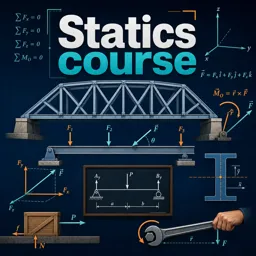
Build problem-solving confidence in statics with this free online course—vectors, equilibrium, moments, trusses, and more. Practice with exercises & certificate.
In this free course, learn about
Apply Newton’s laws; distinguish scalars vs vectors in statics problems
Add 2D vectors via triangle rule and components; compute resultants and angles
Resolve forces into components in Cartesian and non-orthogonal coordinate systems
Work with 3D vectors: spherical (blue triangle), directional cosines, unit-vector methods
Use dot product to find angles between vectors and compute projections
Solve particle equilibrium (2D/3D) with free-body diagrams, cables, pulleys, and springs
Compute moments/torque: r×F, moments about points/axes, and couples in 2D/3D
Reduce force systems to equivalent resultant force + moment; simplify complex loadings
Find support reactions for 2D/3D rigid bodies; identify two-force members
Compute centroids/centers of mass by composite shapes, calculus, and Pappus-Guldinus
Analyze trusses/frames: method of joints, sections, zero-force members, combo method
Determine internal forces N, V, M and build shear and moment diagrams (graphic/equation)
Solve friction problems: impending motion, tipping/slipping, wedges, and belt friction
Compute area moments of inertia using parallel-axis, composite shapes, and calculus methods
About the free online course
Strengthen your engineering and physics foundations by learning how forces really behave when nothing is accelerating. This free online statics course is designed to help you move from memorizing formulas to thinking like a problem solver, so you can set up clean models, choose the right equations, and finish problems with confidence.
You’ll start with the essentials that make or break performance in statics: Newton’s laws, scalars and vectors, and the language of vector addition. From there, you’ll build the skill of expressing forces in different forms, switching between component notation and geometric approaches, and handling non-orthogonal axes without getting lost. As the course progresses, you’ll extend those ideas into three dimensions, using tools such as directional cosines, unit vectors, coordinates, and the dot product to connect geometry with calculation.
With that vector toolbox in place, you’ll work through equilibrium of particles in 2D and 3D, learning how to write clear force-balance equations and how to approach multi-cable, pulley, and spring setups. You’ll then step up to rigid-body mechanics through moments and torque, building intuition for r×F, moments about a point, about an axis, and the special behavior of couples. Along the way, you’ll develop the habit that top students rely on: translating messy real situations into a consistent diagram and a reliable set of unknowns.
The course also connects statics to the problems you see most in exams and real applications: simplifying force systems into equivalent systems, finding reactions at supports in both 2D and 3D, and checking overall system equilibrium. You’ll gain a practical understanding of centroids and distributed loads, and then apply statics methods to structures through trusses, frames, and machines. As you advance, you’ll practice internal forces in members, build shear and moment diagrams with different solution styles, and tackle friction scenarios that require careful reasoning about impending motion.
To keep you progressing, the course includes targeted exercises and review-focused practice that reinforce setup, sign conventions, and efficient solving strategies. By the end, you’ll be better prepared for school assessments and for next-step subjects that depend on statics, with a clearer, more dependable approach to engineering problem solving.
Course content
Video class: Statics: Lesson 1 - Intro and Newton’s Laws, Scalers, and Vectors16m
Exercise: _What is Newton's first law of motion?
Video class: Statics: Lesson 2 - Vector Language, Intro to Vector Addition12m
Exercise: What is the resultant of two concurrent vectors with magnitudes 5 and 7 pounds, both in the positive direction?
Video class: Statics: Lesson 3 - The Triangle Rule for Adding Vectors to Find a Resultant16m
Exercise: What is the magnitude of vector R when adding vectors A and B with given angles?
Video class: Statics: Lesson 4- Vector Addition, Triangle Rule, and Cartesian and Vector Notation23m
Exercise: What is the approximate magnitude of the resultant vector R?
Exercise: _What are the two methods used to find the resultant of vectors F1 and F2 in the given problem?
Video class: Statics: Lesson 6 - Finding Vector Components in Non-Orthogonal Systems07m
Exercise: What is the magnitude of the u and v components of a 30-pound force in a non-orthogonal system with axes separated by 75 degrees?
Video class: Statics: Lesson 7 - Most Missed Topic in Statics, Cartesian Coordinates08m
Exercise: What is the most missed topic in statics according to the expert?
Video class: Statics: Lesson 8 - Intro to 3D Vectors, Deriving Blue Triangle Equations (Spherical Coordinates)15m
Exercise: What is the goal when working with 3D vectors in this tutorial?
Video class: Statics: Lesson 9 - Drill Problems Practicing Blue Triangle Problems (Spherical Coordinates)12m
Exercise: _What are the three unknowns in the blue triangle equations?
Video class: Statics: Lesson 10 - Directional Cosines for 3D Vectors and Components13m
Exercise: What describes the directional cosine method for 3D vectors?
Video class: Statics: Lesson 11 - Finding 3D Vectors When Given Coordinates12m
Exercise: What is the lambda hat method used for in 3D vectors?
Video class: Statics: Lesson 12 - Statics About a Particle, 3D Resultant of Vector Forces17m
Exercise: What are the three methods to express 3D vectors mentioned in the video?
Video class: Statics: Lesson 13 - Dot Product for Angles Between Vectors and Projections23m
Exercise: _What is the mathematical trick used to find the angle between two 3D vectors?
Video class: Statics: Lesson 14 - Using Scaler Equations to Solve for 2 Unknowns11m
Exercise: What does equilibrium of a particle mean in Chapter 3?
Video class: Statics: Lesson 15 - Proving There’s no Such Thing As Straight Strings09m
Exercise: What is the tension in a cable supporting a 100-pound traffic light at a 30-degree angle?
Video class: Statics: Lesson 16 - Equilibrium of a Particle, 2D Forces Around a Pulley10m
Exercise: What is the tension in the ABC cable given the following problem setup?
Video class: Statics: Lesson 17 - 2D Equilibrium of a Particle With Springs14m
Exercise: _What is the equation for force in a spring used in statics according to Dr. Hanson?
Video class: Statics: Lesson 18 - 2D Statics on a Particle, Multiple Free Body Diagrams17m
Exercise: What is the tension of cable DE in the system?
Video class: Statics: Lesson 19 - 3D Statics About a Particle, Calculating Unit Vectors17m
Exercise: What is the tension in the three green cables for lifting a 2500N slab?
Video class: Statics: Lesson 20 - 3 Equations and Unknowns, 3D Vectors14m
Exercise: What is the calculated force in cable TDB given the 600 Newton weight?
Video class: Statics: Lesson 21 - Introduction to Moments rXF, Torque24m
Exercise: _What is a rigid body, according to Jeff Hanson?
Video class: Statics: Lesson 22 - 2D Moment About a Point, 2 Methods12m
Video class: Statics: Lesson 23 - 2D Min Max Moment Calculation12m
Video class: Statics: Lesson 24 - 3D Moment About a Point and rXF Example11m
Video class: Statics: Lesson 25 - Moment About a Specified Axis10m
Exercise: _What is the equation for finding the moment about a wacky axis according to Jeff Hanson's explanation?
Video class: Statics: Lesson 26 - Moment of a Couple in 3D11m
Video class: Statics: Exam 1 - Review Summary07m
Video class: Statics: Exam 1 Review Problem 1, 3D Vector Addition19m
Video class: Statics: Exam 1 Review Problem 2, 2D Forces on a Particle13m
Exercise: _What is the max weight of the backpack that can be hung up in the tree according to the problem?
Video class: Statics: Exam 1 Review Problem 3, 3D Statics on a Particle20m
Video class: Statics: Exam 1 Review Problem 4, 2D Moment Example06m
Video class: Statics: Exam1 Review Problem 5, 3D rXF Moment Example13m
Video class: Statics: Lesson 27 - Equivalent Systems Simplification, Burrito Force!19m
Exercise: _What are the two possible ways to reduce a given system in the section Equivalent Systems?
Video class: Statics: Lesson 28 - Equivalent Systems, Further Simplification11m
Video class: Statics: Lesson 29 - 2D Reaction at Supports, Example Problem13m
Video class: Statics: Lesson 30 - 3D Reaction Forces Illustrated10m
Video class: Statics: Lesson 31 - System Equilibrium, 2D Reactions at the Supports15m
Exercise: _What is a 2-force member?
Video class: Statics: Lesson 32 - Fixed Support 2D Reaction Force Problem07m
Video class: Statics: Lesson 33 - 2D Reactions at the Supports With a Pulley07m
Video class: Statics: Lesson 34 - Tipping Problem, Reactions in 2D08m
Video class: Statics: Lesson 35 - 3D Equilibrium of a Rigid Body, 6 Equations10m
Exercise: _What is missing in the problem that Jeff Hanson is solving?
Video class: Statics: Lesson 36 - 3D Reaction Force Problem, Rigid Body Equilibrium19m
Video class: Statics: Lesson 37 - Intro to Centroids, Where is the Center of Texas?13m
Video class: Statics: Lesson 38 - Intro, Centroids by Composite Shapes, Table Method14m
Video class: Statics: Lesson 39 - Centroid Using Composite Shapes, Center of Area08m
Video class: Statics: Lesson 40 - Centroid of a Volume, Table Method12m
Video class: Statics: Lesson 41 - Centroid of Mass, Body with Different Densities12m
Video class: Statics: Lesson 42 - Intro to Centroid by Calculus Method, Flip the Strip Method15m
Video class: Statics: Lesson 43 - Centroids by Calculus Example Problem09m
Exercise: _What is the equation for x bar using the centroid by calculus method for the given shape?
Video class: Statics: Lesson 44 - Very Challenging Centroids by Calculus Problem31m
Video class: Statics: Lesson 45 - The Theorem of Pappus Guldinus, Volume and Surface Area18m
Video class: Statics: Lesson 46 - Distributed Loads Using Centroids10m
Video class: Statics: Exam 2 Review Summary05m
Exercise: _What is the most important thing to remember when solving equivalent system problems?
Video class: Statics: Exam 2 Review Problem 1; Equivalent Systems13m
Video class: Statics: Exam 2 Review Problem 2; 2D Reaction Forces08m
Video class: Statics: Exam 2 Review Problem 3; 3D Reaction Example15m
Video class: Statics: Exam 2 Review Problem 4, Centroid Composite Shape15m
Exercise: _What is x bar, y bar, and z bar for the 3D area described by Jeff Hanson?
Video class: Statics: Exam 2 Review Problem 5, Centroid by Calculus16m
Video class: Statics: Exam 2 Review Problem 6, Theorem of Pappus Guldinus16m
Video class: Statics: Lesson 47 - Intro to Trusses, Frames, and Machines06m
Video class: Statics: Lesson 48 - Trusses, Method of Joints19m
Video class: Statics: Lesson 49 - Trusses, The Method of Sections14m
Video class: Statics: Lesson 50 - Trusses, How to Find a Zero Force Member, Method of Joints21m
Video class: Statics: Lesson 51 - Trusses, Method of Sections, Truss Tips and Tricks12m
Video class: Statics: Lesson 52- Truss Problem, The Combo Problem15m
Exercise: _What is the "combo method" in truss analysis?
Video class: Statics: Lesson 53 - Frame Problem with 2 (Two) Force Members30m
Video class: Statics: Lesson 54 - More Difficult Frame Problem29m
Video class: Statics: Lesson 56 - Pulley Palooza Problems17m
Video class: Statics: Lesson 57 - Introduction to Internal Forces, M N V17m
Exercise: _What are the three internal forces that occur in a beam when external forces are applied?
Video class: Statics: Lesson 58 - Internal Forces M, N, V on a Frame Problem15m
Video class: Statics: Lesson 59 - Shear Moment Diagram, The Graphic Method19m
Video class: Statics: Lesson 60 - Shear Moment Diagram Problem with Moments14m
Video class: Statics: Lesson 61 - Shear Moment Diagram, The Equation Method17m
Exercise: _What is the method recommended by Jeff Hanson for solving shear/moment diagrams in all cases except one?
Video class: Statics: Lesson 62 - Friction is Fun, Box on an Incline17m
Video class: Statics: Lesson 63 - Friction Slipping Tipping Problem10m
Video class: Statics: Lesson 65 - Challenging Friction Wedge Problem with Roller19m
Video class: Statics: Lesson 66 - Belt Friction Example Problem08m
Exercise: _What is belt friction?
Video class: Statics: Exam 3 Review Summary06m
Video class: Statics: Exam 3 Review Problem 1; Truss Combo Method18m
Video class: Statics: Exam 3 Review Problem 2; Frame Example12m
Video class: Statics: Exam 3 Review Problem 3, Internal Forces M, N, V20m
Video class: Statics: Exam 3 Review Problem 4, Shear Moment Diagram Example22m
Video class: Statics: Exam 3 Review Problem 5, Simple Friction is Fun16m
Video class: Statics: Exam 3 Review Problem 6, Friction Slipping Tipping17m
Video class: Statics: Exam 3 Review Problem 7, Friction Wedge Example12m
Exercise: _What is the value of mu sub s for friction in this problem?
Video class: Statics: Lesson 67 - Introduction to Area Moment of Inertia13m
Video class: Statics: Lesson 68 - Parallel Axis Theorem, Area Moment of Inertia14m
Video class: Statics: Lesson 69 - Moment of Inertia, Composite Shape Method14m
Video class: Statics: Lesson 70 - Area Moment of Inertia, Calculus Method07m
Exercise: _What is the equation to find Iy using the calculus method for a wacky shape not in the back of your book?
Video class: Statics: Final Exam Review Summary05m
Video class: Statics: Lesson 71 - Statics Conclusion and Farewell! What’s Next?03m
This free course includes:
21 hours and 45 minutes of online video course
Digital certificate of course completion (Free)
Exercises to train your knowledge
100% free, from content to certificate
What statics topics are covered in this free course?
The course covers forces and vectors, particle and rigid-body equilibrium, moments, support reactions, centroids, trusses, internal forces, friction, and area moments of inertia.
How are 3D vectors and forces solved in statics?
Lessons use Cartesian components, unit vectors, directional cosines, coordinates, and equilibrium equations to express and combine 3D forces.
Does the course explain shear-force and bending-moment diagrams?
Yes. It teaches graphical and equation methods for shear and moment diagrams, including problems involving applied moments and internal forces.
Ready to get started?Download the app and get started today.