Multiply the prior by the likelihood and normalize the result by the marginal probability of the observed data.

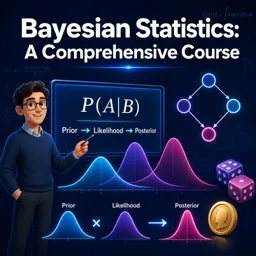
Duration of the online course: 5 hours and 3 minutes
New
Master Bayesian inference with this free statistics course—update beliefs with data, use priors smartly, and earn skills valued in analytics and research.
Bayesian thinking changes how you interpret uncertainty: instead of treating parameters as fixed and data as random, you learn to update what you believe as evidence accumulates. This free online course is designed to help you build that mindset and apply it confidently to real statistical questions, even if Bayes’ rule has felt abstract in the past. By the end, you should be able to move from intuition to calculation and explain, in plain language, what your posterior conclusions mean and why they follow from your assumptions.
You’ll start by strengthening the probability foundations that make Bayesian methods work, especially marginal and conditional probability for continuous variables. From there, Bayes’ rule becomes more than a formula: it becomes a practical tool for reasoning. You will see how the likelihood connects models to data, why it is not the same thing as a probability statement about parameters, and how priors shape conclusions without turning analysis into guesswork. You will also learn why, in many computations, a messy normalizing denominator can be set aside temporarily while still arriving at the correct posterior form.
A key feature of Bayesian modeling is recognizing when assumptions are justified. That’s why the course emphasizes ideas like exchangeability and its relationship to iid thinking, giving you a clearer rationale for common modeling shortcuts. You’ll also explore sequential updating and why, under standard conditions, the order of independent data points should not change your inference—an insight that reinforces both correctness and intuition.
To make Bayesian inference actionable, the course highlights conjugate priors as a fast, interpretable pathway to posterior distributions. You’ll work through classic families such as Beta-Binomial for proportions, Normal-Normal for means (with known variance), and Gamma-Poisson for count data, connecting each choice to practical scenarios like disease prevalence, test scores, and event counts. Predictive thinking is woven throughout, helping you go beyond estimating parameters to forecasting what future observations may look like under both prior and posterior beliefs.
Whether you are a student in school subjects, a beginner aiming for confidence in statistics, or someone preparing for data-focused roles, this course helps you build reliable reasoning habits. You will finish with a clearer grasp of how to express uncertainty, defend modeling choices, and turn data into updated, decision-ready conclusions.

Explore free online Statistics for Data Science courses and build essential skills in probability, data analysis, statistical modeling, hypothesis testing, regression, and more. Learn at your own pace with expert-led lessons for beginners and professionals. Enroll today, earn a certificate, and strengthen your data science career.

Explore free online Bayesian Statistics courses and build practical skills in probability, inference, Bayes' theorem, prior and posterior distributions, predictive modeling, and data analysis. Learn at your own pace with beginner-friendly and advanced options, and earn a certificate to showcase your knowledge in statistics, data science, and machine learning.

5 hours and 3 minutes of online video course

Digital certificate of course completion (Free)

Exercises to train your knowledge

100% free, from content to certificate
How do you calculate a posterior distribution using Bayes' rule?
Multiply the prior by the likelihood and normalize the result by the marginal probability of the observed data.
Why is the Beta distribution conjugate to the Binomial likelihood?
A Beta prior combined with Binomial or Bernoulli data produces a Beta posterior, allowing simple updates to its two parameters.
What posterior predictive distribution results from a Gamma prior and Poisson likelihood?
Integrating out the Poisson rate under a Gamma posterior produces a negative binomial posterior predictive distribution.
Ready to get started?Download the app and get started today.
Install the app now
to access the course
Over 5,000 free courses
Programming, English, Digital Marketing and much more! Learn whatever you want, for free.

Study plan with AI
Our app's Artificial Intelligence can create a study schedule for the course you choose.

From zero to professional success
Improve your resume with our free Certificate and then use our Artificial Intelligence to find your dream job.
You can also use the QR Code or the links below.




Free CourseStatics course
5

(2)

21h45m

35 exercises
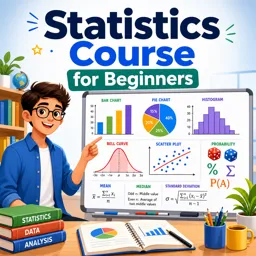
Free CourseStatistics Course for Beginners
5
(2)
9h48m
36 exercises
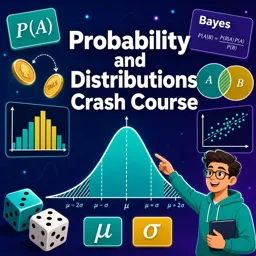
Free CourseProbability and Distributions Crash Course
5
(1)
10h37m
43 exercises
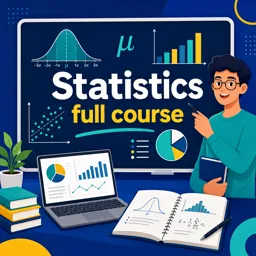
Free CourseStatistics full course
5
(2)
8h15m
Free CourseStatistics
4.8
(31)
12h44m
32 exercises
Free CourseStatistics
4.8
(33)
31h55m
25 exercises
Free CourseStatistics for Data Science
4.5

(2)
8h15m
Free CourseStatistics for Applications
New
28h00m
22 exercises
Free CourseStatistics for Data Science
New
10h53m
8 exercises
Free CourseApplied Statistics
New
16h30m
47 exercises
Carry knowledge in your pocket.
Download the Cursa app.
There are hundreds of free courses available, with a free certificate of completion that is saved in your mobile image gallery.
Download the app to access the Course Completion Certificate for Free.


+ 10 million
students

Free and Valid
Certificate

60 thousand free
exercises

4.8/5 rating in
app stores

Free courses in
video and ebooks