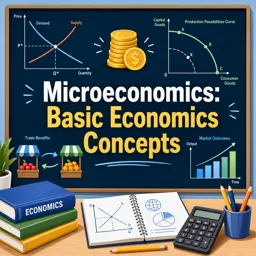

Free ebook on supply, demand, equilibrium, elasticity, market efficiency, taxes, subsidies, and price controls in microeconomics.
Free ebook content
-

Microeconomics Essentials: How Markets Use Supply and Demand
+ Exercise: In a city’s bottled-water market, which situation is best described as a shift of the demand curve rather than a movement along it?
-
Microeconomics Essentials: Building Demand Curves and Reading Buyer Behavior
+ Exercise: A coffee shop lowers the price of a cup of coffee from $5 to $3, and all other factors (income, tastes, related goods, expectations, number of buyers) stay the same. Which statement correctly describes what happens?
-
Microeconomics Essentials: Shifts in Demand and the Determinants of Demand
+ Exercise: A city raises bus fares from $2 to $2.50 and ridership falls. Which statement best describes what happened in terms of demand?
-
Microeconomics Essentials: Building Supply Curves and Understanding Seller Costs
+ Exercise: A seller’s product price rises while technology, input costs, and the number of sellers stay the same. What is the correct way to describe what happens on the supply graph?
-
Microeconomics Essentials: Shifts in Supply and the Determinants of Supply
+ Exercise: A government introduces a per-unit subsidy paid to producers of a good. Which change is most consistent with this policy?
-
Microeconomics Essentials: Market Equilibrium and Price as a Coordinating Signal
+ Exercise: In the movie ticket schedule, if the price is set at $12, what market outcome is expected and what pressure does it create for price adjustment?
-
Microeconomics Essentials: Comparative Statics—Predicting New Equilibria After Shocks
+ Exercise: A holiday weekend increases driving demand for gasoline while a pipeline disruption reduces gasoline supply. What happens to equilibrium price and quantity?


-
Microeconomics Essentials: Price Elasticity of Demand—Responsiveness and Revenue
+ Exercise: Using the midpoint method, price falls from $20 to $18 and quantity demanded rises from 50 to 60. What is the approximate price elasticity of demand (PED), and is demand elastic or inelastic?
-
Microeconomics Essentials: Elasticity of Supply and Short-Run vs Long-Run Adjustment
+ Exercise: A demand surge raises the price of tickets for a concert happening tonight, but the number of seats is fixed. What outcome best describes the short-run market adjustment?
-
Microeconomics Essentials: Consumer Surplus, Producer Surplus, and Total Gains from Trade
+ Exercise: On a standard price–quantity graph at the market outcome (P*, Q*), which shaded region represents producer surplus?
-
Microeconomics Essentials: Market Efficiency and Deadweight Loss from Misallocation
+ Exercise: In a linear supply-and-demand model with a per-unit wedge (such as a tax or subsidy) that moves quantity away from the efficient level, what do the “base” and “height” represent when calculating deadweight loss as a triangle?
-
Microeconomics Essentials: Price Controls—Rent Ceilings, Shortages, and Rationing
+ Exercise: Under a binding rent ceiling (set below equilibrium), what determines the quantity of housing units actually rented?
-
Microeconomics Essentials: Taxes—Tax Incidence, Wedges, and Efficiency Costs
+ Exercise: A per-unit tax t creates a wedge between the price buyers pay (Pb) and the price sellers receive (Ps). Which statement correctly describes the wedge condition and its implication for who bears the tax burden?
-
Microeconomics Essentials: Subsidies and Policy Tradeoffs in Everyday Markets
+ Exercise: In a market with a per-unit subsidy s, which statement best describes how to find the post-subsidy equilibrium and fiscal cost?
About the free ebook
Microeconomics Essentials: Supply, Demand, and Market Equilibrium
This free ebook introduces the core tools economists use to explain how everyday markets work. Learn how buyers and sellers respond to prices, how their decisions form demand and supply curves, and why markets tend toward an equilibrium price and quantity.
Understand market behavior
Explore the difference between a movement along a curve and a shift of the entire curve. The ebook examines the determinants of demand, including income, preferences, related goods, expectations, and the number of buyers. It also explains how production costs, technology, taxes, expectations, and the number of sellers can shift supply.
Analyze changes and responsiveness
Use comparative statics to predict how market shocks affect equilibrium. Learn how price elasticity of demand and supply measure responsiveness, why elasticity matters for total revenue, and why firms may adjust differently in the short run and long run.
Evaluate market outcomes and policies
The ebook connects graphs to welfare analysis through consumer surplus, producer surplus, total gains from trade, efficiency, and deadweight loss. It also explains how price ceilings, taxes, and subsidies create tradeoffs involving shortages, tax incidence, market incentives, and social welfare.
What you will be able to do
- Read and interpret supply-and-demand diagrams.
- Predict the direction of equilibrium changes after a market shock.
- Compare elastic and inelastic responses.
- Assess the effects of common government interventions.
Written for economics learners, this resource provides a practical foundation for analyzing prices, incentives, and policy decisions in real-world markets.
What causes a demand curve to shift?
Changes in income, preferences, prices of related goods, expectations, or the number of buyers shift demand.
How does elasticity affect total revenue?
With elastic demand, a price cut raises total revenue; with inelastic demand, a price increase raises it.
Who bears the burden of a tax in a market?
The less elastic side of the market bears more of the tax burden.
This ebook includes:

14 content chapters

Digital certificate of course completion (Free)

Exercises to train your knowledge

100% free, from content to certificate
Ready to get started?

 recommended
In the app you will also find...

Over 5,000 free courses
Programming, English, Digital Marketing and much more! Learn whatever you want, for free.

Study plan with AI
Our app's Artificial Intelligence can create a study schedule for the course you choose.

From zero to professional success
Improve your resume with our free Certificate and then use our Artificial Intelligence to find your dream job.
You can also use the QR Code or the links below.