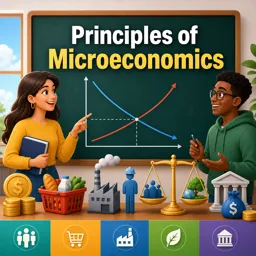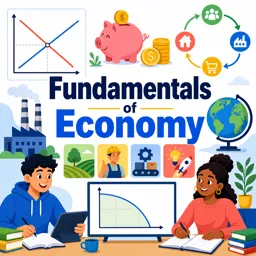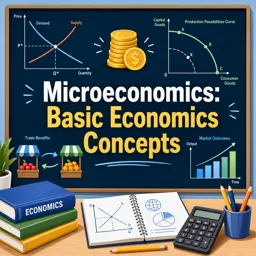

Free ebook on scarcity, opportunity cost, incentives, prices, trade, and practical economic decision-making.
Free ebook content
-

Economic Fundamentals: Scarcity and the Logic of Choice
+ Exercise: In the framework for describing any choice, which element identifies the combinations of actions that are actually possible given the limits (such as time, money, or capacity)?
-
Economic Fundamentals: Trade-Offs and Opportunity Cost
+ Exercise: A student says, “The workshop is free, so it doesn’t really cost me anything.” Which response best applies opportunity cost?
-
Economic Fundamentals: Thinking at the Margin
+ Exercise: Using the marginal decision rule (MB ≥ MC), how many hours should you study if the next hour has MB=4 and MC=4, but the following hour has MB=2 and MC=5?
-
Economic Fundamentals: Incentives and Predicting Behavior
+ Exercise: A policy adds a penalty for an unwanted action, but the monetary amount of the penalty stays the same. According to incentive-based prediction, what change is most likely to increase compliance?


-
Economic Fundamentals: How Prices Coordinate Choices
+ Exercise: During a sudden rainstorm at peak commute time, a ride-sharing app raises prices. What is the main economic function of this higher price?
-
Economic Fundamentals: Trade and Gains from Exchange
+ Exercise: After the change where Drew can edit 1 report in 2 hours (instead of 3), who should specialize in editing and who should specialize in designing based on comparative advantage?
-
Economic Fundamentals: Simple Models for Clear Thinking
+ Exercise: In a simple demand model for coffee, what does it mean to predict that a price increase will reduce cups sold, ceteris paribus?
-
Economic Fundamentals: Costs, Benefits, and Decision Errors
+ Exercise: When deciding whether to keep paying for a subscription you barely use, which approach best applies economic reasoning to avoid the sunk cost fallacy?
-
Economic Fundamentals: Bringing Scarcity, Trade-Offs, and Incentives Together
+ Exercise: When applying the repeatable decision template to a policy change (like setting office days), which approach best reflects marginal analysis?
About the free ebook
Economics Fundamentals: Scarcity, Trade-Offs, and Incentives
This free ebook introduces the core ideas that economists use to explain everyday choices, market behavior, and the use of limited resources. It shows how scarcity affects individuals, businesses, and governments, making choices unavoidable.
Make clearer decisions with economic reasoning
Learn to identify trade-offs and calculate the real cost of a decision through opportunity cost. The ebook explains why good choices compare expected benefits with costs, including costs that are not immediately visible.
- Understand scarcity and why resources cannot satisfy every want.
- Recognize opportunity cost in study, work, spending, and public policy decisions.
- Use marginal thinking to evaluate whether one more unit or action is worthwhile.
- See how incentives influence behavior and help predict responses to change.
Connect personal choices to markets
Explore how prices communicate information and coordinate the choices of buyers and sellers. The ebook also examines how voluntary trade can create gains from exchange when people specialize and value goods differently.
Build practical analytical skills
Simple economic models help isolate important factors, test assumptions, and avoid common decision errors. By bringing scarcity, trade-offs, incentives, prices, and exchange together, this ebook provides a useful framework for interpreting real-world economic questions.
| Key idea | What it helps explain |
| Opportunity cost | What is given up when a choice is made |
| Marginal analysis | Whether an additional action has more benefit than cost |
| Incentives | How people may respond to rewards, costs, and rules |
What is opportunity cost in economics?
Opportunity cost is the value of the next-best alternative given up when a choice is made.
How do incentives affect economic behavior?
Incentives change the costs or benefits of actions, influencing the choices people are likely to make.
Why can trade benefit both buyers and sellers?
Trade can create gains when each side values what it receives more than what it gives up.
This ebook includes:

9 content chapters

Digital certificate of course completion (Free)

Exercises to train your knowledge

100% free, from content to certificate
Ready to get started?

 recommended
In the app you will also find...

Over 5,000 free courses
Programming, English, Digital Marketing and much more! Learn whatever you want, for free.

Study plan with AI
Our app's Artificial Intelligence can create a study schedule for the course you choose.

From zero to professional success
Improve your resume with our free Certificate and then use our Artificial Intelligence to find your dream job.
You can also use the QR Code or the links below.