
A price change alters consumption because a good becomes relatively more or less attractive (substitution effect) and because purchasing power changes (income effect).

Duration of the online course: 20 hours and 41 minutes
5

(8)
Learn to think like an economist with a free microeconomics course: demand, costs, markets and policy tools you can use for exams, careers or business decisions.
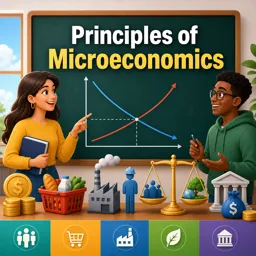
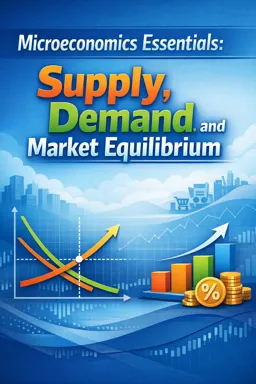
Microeconomics explains how individuals, firms, and governments make choices when resources are limited. In this free online course, you will build a clear, practical way of thinking about everyday decisions: why prices change, how consumers respond, what firms try to maximize, and how markets coordinate millions of independent actions. Instead of relying on memorized definitions, you will develop intuition for the forces behind supply, demand, incentives, and trade-offs.
You will learn how preferences and utility connect to real choices, and how budget constraints shape what people can buy. From there, the course deepens your understanding of demand by exploring why a price change can alter behavior through both substitution and income effects. You will also see how producers think about technology, output, and efficiency, and how costs influence short-run and long-run decisions. These tools are the foundation for analyzing how businesses set strategy and how households respond to changing economic conditions.
As you progress, the focus shifts from individual decisions to market outcomes. You will examine competitive markets, welfare and efficiency, and the conditions under which markets allocate resources well. You will also analyze market power, learning how monopolies and oligopolies differ from perfect competition, why pricing and output change when firms have control, and what happens when cooperation is difficult. The course then expands into labor and input markets, intertemporal choice and present value, uncertainty, and the role of incentives over time.
Finally, you will connect microeconomic theory to public policy and real-world debates. You will explore international trade and comparative advantage, the balance between efficiency and equity, taxation and who really bears a tax, and why market failures such as externalities and informational asymmetry can justify government intervention. With guided practice through exercises, you will strengthen your ability to reason step by step, interpret economic logic, and apply it to problems in school, work, and everyday life.

20 hours and 41 minutes of online video course

Digital certificate of course completion (Free)

Exercises to train your knowledge

100% free, from content to certificate
What is the difference between income and substitution effects in microeconomics?
A price change alters consumption because a good becomes relatively more or less attractive (substitution effect) and because purchasing power changes (income effect).
How does a per-unit tax affect a firm's optimal output?
A per-unit tax raises marginal cost, so a profit-maximizing firm generally reduces output and may raise its price, depending on market structure.
What is the First Fundamental Theorem of Welfare Economics?
It states that, under ideal competitive conditions, a market equilibrium is Pareto efficient: no one can be made better off without making someone else worse off.
Ready to get started?Download the app and get started today.
Install the app now
to access the course
Over 5,000 free courses
Programming, English, Digital Marketing and much more! Learn whatever you want, for free.

Study plan with AI
Our app's Artificial Intelligence can create a study schedule for the course you choose.

From zero to professional success
Improve your resume with our free Certificate and then use our Artificial Intelligence to find your dream job.
You can also use the QR Code or the links below.



Free CourseFundamentals of Economy
5
(3)

1h53m

12 exercises
Free CourseMicroeconomics: Basic Economics Concepts
4.7

(3)
7h39m
50 exercises
Free CoursePrinciples of Macroeconomics
4.6
(5)
14h24m
15 exercises
Free CourseIntro to Economics
4.3
(3)
3h46m
26 exercises
Free CoursePrinciples of Macroeconomics
New
19h50m
29 exercises

Free CourseFinancial Markets
New
27h51m
23 exercises
Carry knowledge in your pocket.
Download the Cursa app.
There are hundreds of free courses available, with a free certificate of completion that is saved in your mobile image gallery.
Download the app to access the Course Completion Certificate for Free.


+ 10 million
students

Free and Valid
Certificate

60 thousand free
exercises

4.8/5 rating in
app stores

Free courses in
video and ebooks
Course comments: Principles of Microeconomics
Anas Aljofi
Thanks from the bottom of my heart ❤️. great job continuing your support for us.