
The course covers scarcity, economic models, trade, supply and demand, GDP, CPI, growth, unemployment, money, inflation, and aggregate demand and supply.

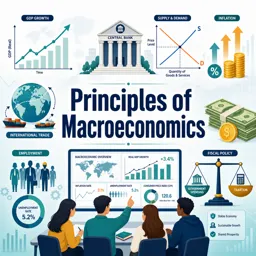
Duration of the online course: 14 hours and 24 minutes
4.3


(3)
Build macroeconomics skills fast with a free online course: understand GDP, inflation, unemployment, supply and demand, and policy decisions—ideal for students.
Macroeconomics helps you make sense of the news you hear every day: rising prices, interest-rate decisions, unemployment reports, trade disputes, and debates about economic growth. This free online course builds a clear foundation for understanding how an economy works, why outcomes can change over time, and how individual decisions connect to national trends. You will develop the ability to read economic indicators with confidence and explain the forces behind common headlines, from inflation shocks to recessions and recoveries.
Starting with core economic principles and the idea of scarcity, the course shows how economists think: using simplified models to focus on what matters, then testing those models against real-world behavior. You will learn how trade can make people and countries better off, and why markets rely on prices and incentives to coordinate decisions. From there, you will connect micro-level intuition to big-picture outcomes through tools used across macroeconomics, including measures of national income, the cost of living, and the drivers of long-run prosperity.
As you move deeper, you will strengthen practical understanding of major metrics and institutions: what GDP captures and what it misses, what the CPI measures and why it matters, and how savings and investment flow through the financial system. The course also clarifies why unemployment statistics can be misleading, how money is created and managed, and why inflation is closely linked to money growth in the long run. These ideas help you interpret policy discussions and understand why different choices create trade-offs.
Finally, you will bring everything together with the aggregate demand and aggregate supply framework to see how economies fluctuate in the short run and why policy can influence output and prices. Interactive exercises throughout help you check your understanding and build exam-ready confidence, making this course a strong fit for school study, college preparation, or anyone looking to improve economic literacy for careers, business decisions, or informed citizenship.

14 hours and 24 minutes of online video course

Digital certificate of course completion (Free)

Exercises to train your knowledge

100% free, from content to certificate
What macroeconomics topics are covered in this free Principles of Macroeconomics course?
The course covers scarcity, economic models, trade, supply and demand, GDP, CPI, growth, unemployment, money, inflation, and aggregate demand and supply.
How does the course explain why countries benefit from international trade?
It explains comparative advantage: countries can gain by specializing in goods they produce at a lower opportunity cost and trading with each other.
What is the difference between GDP and the Consumer Price Index (CPI)?
GDP measures the value of final goods and services produced in an economy, while CPI measures changes in the cost of a typical basket of consumer goods and services.
Ready to get started?Download the app and get started today.
Install the app now
to access the course
Over 5,000 free courses
Programming, English, Digital Marketing and much more! Learn whatever you want, for free.

Study plan with AI
Our app's Artificial Intelligence can create a study schedule for the course you choose.

From zero to professional success
Improve your resume with our free Certificate and then use our Artificial Intelligence to find your dream job.
You can also use the QR Code or the links below.



Free CoursePrinciples of Microeconomics
5
(10)

20h41m

25 exercises
Free CourseFundamentals of Economy
5
(3)
1h53m
12 exercises
Free CourseMicroeconomics: Basic Economics Concepts
4.7
(3)
7h39m
50 exercises
Free CourseIntro to Economics
4.3
(3)
3h46m
26 exercises
Free CoursePrinciples of Macroeconomics
New
19h50m
29 exercises

Free CourseFinancial Markets
New
27h51m
23 exercises
Carry knowledge in your pocket.
Download the Cursa app.
There are hundreds of free courses available, with a free certificate of completion that is saved in your mobile image gallery.
Download the app to access the Course Completion Certificate for Free.


+ 10 million
students

Free and Valid
Certificate

60 thousand free
exercises

4.8/5 rating in
app stores

Free courses in
video and ebooks
Course comments: Principles of Macroeconomics
Dev Lekhwani
Good course for understanding Macroeconomics deeply