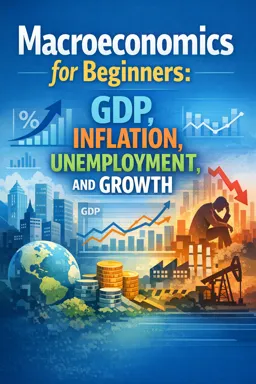

Free ebook explaining GDP, inflation, unemployment, business cycles, economic policy, and long-run growth for economics learners.
Free ebook content
-

Macroeconomics for Beginners: The Economy as a System of Flows and Decisions
+ Exercise: In the circular flow framework, which set correctly matches leakages and injections that affect overall demand for domestic output?
-
GDP and Economic Output: What It Measures and What It Misses
+ Exercise: Which statement best explains why imports are subtracted when calculating GDP using GDP = C + I + G + NX?
-
Nominal vs Real GDP: Prices, Quantities, and Measuring Growth Correctly
+ Exercise: If nominal GDP rises from one year to the next while real GDP is flat, what is the most likely explanation?


-
Inflation Basics: What Rising Prices Mean for Purchasing Power
+ Exercise: A consumer sees gasoline prices spike this month, pushing headline inflation up, while core inflation stays about the same. What is the best interpretation of this pattern?
-
How Inflation Is Measured: CPI, PCE, and the Practical Measurement Issues
+ Exercise: In the mock CPI-like basket, which statement best explains why headline inflation could be higher than the underlying trend in a given month?
-
Unemployment and Labor Market Indicators: Rates, Definitions, and Tradeoffs
+ Exercise: If the unemployment rate falls while the number of employed people stays the same, what is a likely explanation consistent with the labor force definitions?
-
Why Unemployment Changes: Job Flows, Frictions, and Cyclical vs Structural Forces
+ Exercise: Unemployment rises while the job-separation rate stays about the same, and average unemployment duration increases. Which change best explains this pattern?
-
Business Cycles: Expansions, Recessions, and the Indicators Behind the Headlines
+ Exercise: Which combination of signals best supports a “soft landing” interpretation rather than rising recession risk?
-
Aggregate Demand and Aggregate Supply: A Simple Framework for Output and Inflation
+ Exercise: In the AD–AS framework, what short-run pattern most strongly suggests a negative supply shock (such as a sharp rise in key input costs)?
-
Fiscal Policy: Government Spending, Taxes, Deficits, and Stabilization Debates
+ Exercise: Which scenario would most likely produce a larger domestic fiscal multiplier from a new government spending increase?
-
Monetary Policy and Interest Rates: How Central Banks Aim to Manage Inflation and Employment
+ Exercise: Why can a central bank’s policy interest rate affect the interest rate a household or business pays on a loan, even though the policy rate is very short-term?
-
Long-Run Economic Growth: Productivity, Capital, Labor, and Living Standards
+ Exercise: An economy adopts an already-existing technology that makes each worker 10% more productive once, and then returns to its previous annual productivity growth rate. Which statement best describes the long-run impact on real output per person?
-
Interpreting Key Macroeconomic Releases: From Raw Numbers to Meaningful Narratives
+ Exercise: In a month where GDP growth misses expectations mainly due to a larger-than-expected inventory drag, while consumption remains steady, which interpretation best follows a disciplined macro release workflow?
About the free ebook
Macroeconomics for Beginners: GDP, Inflation, Unemployment, and Growth
This free ebook introduces the core ideas used to understand how an economy performs, changes, and affects everyday life. It explains the indicators behind economic news without assuming prior economics knowledge.
Understand the numbers behind the headlines
Learn what GDP measures, why real GDP differs from nominal GDP, and why output figures do not capture every part of well-being. Explore inflation, purchasing power, and the practical challenges of price measurement through indexes such as CPI and PCE.
Make sense of jobs, cycles, and policy
The ebook examines unemployment definitions, labor-market flows, and the difference between cyclical and structural forces. It also presents business cycles and a clear aggregate demand and aggregate supply framework for interpreting movements in output and prices.
Connect policy decisions to economic outcomes
- Fiscal policy, including spending, taxes, deficits, and stabilization debates
- Monetary policy, interest rates, inflation, and employment objectives
- Long-run growth through productivity, capital, labor, and living standards
- Methods for interpreting major macroeconomic releases with context
A practical foundation for economic interpretation
By the end, readers can better evaluate reports on growth, inflation, and employment; distinguish raw data from meaningful trends; and recognize the tradeoffs that shape public-policy discussions.
What is the difference between nominal GDP and real GDP?
Nominal GDP uses current prices, while real GDP adjusts for price changes to show changes in output volume.
How do CPI and PCE measure inflation differently?
Both track price changes, but they use different spending data, item weights, and methods for reflecting consumer substitutions.
What causes unemployment to rise during a recession?
When demand falls, firms may reduce hiring or cut jobs; job finding also becomes harder, increasing cyclical unemployment.
This ebook includes:

13 content chapters

Digital certificate of course completion (Free)

Exercises to train your knowledge

100% free, from content to certificate
Ready to get started?

 recommended
In the app you will also find...

Over 5,000 free courses
Programming, English, Digital Marketing and much more! Learn whatever you want, for free.

Study plan with AI
Our app's Artificial Intelligence can create a study schedule for the course you choose.

From zero to professional success
Improve your resume with our free Certificate and then use our Artificial Intelligence to find your dream job.
You can also use the QR Code or the links below.