They channel savings into investments and offer tools such as diversification, insurance, futures, and options to transfer or reduce risk.

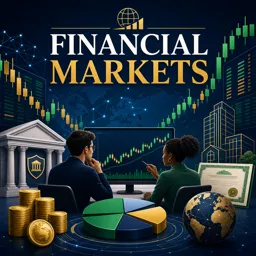
Duration of the online course: 27 hours and 51 minutes
New
Build investing confidence with a free financial markets course—learn risk, portfolios, stocks, bonds, derivatives and policy, plus practice questions and a certificate.
Financial markets shape how societies fund homes, businesses, innovation, and public services. This free online course helps you understand what financial markets are designed to do, how they sometimes fail, and how individuals and institutions make decisions under uncertainty. You will learn to read market narratives more critically, connect headlines to underlying mechanisms, and think in probabilities rather than predictions—skills that matter for students, future professionals, and anyone managing personal finances.
The course starts with the purpose of financial markets and quickly moves into the realities of risk, financial crises, and the limits of widely used models when assumptions break down. From there, it explores how technology and financial invention transform markets, including the role of corporate structures and incentives. You will see why diversification can raise the quality of outcomes without eliminating risk, and why institutions such as insurance companies, banks, and clearinghouses exist to absorb shocks, reduce frictions, and keep promises credible.
As you progress, you will connect theory to real-world assets and market infrastructure: stocks and dividends, debt and interest rates, real estate and REITs, futures and options, and the ways leverage can amplify both booms and busts. You will also examine the Efficient Markets perspective and then contrast it with behavioral finance, where psychology, reference points, and loss aversion help explain patterns that pure rational models miss. Discussion of regulation and macroprudential oversight ties these ideas to stability: why rules change after crises, what they try to prevent, and how self-regulation and public-sector roles can complement market forces.
Throughout, short exercises reinforce key concepts so you can test your understanding and build a toolkit you can apply to studying economics, preparing for business roles, or evaluating investment conversations with more clarity. By the end, you will be able to describe what different institutions contribute, why certain products exist, and how finance can serve broader human purposes when incentives and safeguards are aligned.

27 hours and 51 minutes of online video course

Digital certificate of course completion (Free)

Exercises to train your knowledge

100% free, from content to certificate
How do financial markets help businesses and investors manage risk?
They channel savings into investments and offer tools such as diversification, insurance, futures, and options to transfer or reduce risk.
Why is it difficult to consistently beat the stock market according to the Efficient Markets Hypothesis?
Market prices quickly incorporate widely available information, so finding consistently underpriced or overpriced securities is difficult.
What is the difference between a broker, a dealer, and a clearinghouse?
A broker executes trades for clients, a dealer trades from its own inventory, and a clearinghouse helps guarantee and settle transactions.
Ready to get started?Download the app and get started today.
Install the app now
to access the course
Over 5,000 free courses
Programming, English, Digital Marketing and much more! Learn whatever you want, for free.

Study plan with AI
Our app's Artificial Intelligence can create a study schedule for the course you choose.

From zero to professional success
Improve your resume with our free Certificate and then use our Artificial Intelligence to find your dream job.
You can also use the QR Code or the links below.



Free CoursePrinciples of Microeconomics
5

(10)

20h41m

25 exercises
Free CourseFundamentals of Economy
5
(3)
1h53m
12 exercises
Free CourseMicroeconomics: Basic Economics Concepts
4.7

(3)
7h39m
50 exercises
Free CoursePrinciples of Macroeconomics
4.6
(5)
14h24m
15 exercises
Free CourseIntro to Economics
4.3
(3)
3h46m
26 exercises
Free CoursePrinciples of Macroeconomics
New
19h50m
29 exercises
Carry knowledge in your pocket.
Download the Cursa app.
There are hundreds of free courses available, with a free certificate of completion that is saved in your mobile image gallery.
Download the app to access the Course Completion Certificate for Free.


+ 10 million
students

Free and Valid
Certificate

60 thousand free
exercises

4.8/5 rating in
app stores

Free courses in
video and ebooks