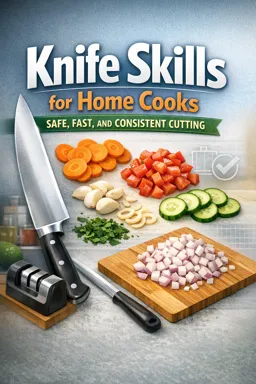

Free ebook on safe, fast, and consistent kitchen knife skills for home cooks, from grip and sharpening to slicing, dicing, and care.
Free ebook content
-

Kitchen Knife Skills Foundations: Safety, Setup, and Control
+ Exercise: While chopping, you notice your cutting board is starting to slide slightly. What is the best immediate action to restore safety and control?
-
Choosing Kitchen Knives for Home Cooks: What You Need and Why
+ Exercise: Which 3-knife minimalist kit best covers everyday chopping, small precision work, and clean slicing of crusty or delicate foods?
-
How to Hold a Knife: Pinch Grip, Guide Hand, and Efficient Motion
+ Exercise: Which action best follows the safe “reset” rule when repositioning your guide hand for the next slice?
-
Knife Sharpness and Honing: Safer Cutting Through Better Edges
+ Exercise: After two small sets of light strokes on a honing rod, your knife still fails the paper/tomato test and you see shiny glints along multiple sections of the edge under bright light. What should you do next?
-
Cutting Boards, Knife Care, and Storage to Protect Blades and Hands
+ Exercise: Which storage practice best protects both the knife’s edge and your hands when using a wall-mounted magnetic strip?


-
Straight Slicing: Consistent Thickness for Vegetables and Proteins
+ Exercise: When your straight slices become wedge-shaped (thick on one side, thin on the other), what is the most likely cause?
-
Dicing Skills: Small, Medium, and Large Dice with Repeatable Results
+ Exercise: When aiming for a 12 mm (medium) dice using the repeatable dicing process, which approach best ensures consistent cubes?
-
Julienne and Batonnet: Matchsticks for Stir-Fries, Salads, and Garnishes
+ Exercise: When making julienne or batonnet, which step most directly determines whether the final sticks will be uniform?
-
Chiffonade and Herb Handling: Clean Cuts Without Bruising
+ Exercise: When chiffonading basil, which approach best minimizes bruising and keeps the ribbons bright?
-
Efficient Prep for Common Ingredients: Onions, Garlic, Tomatoes, and Potatoes
+ Exercise: When dicing an onion efficiently and safely, which approach best keeps the layers stable and reduces rework?
-
Building Speed Safely: Rhythm, Repetition, and Workflow
+ Exercise: During metronome-style pacing, what is the safest way to increase cutting speed over time?
-
Injury Prevention and First Aid Basics for Home Kitchens
+ Exercise: You’re cutting when someone asks you a question and you feel your attention shift. What is the safest default response?
About the free ebook
Knife Skills for Home Cooks: Safe, Fast, and Consistent Cutting
Build practical knife confidence with this free ebook for home cooks who want cleaner cuts, safer prep, and more efficient kitchen routines. Learn how a stable setup, a sharp blade, and deliberate hand positioning can improve both control and results.
Cut with control, not force
Discover the essential habits behind reliable knife work: choosing useful kitchen knives, using a secure pinch grip, positioning the guide hand, and moving the blade smoothly. A sharp, well-maintained knife is safer than a dull one because it requires less pressure and is less likely to slip.
Make every cut more consistent
Practice common cuts for vegetables, herbs, and proteins, including straight slices, dice, julienne, batonnet, and chiffonade. The ebook explains how to create even pieces that cook at a similar rate and give dishes a more professional appearance.
Protect your hands and your tools
Learn smart cutting-board choices, safe storage, honing and care routines, and efficient ways to prepare everyday ingredients such as onions, garlic, tomatoes, and potatoes. Guidance on workflow, repetition, and basic first aid helps you build speed without sacrificing safety.
Designed for everyday cooking
- Use a focused set of kitchen knives effectively.
- Improve accuracy through repeatable cutting motions.
- Reduce avoidable slips, dull blades, and prep-time frustration.
- Create a safer, more organized home-kitchen workspace.
Use these techniques to make meal preparation calmer, more precise, and more enjoyable.
What is the safest way to hold a chef's knife?
Use a pinch grip: pinch the blade just in front of the handle while wrapping your remaining fingers around the handle.
Why is a sharp kitchen knife safer than a dull knife?
A sharp edge cuts with less force, reducing the chance that the blade slips off the food.
What is the difference between julienne and batonnet cuts?
Both are stick cuts; julienne is thinner, while batonnet is thicker and commonly used for fries or vegetable sticks.
This ebook includes:

12 content chapters

Digital certificate of course completion (Free)

Exercises to train your knowledge

100% free, from content to certificate
Ready to get started?

 recommended
In the app you will also find...

Over 5,000 free courses
Programming, English, Digital Marketing and much more! Learn whatever you want, for free.

Study plan with AI
Our app's Artificial Intelligence can create a study schedule for the course you choose.

From zero to professional success
Improve your resume with our free Certificate and then use our Artificial Intelligence to find your dream job.
You can also use the QR Code or the links below.