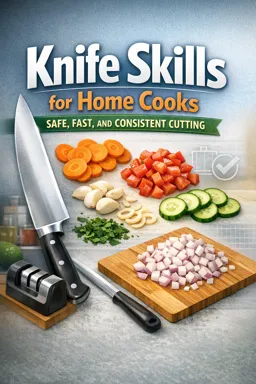
What “the right knife” means for a home cook
Choosing kitchen knives is less about owning many tools and more about matching a few reliable shapes to the foods you cut most often. A good home kit covers three jobs: (1) most everyday slicing and chopping, (2) small, precise work in-hand or on the board, and (3) clean slicing through crusty or delicate foods without crushing. Everything else is optional and should be added only when it solves a repeated problem in your cooking.
The minimalist home kit: 3 essential knives
1) Chef’s knife (your primary board knife)
What it’s for: onions, carrots, herbs, potatoes, squash, raw and cooked meats, most prep on a cutting board.
Why it earns a spot: the curved belly and pointed tip make it versatile: you can rock for herbs, push-cut for vegetables, and use the tip for detail work.
- Typical lengths: 8 in / 20 cm is the most common “do-everything” size; 7 in / 18 cm is friendlier for smaller hands and tight boards; 10 in / 25 cm suits large batches and big produce.
- What to look for: a thin blade behind the edge (cuts with less wedging), comfortable handle, and a profile you like (more curve for rocking, flatter for push-cutting).
2) Paring knife (precision and small tasks)
What it’s for: trimming strawberries, peeling, coring tomatoes, deveining shrimp, removing blemishes, segmenting citrus, small garnish work.
Why it earns a spot: it’s nimble where a chef’s knife feels oversized, and it’s safer and cleaner for small, controlled cuts.
- Listen to the audio with the screen off.
- Earn a certificate upon completion.
- Over 5000 courses for you to explore!

Download the app
- Typical lengths: 3–4 in / 8–10 cm.
- What to look for: a pointed tip, thin blade, and a handle that doesn’t feel slippery when wet.
3) Serrated bread knife (clean slicing without crushing)
What it’s for: crusty bread, soft sandwich loaves, cakes, ripe tomatoes, citrus, and any food with a tough exterior and soft interior.
Why it earns a spot: serrations “grab” the surface so you can saw gently without compressing the food.
- Typical lengths: 8–10 in / 20–25 cm (long enough to slice in fewer strokes).
- What to look for: a comfortable handle and a blade that isn’t overly thick; an offset handle can keep knuckles off the board.
Optional add-ons (only if they match your cooking)
Nakiri (vegetable specialist)
What it’s for: high-volume vegetable prep—cabbage, carrots, onions, herbs, potatoes.
Why add it: the tall, flat edge excels at straight up-and-down chopping and push-cuts; the height gives knuckle clearance and helps scoop ingredients.
Trade-offs: less suited to tasks needing a sharp tip (like trimming silver skin) and not ideal for rocking if the profile is very flat.
Boning knife (meat breakdown and trimming)
What it’s for: removing bones from chicken thighs, trimming fat and silverskin, separating joints, portioning raw meat.
Why add it: the narrow blade navigates around bones with less waste.
Trade-offs: not necessary if you mostly buy boneless cuts; not a substitute for a chef’s knife for general chopping.
Carving/slicing knife (clean slices of cooked proteins)
What it’s for: brisket, roast turkey, ham, prime rib, smoked salmon—anything you want in neat, thin slices.
Why add it: a long, narrow blade reduces drag and helps you slice in fewer strokes for cleaner edges.
Trade-offs: limited use if you rarely cook large roasts; takes storage space.
Choosing blade length: match your hand, board, and typical tasks
Blade length affects control, reach, and efficiency. Longer blades slice large items in fewer strokes but feel less nimble; shorter blades feel easier to steer but may require more strokes and can struggle with big produce.
A practical way to pick your chef’s knife length
- Start from your board size: if your board is small (e.g., under ~12×18 in / 30×45 cm), a 7–8 in knife often feels more manageable; larger boards can comfortably handle 8–10 in.
- Consider your most common ingredients: if you frequently cut melons, cabbage, butternut squash, or large roasts, lean longer (8–10 in). If you mostly prep for 1–2 people and cut smaller veg, 7–8 in is usually ideal.
- Check knuckle clearance and comfort: taller blades (more height at the heel) give better knuckle clearance; this matters as much as length for comfort.
- Do a “tip reach” check: hold the knife in a normal grip and place the tip on the board; you should be able to lift and lower the handle comfortably without feeling like you’re wrestling the knife.
Paring and bread knife lengths
- Paring: choose the smallest size that still feels stable—3.5 in / 9 cm is a common sweet spot.
- Bread: choose long enough to span the loaf; 9–10 in / 23–25 cm is great if you slice boules and batards; 8 in / 20 cm works for sandwich loaves and tomatoes.
Blade materials: stainless vs high-carbon vs hybrid
Steel choice affects corrosion resistance, edge retention, sharpening feel, and how “fussy” the knife is day-to-day. For home cooks, the best steel is the one you’ll maintain without stress.
| Material type | Pros | Cons | Best for |
|---|---|---|---|
| Stainless steel | Resists rust and staining; low-maintenance; good all-around performance | Some stainless steels can feel slower to sharpen; edge retention varies widely by brand | Most home kitchens; people who want easy care |
| High-carbon (non-stainless) | Often takes a very keen edge; pleasant sharpening feedback; can be very thin and precise | Can rust/patina if left wet; needs prompt drying; reactive with acidic foods | Enthusiasts who don’t mind extra care |
| Hybrid / semi-stainless | Better corrosion resistance than pure carbon; often sharpens well; good balance of traits | Still benefits from drying and basic care; performance depends on heat treatment | Home cooks who want “best of both” |
Practical takeaway: if you want a worry-free first set, choose stainless or semi-stainless. If you love sharpening and don’t mind wiping and drying immediately, high-carbon can be rewarding.
Edge geometry and grind: why some knives feel “laser-like”
Two knives can be equally sharp but cut very differently. Geometry determines how easily the blade passes through food and how much it wedges or cracks dense items.
Key terms (in plain language)
- Thin behind the edge: the blade is slim right above the cutting edge, so it slips through onions and potatoes with less resistance.
- Thick behind the edge: the blade acts like a wedge; it can split carrots and stick in potatoes even when sharp.
- Grind: the blade’s cross-sectional shape (how it tapers from spine to edge). Common grinds include full flat, hollow, and convex variations.
- Bevel angle: the angle at the very edge. Lower angles can feel sharper but may be more delicate; higher angles can be tougher but feel less “bitey.”
Practical pros/cons you can feel on day one
- Thinner, finer geometry: effortless slicing, cleaner cuts on tomatoes and herbs; can be more prone to edge damage if you twist in hard foods or hit bones.
- Thicker, sturdier geometry: tolerates rougher use; can feel wedgy on dense produce and may crack hard vegetables instead of slicing cleanly.
Shopping tip: if you can, look down the blade from spine to edge (carefully). A knife that tapers smoothly and looks relatively thin near the edge usually performs better for everyday prep than a chunky “axe-like” blade.
Handle shapes and construction: comfort is performance
Handle comfort affects control and fatigue. The “best” handle is the one that fits your hand and stays stable when wet.
Common handle styles
- Western (often with a bolster or partial bolster): familiar shape, usually heavier; can feel secure for many users. A full bolster can make sharpening harder and add unnecessary weight.
- Japanese wa-handle (octagonal/D-shaped/oval): often lighter, shifts balance forward toward the blade; can feel agile for vegetable work. Some shapes may feel odd in certain grips—try before buying if possible.
What to check in your hand
- Hot spots: any sharp edges or corners that press into your palm during a normal grip.
- Slipperiness: glossy plastic can feel slick when wet; textured composites or finished wood often feel more secure.
- Handle-to-blade transition: the area near the heel should feel smooth and not pinch your fingers.
Decision guide: how to evaluate a knife before you buy
Step-by-step in-store checks (or at home if you can return)
- Balance test: hold the knife where you naturally grip it and see if it feels neutral. Many people like balance near the pinch point (where blade meets handle), but some prefer slightly blade-forward for chopping. Avoid knives that feel “handle-heavy” and awkward.
- Comfort check (30-second hold): keep your normal grip for 30 seconds. If you feel pressure points, that won’t improve during a long prep session.
- Weight preference: compare a lighter and heavier knife. Lighter knives feel nimble and reduce fatigue for long sessions; heavier knives can feel stable and help with dense foods, but can tire your wrist if you do lots of chopping.
- Blade thinness check: look at the blade thickness near the edge and at the spine. Extremely thick blades often wedge in potatoes and carrots.
- Board clearance: mimic a chopping motion on a flat surface (without hitting anything). Make sure your knuckles would clear the board comfortably.
- Fit-and-finish: run a finger (carefully) along the spine and choil (the curved area near the heel). Rounded edges feel better during long prep.
Budget tiers (what to expect)
| Tier | What you can get | What to watch for |
|---|---|---|
| Entry | Reliable stainless chef’s knife + paring + bread knife; decent factory edge; durable | Overly thick blades; rough handle transitions; “all-in-one” gimmicks |
| Mid-range | Noticeably better cutting feel (thinner geometry), improved edge retention, better comfort/finish | Full bolsters that complicate sharpening; flashy coatings that don’t improve performance |
| Premium | Excellent geometry and finish; steels that hold a keen edge; refined handles | Paying for looks over geometry; very hard, thin edges that demand careful use |
What to avoid
- Gimmick knife sets: large blocks with many rarely used shapes often include mediocre steel and thick grinds. Spend the same money on 2–3 better knives.
- Overly thick blades: they feel “stuck” in dense produce and cause more splitting and cracking.
- Extreme marketing features: hollow “air pockets,” aggressive scallops, or novelty serrations that are hard to maintain and don’t replace good geometry.
- Full bolster that runs to the edge: can interfere with sharpening and force you to grind away metal to keep the edge flat over time.
Recommended starter toolkit (minimal, high-coverage)
Starter toolkit
- Chef’s knife: 8 in / 20 cm (or 7 in / 18 cm if you prefer smaller)
- Paring knife: 3–4 in / 8–10 cm
- Serrated bread knife: 8–10 in / 20–25 cm
How each knife maps to common ingredients
| Ingredient/task | Best knife | Why |
|---|---|---|
| Onions, carrots, celery (mirepoix) | Chef’s knife | Efficient chopping and slicing on the board |
| Herbs (parsley, cilantro) | Chef’s knife | Versatile profile for rocking or push-cutting |
| Potatoes, sweet potatoes | Chef’s knife (thin geometry helps) | Cleaner cuts with less wedging |
| Cabbage, lettuce, melons | Chef’s knife (8–10 in) | Longer blade spans large produce |
| Strawberries, mushrooms trimming, garlic peeling tasks | Paring knife | Small, precise control |
| Tomatoes (very ripe), citrus rounds | Serrated bread knife | Serrations bite the skin without crushing |
| Crusty bread, sandwich loaves, cake layers | Serrated bread knife | Clean slices with minimal compression |
| High-volume vegetable chopping (daily) | Nakiri (optional) | Flat edge and tall blade for fast veg prep |
| Trimming chicken thighs, removing silverskin | Boning knife (optional) | Narrow blade navigates around bones and seams |
| Slicing roast turkey, brisket, ham | Carving/slicing knife (optional) | Long, narrow blade for smooth, thin slices |