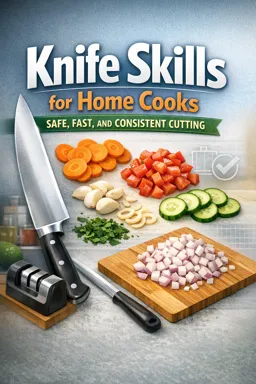
Efficient Prep Workflows: What “Efficient” Means for These Ingredients
Efficiency here means you can repeat the same results with minimal rework: fewer slips, fewer ragged cuts, less waste, and less time spent “fixing” pieces that came out uneven. Each workflow below is built around three priorities: (1) stable ingredient + stable board contact, (2) a cutting route that matches the final shape (slice vs dice vs wedges), and (3) handling that protects texture (no smashed garlic, no crushed tomatoes) while keeping your fingers out of the cutting path.
Onions: Peel, Root Management, Slicing vs Dicing Routes, and Tear Reduction
Workflow overview (why this route works)
Onions are slippery once cut and they fall apart if the root end is removed too early. The root is your “handle” that holds layers together while you slice or dice. The most efficient onion prep keeps the root intact until the end, uses flat faces for stability, and chooses a route based on whether you want slices (for sautéing) or dice (for soups, sauces, and mirepoix).
Step-by-step demo: fast, low-waste onion dice (accuracy-first)
- Trim only the stem end: Cut off the top (stem) end. Leave the root end intact.
- Halve through the root: Set onion on its side and cut from stem end through the root, creating two halves with root halves still attached.
- Peel efficiently: Remove papery skin and the first tough outer layer if needed. Keep the root end intact; it should still “pin” the layers together.
- Flat side down: Place one half cut-side down for maximum stability.
- Make horizontal cuts (optional, based on dice size): For medium/large dice, you can skip horizontals and rely on vertical + crosscuts. For small dice, add 1–2 horizontal cuts parallel to the board, stopping short of the root so the onion stays connected.
- Make vertical cuts: Slice from the stem side toward the root, spacing cuts to match your target dice size. Stop before the root so the pieces remain attached.
- Crosscut to dice: Rotate your knife to cut across the vertical cuts, creating dice. Keep the tip and edge moving cleanly; don’t press down hard near the root.
- Finish and discard root: When you reach the root, cut it off and discard (or save for stock). Separate any remaining connected pieces with 1–2 final cuts.
Step-by-step demo: onion slices (for sautéing, fajitas, salads)
- Stem off, root on: Same start: remove stem end, halve through root, peel.
- Choose slice direction: For longer, sturdier slices that hold shape, slice pole-to-pole (from stem toward root). For shorter, more broken-down slices, slice across the onion’s “equator.”
- Flat side down: Place half cut-side down.
- Slice with consistent spacing: Cut from stem toward root, keeping the root intact until the last few slices.
- Remove root last: Cut away the root and discard.
Tear reduction that doesn’t compromise safety
- Use a sharp knife: A clean cut releases fewer irritating compounds than crushing/tearing.
- Chill briefly if needed: 10–15 minutes in the fridge can reduce volatility. Don’t freeze (texture suffers and it can get slippery).
- Ventilation beats gimmicks: A running hood fan or a small fan aimed away from your face helps more than rushing.
- Don’t cut with your face over the board: Keep your head back; bring the onion to the knife, not your eyes to the onion.
- Rinse hands/board after: Onion juice on fingers can transfer to eyes later.
Common onion mistakes (and what to do instead)
- Cutting off the root first: Onion falls apart and slows you down. Leave root until the end.
- Trying to dice a wobbly half: Always cut through root and use the flat face down.
- Overdoing horizontal cuts: Too many horizontals increase risk and can create mush. Use 0–2 horizontals depending on dice size.
- Pressing straight down near the root: Causes cracking and uneven pieces. Use a smooth slicing motion and finish the root last.
- Chasing perfect cubes from a tapered onion: Accept slight variation near the root; prioritize consistent cut spacing and even cooking.
Timed, accuracy-first practice set (onions)
Goal: consistent pieces with minimal waste; speed comes from fewer corrections.
- Set A (6 minutes): Dice 1 onion into medium dice. Target: >80% pieces within your chosen size, root waste no larger than a thumbnail.
- Set B (4 minutes): Slice 1 onion half pole-to-pole into 3–4 mm slices. Target: slices that hold together when lifted.
- Set C (3 minutes): Small dice 1/2 onion. Target: no “smeared” onion paste on the board; pieces separate cleanly.
Garlic: Crushing, Peeling, Slicing vs Mincing, and Mincing Without Smearing
Workflow overview (why garlic gets messy)
Garlic smears when it’s very fresh, very warm, or when the knife is dull and you end up pressing instead of cutting. The efficient workflow uses a controlled crush only to loosen the skin (not to pulverize), keeps the clove stable, and uses a cutting pattern that matches your goal: slices for gentle flavor, mince for stronger distribution.
Step-by-step demo: quick peel with controlled crush
- Separate cloves: Break the head into individual cloves.
- Trim the hard end: Slice off the dry root nub (just a thin slice).
- Controlled crush: Place the flat of the knife on the clove and press down firmly once with the heel of your hand. Aim to crack the skin, not flatten the clove into paste.
- Peel: Skin should slip off easily. If it clings, crush once more lightly rather than scraping with the blade.
Step-by-step demo: garlic slices (clean, even)
- Stabilize: After peeling, split the clove lengthwise if it’s large so it sits flatter.
- Slice: Make thin slices with a smooth forward motion. Keep slices consistent for even browning.
Step-by-step demo: garlic mince without smearing
- Dry the surface: If the clove is wet, pat it dry. Moisture encourages smearing.
- Start with slices: Slice the clove lengthwise into planks.
- Stack and cut into matchsticks: Gather planks and cut into thin sticks.
- Crosscut to mince: Turn the sticks and cut across into fine pieces.
- Optional final pass: If you need finer mince, gather into a pile and make a few light, quick crosscuts. Avoid pressing the blade flat and dragging; that creates paste.
- Salt only if you want paste: Salt draws moisture and helps create a paste—great for marinades, not for clean mince.
Common garlic mistakes (and what to do instead)
- Over-crushing to peel: You lose clean texture and it sticks to the board. Crush just enough to loosen skin.
- Trying to mince a rolling clove: Split large cloves for a flatter base.
- Smearing by pushing the blade: Cut with repeated clean strokes; don’t mash and drag.
- Letting minced garlic sit in a wet pile: It clumps and turns pasty. Spread it briefly or move it to a dry spot.
- Burning thin slices: Slices brown fast; keep them thicker if cooking over high heat.
Timed, accuracy-first practice set (garlic)
- Set A (3 minutes): Peel 8 cloves using controlled crush. Target: no clove fully flattened.
- Set B (4 minutes): Slice 4 cloves into even slices. Target: slices similar thickness so they brown evenly.
- Set C (5 minutes): Mince 4 cloves. Target: visible pieces (not paste), minimal garlic film on the board.
Tomatoes: Serrated vs Chef’s Knife, Preventing Juice Loss, Clean Wedges and Dice
Workflow overview (matching knife to skin and ripeness)
Tomato skin can resist a straight edge if the knife isn’t very sharp, causing you to press and crush the flesh (juice loss, ragged cuts). A serrated knife “bites” the skin with less pressure. A sharp chef’s knife can be even cleaner on ripe tomatoes if it glides through with minimal force. Efficiency comes from choosing the tool that lets you use the least downward pressure.
- Listen to the audio with the screen off.
- Earn a certificate upon completion.
- Over 5000 courses for you to explore!

Download the app
Choosing the knife
- Use a serrated knife when: tomatoes are very ripe/soft, your chef’s knife isn’t extremely sharp, or you’re getting skin drag.
- Use a sharp chef’s knife when: you can start the cut without pressing, and you want ultra-clean faces for dice or presentation.
Step-by-step demo: clean wedges (salads, plating)
- Stabilize: Place tomato stem-side up. Slice a thin piece off one side to create a flat base if it wobbles.
- Halve through the core: Cut from stem to bottom.
- Remove core (optional): For cleaner wedges, cut out the tough core with two angled cuts.
- Wedge: Place halves cut-side down and cut into equal wedges. Use gentle sawing with serrated, or smooth slicing with a sharp chef’s knife.
Step-by-step demo: tomato dice with less juice loss
- Choose firmness: Slightly firmer tomatoes dice cleaner. Very ripe tomatoes are better for rough chop or sauce unless you use a serrated knife carefully.
- Halve and core: Cut in half and remove core.
- Seed only if needed: For salsa or watery salads, gently squeeze out seeds over a bowl. Don’t crush; let gravity help.
- Slice into strips: Place cut-side down. Make even slices, then cut into strips.
- Crosscut to dice: Turn strips and cut into dice. Wipe the blade if it gets slick; a clean blade cuts cleaner.
Common tomato mistakes (and what to do instead)
- Pressing hard to break the skin: Switch to serrated or sharpen your chef’s knife; reduce downward force.
- Cutting on a slick puddle: Tomato juice can make the board slippery. Pause and wipe the board for safety and cleaner cuts.
- Trying to dice ultra-ripe tomatoes like an onion: Use serrated and gentler strokes, or choose a different prep (rough chop) if texture is collapsing.
- Over-seeding aggressively: You lose flesh and make mush. Seed only when the dish needs it.
- Uneven wedges: Start by halving through the core, then divide each half evenly.
Timed, accuracy-first practice set (tomatoes)
- Set A (4 minutes): Cut 2 tomatoes into 8 equal wedges each. Target: wedges similar size, minimal crushed edges.
- Set B (6 minutes): Dice 2 tomatoes (medium dice). Target: pieces hold shape; board stays reasonably clean (wipe once if needed).
- Set C (3 minutes): Knife comparison: slice 1 tomato with chef’s knife, 1 with serrated. Target: identify which gives cleaner cuts with less pressure in your setup.
Potatoes: Peeling Options, Squaring for Even Roasting, Fries, and Safe Handling for Hard Items
Workflow overview (hard, round, and easy to slip)
Potatoes combine two risk factors: firmness (more force) and round shapes (rolling). Efficiency is mostly about creating a stable flat face early, then choosing a route that minimizes offcuts while giving you even sizes for even cooking. For hard items, if you feel yourself increasing force, stop and reset the potato’s stability rather than “powering through.”
Peeling options (choose based on dish and time)
- No peel: Best for rustic roast potatoes and wedges; scrub well and trim blemishes.
- Peel with a peeler: Fastest and lowest waste for smooth mash or gratins.
- Peel with a knife (only when needed): Useful for very thick skins or spot-peeling, but easier to waste flesh. If you do, take thin strips and keep the potato stable on a flat face.
Step-by-step demo: squaring a potato for even roasting (batons/cubes)
- Create a stable base: Slice a thin slab off one side lengthwise so the potato won’t roll.
- Square the sides: With the flat side down, cut off the remaining rounded sides to form a rectangular block. Save offcuts for mash, soup, or stock-thickening (reduce waste).
- Cut into planks: Slice the block into even planks (thickness = your roast size).
- Cut into batons or cubes: Stack planks and cut into sticks, then crosscut into cubes if desired.
- Rinse/dry if roasting: If you rinse starch for crispness, dry thoroughly so the board and your hands don’t get slippery during cutting.
Step-by-step demo: sticks for fries (consistent thickness)
- Square first: Make a block as above; this is the key to uniform fries.
- Planks: Cut into planks matching fry thickness (e.g., 8–10 mm for classic fries).
- Sticks: Cut planks into sticks. Keep the stack aligned; if it shifts, restack rather than forcing the cut.
- Manage offcuts: Cook scraps separately (they brown faster) or reserve for another use.
Step-by-step demo: safe handling for hard items (when the potato fights back)
- Check board grip: If the board moves at all, fix it before continuing.
- Re-establish a flat face: If the potato rocks, cut a new flat face. Never cut a rolling potato.
- Use a longer stroke, not more pressure: Let the edge travel through the potato. If you’re pushing down hard, your edge may be dull or your angle is off—reset.
- Split big potatoes first: Halve or quarter to reduce resistance and improve stability.
- Clear the cut path: Don’t let pieces pile up near your knife hand; move them aside so the blade doesn’t ride up onto uneven surfaces.
Common potato mistakes (and what to do instead)
- Cutting a round potato without a base: Always create a flat face first.
- Uneven roast pieces: Square into a block, then cut to a consistent thickness.
- Throwing away offcuts: Save trimmings for mash, soup, hash, or par-cook and roast as “chef’s snacks.”
- Wet, slippery cutting: After rinsing, dry the potato and your hands; wipe the board.
- Forcing the knife through: Reset the potato, reduce piece size, and ensure the knife is cutting cleanly rather than wedging.
Timed, accuracy-first practice set (potatoes)
- Set A (7 minutes): Square 2 medium potatoes into blocks and cut into 2 cm roast cubes. Target: cubes within a narrow size range; offcuts saved in a separate pile.
- Set B (8 minutes): Cut 2 potatoes into fry sticks (choose one thickness and stick to it). Target: sticks that look uniform when lined up; no tapered “spears.”
- Set C (3 minutes): Stability drill: take 1 potato and practice creating a flat base, then rotating to create a second flat side. Target: zero rocking at each stage before you cut further.
| Ingredient | Stability move | Key efficiency lever | Waste reduction tip |
|---|---|---|---|
| Onion | Halve through root, flat side down | Leave root until the end | Save root/skins for stock (if you do stock) |
| Garlic | Controlled crush to peel | Slice → sticks → mince (no mashing) | Trim minimal; avoid pulverizing during peel |
| Tomato | Flat base if needed | Choose serrated when skin drags | Seed only when the dish needs it |
| Potato | Create flat face immediately | Square to a block for even cuts | Reserve offcuts for another prep |