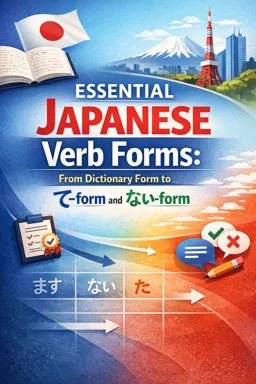

Free ebook on essential Japanese verb forms, covering dictionary, ます, て, ない, past, and polite negative forms.
Free ebook content
-

Japanese Verb Basics: Dictionary Form, Meaning, and Sentence Placement
+ Exercise: 次のうち、辞書形(普通形・肯定)についての説明として正しいものはどれですか?
-
Verb Groups for Conjugation: Group 1, Group 2, and Irregular Verbs
+ Exercise: A new verb ends in …いる or …える. According to the checklist, what is the best first guess for its conjugation group?


-
Polite Present/Future: Forming and Using ます-form
+ Exercise: Which change best describes what happens when you switch a verb from dictionary form to ます-form?
-
Polite Past: ました-form and Common Time Expressions
+ Exercise: Which sentence correctly uses a natural past time expression and changes only the verb ending from ます to ました (keeping particles the same)?
-
Casual Style Essentials: Plain Present and Plain Past (た-form)
+ Exercise: Which option correctly forms the casual past (た-form) of the dictionary verb よむ?
-
The て-form: How to Build It and Why It’s Used So Often
+ Exercise: Which sentence correctly uses the て-form to connect two actions in sequence (Vて、Vて)?
-
Irregular and Special Cases: いく→いって and Other High-Frequency Exceptions
+ Exercise: Which set correctly shows the て-form, た-form, and ない-form of いく (行く), including its special-case behavior?
-
The ない-form: Making Negatives in Casual Japanese
+ Exercise: Which rule correctly forms the casual negative (ない-form) for Group 1 (う-verbs)?
-
Polite Negative and Style Matching: ません, ませんでした, and When to Switch
+ Exercise: Which sentence best follows the guideline to keep one sentence in a single style (polite or casual) when expressing “I didn’t go yesterday”?
-
Past Negative: Forming なかった and Common Conversation Patterns
+ Exercise: In casual Japanese, if you want to say “I didn’t go yesterday,” which form and pattern best matches the past negative described (including the common soft/polite option)?
-
Putting Verb Forms to Work: Daily-Life Dialogues and Reading Confidence
+ Exercise: カジュアル→丁寧に統一するとき、依頼の「て-form」(例:作って/見て/出して)を丁寧に言い換える最も適切な形はどれですか。
About the free ebook
Essential Japanese Verb Forms
This free ebook explains the Japanese verb forms needed to move from recognizing dictionary forms to building useful everyday sentences. Learn how verb meaning, sentence placement, and conjugation groups work together.
Build the forms used in real Japanese
Japanese verbs change according to politeness, tense, negation, and connection. The lessons guide you through ます, ました, plain present, た-form, て-form, ない-form, and polite negative forms.
- Identify Group 1, Group 2, and irregular verbs.
- Form polite present, past, negative, and past-negative sentences.
- Use the て-form for common connected expressions.
- Recognize high-frequency exceptions such as いく becoming いって.
- Match casual and polite styles in daily situations.
Clear patterns with practical context
Rather than memorizing isolated endings, you will see how each form functions in conversations and short reading examples. Special attention is given to negative patterns, time expressions, and choosing the appropriate speech style.
What you will gain
By the end, you will be able to break down common Japanese verbs, create essential affirmative and negative forms, and read simple daily-life exchanges with greater confidence.
How do I tell whether a Japanese verb is Group 1 or Group 2?
Check the dictionary-form ending and learn key exceptions; the ebook explains the main classification patterns.
What is the difference between the て-form and the た-form?
The て-form connects actions and supports many expressions, while the た-form commonly expresses plain past.
How is the casual negative ない-form different from ません?
ない is the plain casual negative, while ません is the polite negative used in formal or respectful situations.
This ebook includes:

11 content chapters

Digital certificate of course completion (Free)

Exercises to train your knowledge

100% free, from content to certificate
Ready to get started?

 recommended
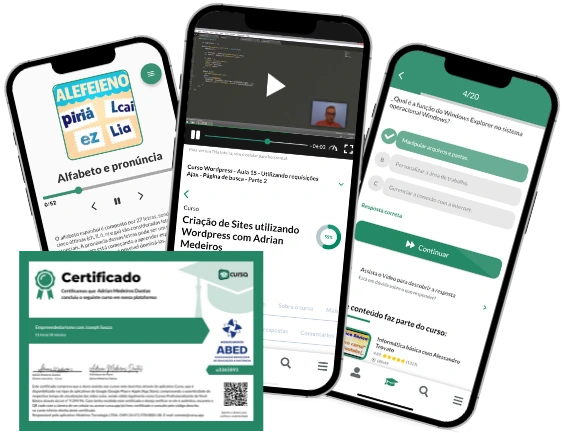
In the app you will also find...

Over 5,000 free courses
Programming, English, Digital Marketing and much more! Learn whatever you want, for free.

Study plan with AI
Our app's Artificial Intelligence can create a study schedule for the course you choose.

From zero to professional success
Improve your resume with our free Certificate and then use our Artificial Intelligence to find your dream job.
You can also use the QR Code or the links below.