Yabai is a flexible slang word that can mean “amazing,” “awesome,” “dangerous,” “terrible,” or “oh no,” depending on the situation and tone.


Duration of the online course: 13 hours and 36 minutes
New
Sound natural in casual Japanese—learn slang, Tokyo expressions, and real-life vocabulary in this free online course with practice exercises and a certificate option.
Want Japanese that sounds real, not scripted? This course helps you move beyond textbook phrases and build the kind of vocabulary people actually use in everyday conversation. You will learn how to express yourself naturally in casual settings, recognize common slang, and understand the tone behind words that can sound friendly, blunt, playful, or rude depending on context. It is designed for learners who want to feel confident speaking with friends, texting, or chatting without accidentally sounding like an anime character or using expressions that feel outdated or too intense.
Instead of memorizing isolated words, you will train your ear and instincts for what feels native. You will practice simple, natural self-introductions, everyday reactions, and useful conversational phrasing, while also learning what not to say and why. Along the way, you will develop better control of politeness and distance, including when a respectful style is appropriate and how Japanese communication often stays indirect even in emotional moments. This makes the course practical for real relationships, travel, and living situations where nuance matters.
You will also expand your vocabulary around modern life: expressing frustration, giving compliments, joking, talking about health, food cravings, entertainment, and current events. The focus is always on meaning plus impact, so you understand not only what a word translates to, but what it implies when a native speaker hears it. Short practice checks help reinforce comprehension and usage so the new expressions become easy to recall in conversation.
Because it is a free online course, you can learn at your own pace and revisit key moments whenever you need. By the end, you should be able to sound more natural, avoid common pitfalls, and choose words that match the situation—whether you want to be polite, casual, funny, or simply clear.

13 hours and 36 minutes of online video course

Digital certificate of course completion (Free)

Exercises to train your knowledge

100% free, from content to certificate
What does yabai mean in Japanese slang?
Yabai is a flexible slang word that can mean “amazing,” “awesome,” “dangerous,” “terrible,” or “oh no,” depending on the situation and tone.
What is the difference between Japanese casual speech and keigo?
Casual speech is used with friends and peers, while keigo uses respectful or humble forms for customers, superiors, and formal situations.
How do you say “I don’t understand” casually in Japanese?
A common casual expression is wakannai (わかんない), a shortened form of wakaranai, meaning “I don’t understand.”
Ready to get started?Download the app and get started today.
Install the app now
to access the course
Over 5,000 free courses
Programming, English, Digital Marketing and much more! Learn whatever you want, for free.

Study plan with AI
Our app's Artificial Intelligence can create a study schedule for the course you choose.

From zero to professional success
Improve your resume with our free Certificate and then use our Artificial Intelligence to find your dream job.
You can also use the QR Code or the links below.




Free CourseJapanese Grammar lessons
5

(1)

19h14m

32 exercises
Free CourseKanji lessons
5
(1)
1h10m
1 exercises
Free CourseKanji reading and writing practice
5
(1)
3h54m
11 exercises
Free CourseJapanese Vocabulary N5
5
(5)
4h29m
4 exercises
Free CourseJapanese basic vocabulary
4.8
(6)
140h00m
1 exercises
Free CourseJapanese
4.8
(61)
5h15m
45 exercises
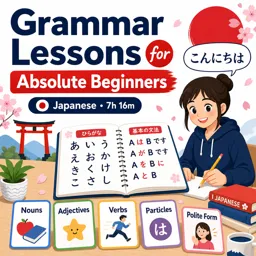
Free CourseGrammar Lessons for Absolute Beginners
4.8

(4)
7h16m
21 exercises

Free CourseJapanese
4.7
(222)
2h36m
6 exercises

Free CourseJapanese From Zero
4.7
(3)
55h38m
46 exercises

Free CourseJapanese Business Language
4.3
(4)
56m
Carry knowledge in your pocket.
Download the Cursa app.
There are hundreds of free courses available, with a free certificate of completion that is saved in your mobile image gallery.
Download the app to access the Course Completion Certificate for Free.


+ 10 million
students

Free and Valid
Certificate

60 thousand free
exercises

4.8/5 rating in
app stores

Free courses in
video and ebooks